

ABL Space Systems: Inside Its Rockets and Future Plans
ABL Space Systems entered the aerospace industry with an ambitious promise: make orbital launches simpler, more mobile and easier to repeat. Its main product, the RS1 rocket, was designed to transport small satellites into orbit without requiring the large permanent infrastructure normally associated with launch operations.
The company’s approach centred on a containerised rocket, a deployable ground system and an engine architecture based on established propulsion technology. ABL wanted customers to move RS1 by road, sea or air and establish a launch operation from a suitable concrete pad with relatively limited infrastructure.
However, ABL Space Systems never completed a successful orbital mission. Its first RS1 launch failed shortly after liftoff in January 2023, while the second vehicle was destroyed following a static-fire test in July 2024. These setbacks contributed to a major strategic change in the company’s direction.
In February 2025, ABL Space Systems became Long Wall and moved away from commercial satellite launching. Its rocket technology is now being adapted for hypersonic testing, missile-target missions and interceptor development. This article examines the original rockets, the failures that reshaped the business and the company’s publicly announced future plans.
What Was ABL Space Systems?
ABL Space Systems was founded in 2017 as a privately held American aerospace company. Its original mission was to develop a relatively affordable and responsive launch service for small satellites, government payloads and commercial spacecraft needing more control over their launch schedules.
The company entered a crowded small-launch market that included established and developing vehicles from Rocket Lab, Firefly Aerospace, Astra and other providers. Rather than building the smallest possible rocket, ABL focused on a vehicle capable of carrying a substantial small-satellite payload while remaining transportable.
RS1 and the GS0 ground system formed the core of the business. RS1 was the two-stage launch vehicle, while GS0 contained the ground equipment needed to support launch operations. Together, they were intended to create a mobile orbital-launch capability that could operate from several locations.
ABL attracted attention because its plan combined launch-vehicle manufacturing with operational flexibility. The company also developed production, testing and integration facilities that later became valuable when its mission changed from commercial space launch to defence technology.
Why ABL Developed the RS1 Rocket
Small satellites are often launched as secondary payloads on larger rockets. That approach can reduce launch costs, but the satellite operator may have limited control over the launch date, destination and mission schedule. A dedicated rocket can provide greater flexibility for customers that need a specific orbit.
ABL developed RS1 to serve this part of the market. The company described the vehicle as a simple, scalable rocket intended for regular orbital missions rather than an experimental platform filled with unnecessary complexity. Its engineering decisions prioritised manufacturability, transportability and operational speed.
The company’s website advertised RS1 as capable of carrying as much as 1,350 kilograms of payload on demand. That placed the rocket above very small launch vehicles and allowed it to target customers with individual satellites, grouped spacecraft or government missions requiring dedicated access.
RS1 was also intended to support responsive launch operations. In theory, a transportable rocket and ground system could give defence customers additional choices when a satellite needed to be replaced, deployed quickly or launched from a location selected for a particular orbit.
Inside the RS1 Rocket
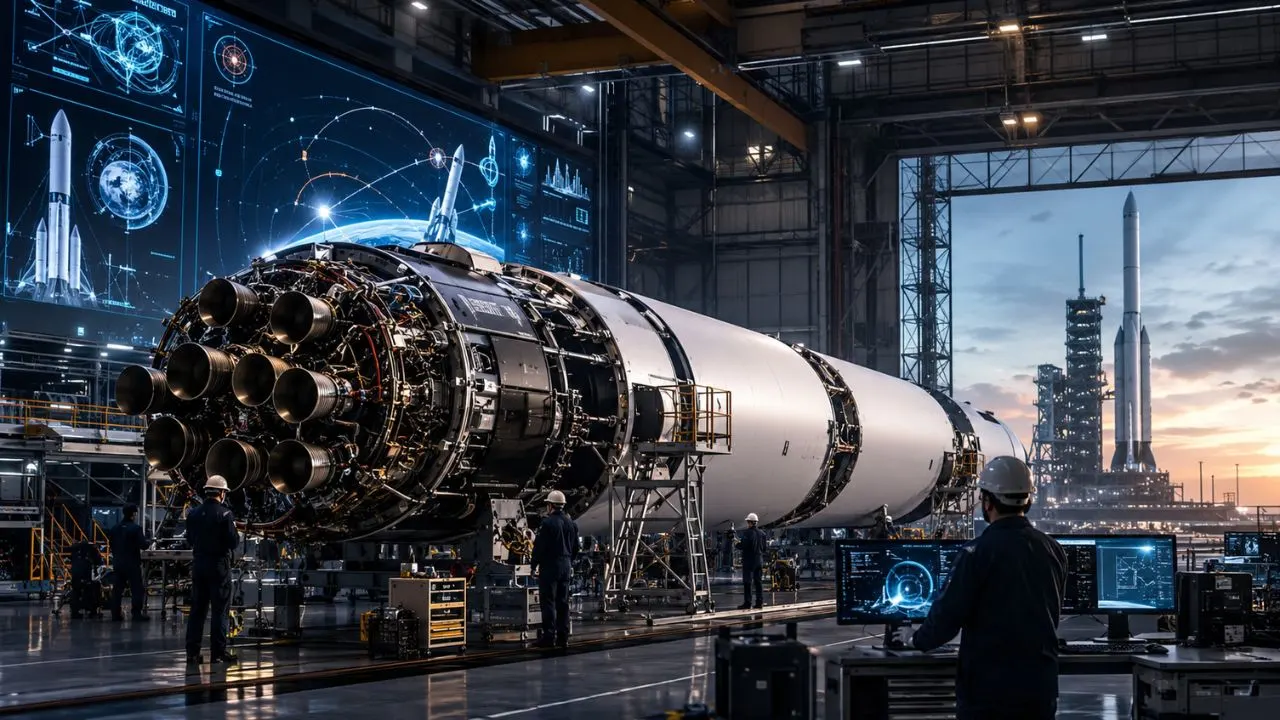
RS1 was a two-stage rocket measuring approximately 88 feet in length and 72 inches in diameter. Its relatively narrow design helped the stages fit inside standard shipping containers, making the vehicle easier to transport than rockets requiring specialised oversized logistics.
The first version of the rocket used nine sea-level E2 engines on its first stage. A vacuum-optimised E2 engine powered the second stage. The first stage produced a stated combined sea-level thrust of approximately 109,000 pounds-force, while the second-stage engine produced around 13,000 pounds-force in a vacuum.
ABL later developed a Block 2 first stage containing 11 E2 engines. This configuration was being prepared for the planned second RS1 flight in 2024. The additional engines reflected changes to the vehicle’s performance and propulsion design, although the Block 2 rocket never reached the launch attempt.
The payload was protected by a two-part aluminium fairing designed to separate after the rocket passed through the period of intense atmospheric heating. ABL used non-pyrotechnic separation devices to reduce shock loads on the spacecraft during fairing deployment.
The E2 Rocket Engine
The E2 was central to ABL’s launch architecture because versions of the same engine powered both stages. Using a common engine family can reduce the number of separate propulsion systems a company must design, manufacture, test and support.
E2 used liquid oxygen as the oxidiser and could operate with RP-1 rocket kerosene or Jet-A fuel. ABL selected a gas-generator cycle and turbopump-fed architecture, technologies with a long history in liquid-propellant rocket engines.
The sea-level version was listed at approximately 12,100 pounds-force of thrust, while the vacuum version produced approximately 13,000 pounds-force. ABL manufactured and tested the engines internally, giving the company greater control over design changes, production schedules and quality processes.
ABL combined additive and conventional manufacturing methods. Complex components containing internal fluid passages, including parts of the thrust chamber and turbopumps, could be printed in specialised alloys and then machined. Simpler components were produced through established forging and machining methods.
GS0 and Mobile Launch Operations
GS0 was ABL’s deployable ground system. The company described it as equipment capable of transforming a suitable flat concrete pad into an orbital launch site, reducing reliance on large permanent towers and extensive fixed infrastructure.
The system included the launch mount, propellant-handling equipment, controls, power systems and other hardware needed to prepare and launch RS1. These components could be transported to a launch location and arranged for a specific campaign.
RS1’s first stage was designed to travel inside a 53-foot shipping container. The second stage and payload fairing could each fit inside 20-foot containers. This approach allowed the main vehicle elements to move using established freight networks.
Mobility was one of the most distinctive parts of ABL’s strategy. It also became relevant after the commercial-launch programme ended because portable launch equipment has potential uses in military testing, missile-target operations and deployments from temporary locations.
The First RS1 Launch
RS1 made its first flight from the Pacific Spaceport Complex on Kodiak Island, Alaska, on January 10, 2023. The mission was intended to demonstrate the complete launch system and place two small satellites into orbit, but the rocket failed soon after leaving the pad.
According to ABL’s investigation summary, a fire developed in the rocket’s aft cavity about 10.93 seconds after liftoff. The fire damaged important electrical harnesses and caused a complete loss of power, forcing all nine engines to shut down simultaneously.
The investigation attributed the fire to an overly restrictive launch mount and flame deflector. Exhaust gases recirculated beneath the rocket and placed excessive heat on the base heat shield, eventually producing the conditions that damaged the vehicle.
After losing thrust, RS1 fell back onto the launch area and was destroyed. No personnel were injured, but the rocket did not reach orbit and the launch facility sustained damage. ABL later redesigned elements of the vehicle and ground system as part of its planned return to flight.
Preparing RS1 Flight Two
ABL continued developing RS1 after the first failure and produced a Block 2 vehicle for its second mission. The revised first stage contained 11 E2 engines and incorporated changes based on the maiden-flight investigation and further ground testing.
Before launch, the company planned to conduct a 13-second static fire on July 19, 2024. During a static fire, the rocket remains secured to the ground while its engines ignite, allowing engineers to evaluate propulsion and vehicle systems under launch-like conditions.
All 11 engines ignited, but the vehicle automatically stopped the test after approximately half a second because of a low-pressure reading associated with a faulty sensor. A fire then formed outside the rocket’s base and was fed by fuel leaks from two engines.
Water and inert-gas systems initially contained the fire but could not extinguish it. When the available water supply was depleted, temperatures rose, systems failed and the rocket’s structure eventually buckled onto the pad.
Why the Second RS1 Was Lost
ABL’s initial data review found that Engines 5 and 8 experienced a combustion instability during startup. Inspections revealed erosion in the propellant injectors and chamber liners consistent with a high-frequency instability inside the E2 combustion chamber.
The company’s leading theory was that differences in the Block 2 first-stage propellant feed system produced a higher-energy startup than the conditions experienced on the test stand. This may have triggered the instability in two of the vehicle’s 11 engines.
ABL noted that it had completed more than 300 previous E2 engine tests and had observed a similar phenomenon only once. However, the exact vehicle conditions were located in an area of the engine-start operating range for which the company had relatively limited test data.
The event illustrated how a system that works during individual engine testing can behave differently when integrated into a complete rocket. Feed systems, startup timing, pressure conditions, ground equipment and emergency-response capability can all affect the result of a full-stage test.
Why ABL Left Commercial Launch
After the destruction of the second RS1 vehicle, ABL faced the cost and time required to complete another investigation, modify the rocket, rebuild hardware and conduct a new launch campaign. The company also reduced its workforce as it reassessed the commercial future of RS1.
The wider dedicated small-launch market had become increasingly difficult. Customers could often place small satellites on larger rideshare missions, while competing launch providers were already demonstrating operational vehicles or working toward greater launch frequency.
In November 2024, ABL announced that it would shift its focus from commercial orbital launching toward missile defence. The decision did not mean that all RS1 technology would be abandoned; instead, the company planned to redirect its launch hardware, engines and ground systems toward defence applications.
This move transformed ABL from a satellite-launch startup into a defence technology company. The change became official on February 19, 2025, when the business adopted the Long Wall name and presented a new mission centred on accelerating missile-defence development.
ABL Space Systems Becomes Long Wall
Long Wall says it is building on seven years of research, manufacturing, testing and flight operations completed under the ABL Space Systems name. Instead of starting an entirely new company, it is applying existing infrastructure and engineering experience to a different market.
The new company currently presents three main products: Cyclops, RSX and Ironwood. Cyclops is a proposed exoatmospheric missile interceptor, RSX is a liquid-powered booster for testing and threat replication, and Ironwood is deployable ground-support equipment.
Long Wall’s strategy emphasises containerised equipment, vertical integration and systems designed for larger-scale production. The company argues that these principles could shorten development cycles and reduce the cost of testing and fielding missile-defence technology.
This remains a developing strategy. Although Long Wall has disclosed prototypes, facilities and product plans, the public information available does not establish that every announced system has completed flight testing or entered operational military service.
RSX and Hypersonic Testing
RSX is the direct technological descendant of RS1. Rather than carrying commercial satellites into orbit, it is intended to provide a liquid-propellant booster for hypersonic flight tests, missile-defence experiments and threat-replication missions.
Threat-replication vehicles imitate some characteristics of potential hostile missiles during defence testing. They allow sensors, tracking networks and interceptors to be evaluated against realistic trajectories without using an operational enemy weapon.
Using an internally produced liquid rocket could give Long Wall greater control over test schedules. The company could theoretically modify trajectories, payloads and vehicle configurations for different experiments rather than purchasing every test flight from a separate launch provider.
Long Wall also states that RSX will support development of its Cyclops interceptor by providing test flights and target vehicles. However, future performance will depend on successful integrated testing and on whether the company can demonstrate that the adapted system has overcome the problems experienced during the RS1 programme.
Ironwood Ground Systems
Ironwood is the renamed and repurposed successor to ABL’s deployable ground-support concept. Long Wall describes it as modern ground-support equipment for global launch and test operations, including command and control, electrical power and communications.
The system preserves one of the strongest ideas behind GS0: launch infrastructure does not always need to be permanently built around one pad. Containerised equipment can be transported, installed and operated at different ranges or test locations.
Long Wall says versions of its ground systems have already operated through all four seasons in demanding environments. Experience from Alaska and other ABL test activities could help the company design equipment for remote or temporary military locations.
Ironwood may therefore become as strategically important as the rocket. Frequent missile and hypersonic testing requires power, communications, propellant handling, command systems and safe launch equipment, not merely a flight vehicle.
Cyclops Missile Interceptor
In December 2025, Long Wall announced Cyclops, a surface-launched exoatmospheric interceptor intended to defeat missiles during the midcourse phase of flight. During this phase, a long-range missile or its warhead may travel outside Earth’s atmosphere.
Cyclops is designed around hit-to-kill interception. Instead of relying mainly on an explosive fragmentation warhead, its kill vehicle would attempt to collide directly with the target at extremely high speed. This requires accurate sensing, guidance, propulsion and control.
Long Wall says it produced an initial kill-vehicle prototype and began testing during 2025. It also built a test unit for a containerised launch station designed to deploy the interceptor from locations with limited fixed support, including potential land and sea sites.
The company’s central promise is manufacturability. Long Wall claims its existing facilities could eventually produce more than 100 Cyclops rounds annually when fully utilised. This is a production goal announced by the company, not evidence that operational interceptors are already being produced at that rate.
Long Wall’s Future Plans
Long Wall’s immediate future appears focused on developing Cyclops, demonstrating RSX flight capability and expanding Ironwood ground operations. These three systems are designed to work together: RSX supports tests, Ironwood supports deployment, and Cyclops represents the intended operational defence product.
The company also plans to use its manufacturing footprint for interceptor development and initial production. Its disclosed capabilities include three-dimensional printing, CNC machining, welding, electronics assembly, environmental testing, engine hot-fire testing and integrated vehicle work.
A major challenge will be proving reliability. ABL developed substantial launch technology, but RS1’s only flight failed and its second vehicle was lost before launch. Long Wall must show that lessons from these events have produced safer propulsion, stronger test procedures and more dependable integrated systems.
Another challenge will be winning government confidence and sustained programme support. Missile-defence systems require extensive testing, regulatory coordination and customer validation. The company’s announcements show its intended direction, but future contracts, test results and deployments will determine whether the transition becomes commercially successful.
Why the ABL Story Matters
ABL Space Systems shows how difficult the commercial rocket industry can be. A company may develop engines, factories, launch equipment and a nearly complete vehicle, yet a small number of technical failures can delay operations and change the entire business case.
Its history also demonstrates that aerospace technology can be repurposed. The E2 engine, RS1 booster structure and GS0 ground system were created for satellite launches, but their underlying capabilities may also support missile testing and defence programmes.
The transformation does not erase the RS1 failures. Those events remain central to evaluating Long Wall because defence customers will expect reliable operation under demanding conditions. The company must convert experience from failure into measurable engineering improvement.
Whether Long Wall succeeds will depend less on its earlier promises and more on future demonstrations. Successful RSX flights, interceptor tests, production milestones and customer programmes would show that ABL’s technology has found a sustainable second purpose.
Frequently Asked Questions
Does ABL Space Systems still exist?
ABL Space Systems changed its name to Long Wall in February 2025. The company no longer presents commercial satellite launch as its main business and now focuses on missile defence and hypersonic testing.
Did the RS1 rocket ever reach orbit?
No. RS1’s only launch attempt failed approximately 11 seconds after liftoff in January 2023. A second vehicle was destroyed after a static-fire test in July 2024 and never launched.
What engines did RS1 use?
RS1 used ABL’s liquid-propellant E2 engines. Its original first stage had nine sea-level E2 engines, while one vacuum E2 powered the second stage. A later Block 2 first stage used 11 engines.
What is RSX?
RSX is Long Wall’s liquid-powered booster for hypersonic flight testing and missile-threat replication. It is based on technology and experience developed through the RS1 programme.
What are ABL Space Systems’ future plans?
Under the Long Wall name, the company plans to develop the Cyclops missile interceptor, operate RSX test vehicles and provide deployable Ironwood ground equipment. These remain developing programmes whose progress will depend on testing and customer adoption.
Conclusion: ABL Space Systems’ Rockets and Future Plans
ABL Space Systems began with a plan to simplify dedicated satellite launches. Its RS1 rocket combined liquid E2 engines, containerised stages and a deployable GS0 ground system intended to support flexible missions from multiple launch sites.
The technical concept was distinctive, but the programme never completed a successful orbital launch. The first RS1 failed shortly after liftoff, while the second vehicle was lost during its pre-launch test campaign. These failures made commercial recovery more difficult.
ABL responded by leaving the commercial launch market and becoming Long Wall. RS1 technology now supports the RSX test booster, GS0 has evolved into Ironwood, and the company is developing Cyclops as a proposed mass-producible missile interceptor.
The next stage of the story will be determined by results rather than designs. Successful flight tests, reliable propulsion and proven interceptor performance would give ABL’s original technology a new future. Until then, Long Wall remains an ambitious aerospace transition still working to demonstrate its defence systems in operation.