
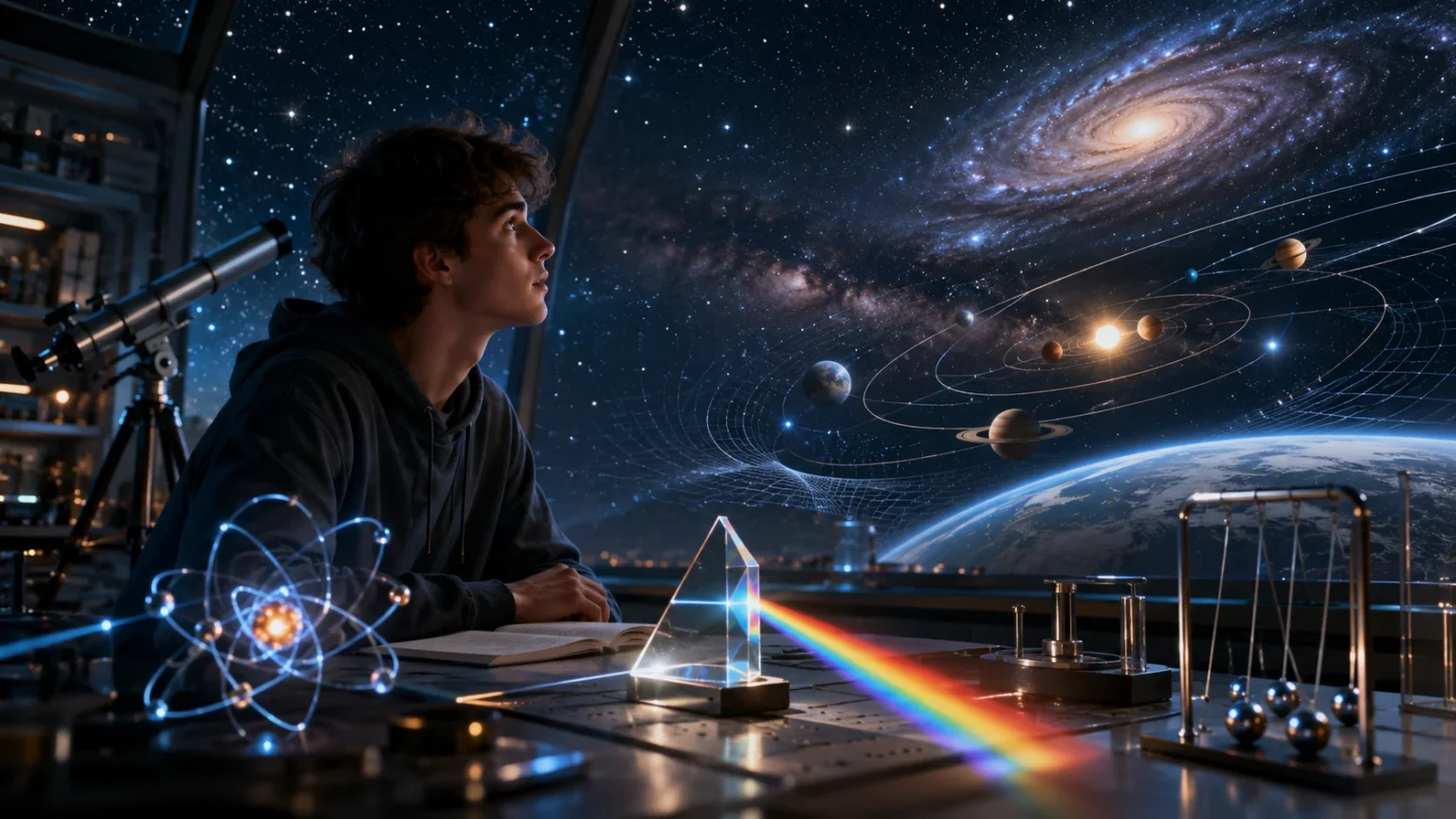

Physics for Beginners: Understanding How the Universe Works
Physics may sound like a subject filled with difficult equations, but at its heart, it asks surprisingly simple questions. Why do objects fall? How does light travel? Why do planets orbit stars? What is matter made of? Physics for beginners becomes much easier when you see it as a way of understanding the patterns behind everyday life and the universe around us.
From the phone in your hand to distant galaxies, the same basic laws of physics are constantly at work. Gravity keeps your feet on the ground, electromagnetism makes electronic devices possible, thermodynamics explains how heat moves, and quantum physics describes the strange behavior of nature at extremely small scales. Physics connects ordinary experiences with some of the biggest mysteries in science.
Scientists have developed remarkably successful theories to describe nature, yet physics is far from finished. Researchers continue studying dark matter, dark energy, black holes, gravitational waves, neutrinos, quantum behavior, and the early universe. Some discoveries confirm theories developed decades ago, while others reveal unanswered questions that may require entirely new ideas.
You do not need advanced mathematics to begin understanding these concepts. The best place to start is with the fundamental ideas—motion, forces, energy, matter, waves, gravity, and atoms—and gradually build toward relativity and quantum mechanics. Once these foundations are clear, the universe begins to look less mysterious and much more connected.
What Is Physics?
Physics is the branch of science that studies matter, energy, motion, forces, space, time, and the interactions between them. Physicists try to discover basic rules that can explain how natural systems behave. These rules can describe something as simple as a rolling ball or something as enormous as the movement of galaxies across the universe.
One reason physics is so powerful is that the same principles often work in completely different situations. The laws governing motion can help engineers design cars, scientists calculate spacecraft trajectories, and astronomers understand planetary orbits. A relatively small number of fundamental principles can therefore explain an extraordinary range of events.
Physics is usually divided into major areas such as classical mechanics, electromagnetism, thermodynamics, optics, relativity, quantum mechanics, nuclear physics, particle physics, and astrophysics. These branches focus on different aspects of nature, but they frequently overlap. Understanding one area often makes concepts in another area easier to recognize.
Physics is also highly experimental. Scientists develop ideas, express them through mathematical models, and compare their predictions with observations or experiments. A theory earns scientific confidence when repeated evidence supports its predictions. If measurements disagree with a theory, physicists may need to improve it or search for a better explanation.
Motion Is Where Basic Physics Begins
Motion simply describes how an object’s position changes over time. A car traveling along a road, Earth moving around the Sun, and a football crossing a field are all examples of motion. To describe them scientifically, physicists use concepts such as distance, displacement, speed, velocity, acceleration, and time.
Speed tells us how quickly something moves, while velocity includes both speed and direction. A car traveling at 60 kilometers per hour has a speed, but saying it travels north at 60 kilometers per hour describes its velocity. This distinction becomes important because changing direction means velocity changes even if speed stays constant.
Acceleration describes how quickly velocity changes. An object accelerates when it speeds up, slows down, or changes direction. A car turning around a bend is therefore accelerating even when the number on its speedometer remains unchanged. Similar ideas apply to objects falling toward Earth and planets continuously changing direction while orbiting the Sun.
This area of physics is called classical mechanics, and it provides the foundation for understanding the motion of everyday objects. Newton’s laws describe most ordinary motion extremely well, from machines and vehicles to projectiles and spacecraft. Only under extreme conditions, such as speeds close to the speed of light, do physicists need more advanced theories.
Newton’s Laws Explain How Forces Change Motion
A force is a push or pull capable of changing an object’s motion. Gravity, friction, tension, and electromagnetic interactions can all create forces. Isaac Newton summarized the relationship between forces and motion in three famous laws that remain among the most important basic physics concepts taught to beginners.
Newton’s first law says that an object remains at rest or continues moving at constant velocity unless a net external force acts on it. This property is called inertia. A book stays on a table until something moves it, while an object already moving would continue unless forces such as friction slow it down.
Newton’s second law connects force, mass, and acceleration through the familiar relationship F = ma. Greater force produces greater acceleration, while objects with greater mass require more force to achieve the same acceleration. This explains why pushing an empty shopping cart is much easier than accelerating one filled with heavy groceries.
Newton’s third law says that forces occur in interacting pairs. When you push against the ground while walking, the ground pushes back on you. A rocket works on the same principle: gases are accelerated backward, while the rocket receives momentum in the opposite direction and moves forward—even in the vacuum of space.
Energy Makes Change Possible
Energy is one of the most important ideas in all of physics. It is commonly described as the capacity to cause change or perform work, although physicists define it more precisely within different systems. Energy appears in many forms, including kinetic, potential, thermal, chemical, electrical, nuclear, and electromagnetic energy.
Kinetic energy is associated with motion. A moving bicycle, flowing river, spinning turbine, and orbiting satellite all possess kinetic energy. Potential energy, meanwhile, depends on an object’s position or configuration. A raised object has gravitational potential energy because gravity can accelerate it downward if it is released.
One of the most powerful laws of physics is the conservation of energy. Energy cannot simply disappear from an isolated system; instead, it changes form. When a ball falls, gravitational potential energy becomes kinetic energy. When brakes stop a bicycle, much of that kinetic energy eventually becomes thermal energy through friction.
Energy conservation allows physicists to analyze complicated problems without following every tiny movement involved. The concept applies from engines and electrical circuits to stars and particle collisions. Understanding how energy moves and transforms is therefore one of the most useful skills a beginner can develop when learning physics.
Momentum Helps Explain Collisions and Movement
Momentum describes the quantity of motion an object carries and is calculated by multiplying mass by velocity. A heavy truck moving quickly therefore has much greater momentum than a slowly moving tennis ball. Because velocity has direction, momentum also has direction, making it especially useful for understanding collisions and interactions.
Like energy, momentum follows an important conservation law. In an isolated system, total momentum remains constant even when individual objects change their speeds or directions. When two billiard balls collide, momentum is transferred between them, but the total momentum of the system remains consistent when external forces are negligible.
Momentum conservation also helps explain rocket propulsion. A rocket pushes exhaust gases rapidly in one direction, giving those gases momentum. To keep the total momentum balanced, the rocket gains momentum in the opposite direction. Rockets therefore do not need air to push against, which is why they can operate successfully in space.
The idea also applies to subatomic particles. Physicists analyze the momentum and energy of particles produced inside powerful accelerators to reconstruct what happened during a collision. Principles that can describe two balls colliding on a table can therefore also help scientists investigate some of the smallest building blocks of matter.
Gravity Shapes Planets, Stars, and Galaxies
Gravity is the interaction most people experience directly every day. It keeps objects on Earth, causes rain to fall, influences ocean tides, holds the Moon in orbit, and keeps planets traveling around the Sun. On larger scales, gravity plays a central role in the formation and behavior of stars, galaxies, and cosmic structures.
Newton described gravity as an attraction between objects with mass. The gravitational interaction grows stronger as masses increase and weaker as their separation increases. This description works extremely well for everyday objects, planetary motion, satellites, and many spacecraft calculations, making Newtonian gravity one of physics’ most successful practical tools.
Albert Einstein later gave physics a deeper description through general relativity. In this theory, mass and energy affect the geometry of spacetime. Objects follow paths through this curved spacetime, producing what we experience as gravity. This description becomes especially important around extremely massive objects such as neutron stars and black holes.
General relativity also predicted gravitational waves—ripples in spacetime produced by accelerating massive objects. Modern observatories can detect these tiny disturbances from events such as merging black holes and neutron stars. Their detection opened a new way of studying the universe, allowing astronomers to observe cosmic events through gravity rather than light alone.
Waves Carry Energy Across the Universe
A wave transfers energy or information from one location to another without necessarily transporting matter over the same distance. Ocean waves, sound waves, seismic waves, radio waves, and light all show wave-like behavior. Although these examples may look very different, similar concepts can describe their frequency, wavelength, amplitude, and speed.
Frequency measures how many wave cycles occur during a particular amount of time, while wavelength describes the distance between repeating points on a wave. Frequency and wavelength are closely connected to wave speed. Understanding these relationships helps explain everything from musical notes and radio signals to colors of visible light.
Sound is a mechanical wave and requires a medium such as air, water, or solid material to travel. Vibrating objects create pressure disturbances that move through the surrounding material. Because space is largely a vacuum, ordinary sound cannot travel between planets in the same way it travels through Earth’s atmosphere.
Light behaves differently because electromagnetic waves can travel through a vacuum. Visible light represents only a tiny portion of the electromagnetic spectrum, which also includes radio waves, microwaves, infrared, ultraviolet, X-rays, and gamma rays. Astronomy uses these different wavelengths to reveal objects and processes that human eyes cannot see directly.
Electricity and Magnetism Are Deeply Connected
Electricity and magnetism may initially seem like separate topics, but physics shows that they are different aspects of the same fundamental interaction: electromagnetism. Electric charges create electric fields, moving charges can produce magnetic fields, and changing magnetic fields can create electric effects.
This relationship explains how many technologies work. Electric motors convert electrical energy into mechanical motion, while generators do essentially the reverse by converting mechanical motion into electrical energy. Transformers, speakers, microphones, power grids, wireless communication, and countless electronic devices all depend on electromagnetic principles.
Electromagnetic theory also transformed our understanding of light. In the nineteenth century, James Clerk Maxwell developed equations connecting electricity and magnetism. His work showed that changing electric and magnetic fields could propagate through space as waves, and the predicted speed matched the known speed of light.
Electromagnetism is also essential at the atomic level. It helps explain how charged particles interact and why atoms can combine into molecules. Most ordinary forces we experience when touching objects ultimately arise from electromagnetic interactions among atoms, making this force one of the most important ingredients of everyday physical reality.
Thermodynamics Explains Heat and Temperature
Thermodynamics studies energy, heat, temperature, and how energy moves through physical systems. Temperature measures aspects of the microscopic motion and energy distribution of particles, while heat describes energy transferred because of a temperature difference. Understanding that distinction makes many everyday thermal processes easier to explain.
Place a warm object beside a colder one and energy tends to move from the warmer object toward the colder environment until the system approaches thermal equilibrium. This principle helps explain cooling drinks, heating rooms, refrigerator operation, weather patterns, engines, and many industrial processes.
The laws of thermodynamics place fundamental limits on how energy transformations can occur. The first law reflects energy conservation, while the second law introduces the idea of entropy. In broad terms, natural processes tend to move toward states in which energy is more dispersed and less available to perform useful work.
The second law also explains why machines cannot be perfectly efficient. Some energy inevitably becomes less useful, often appearing as waste heat. Engineers therefore use thermodynamic principles when designing engines, power stations, cooling systems, batteries, spacecraft, computers, and technologies intended to improve energy efficiency.
Atoms Build the Matter Around Us
Everything from rocks and oceans to plants and human bodies is made from atoms. An atom contains a tiny nucleus surrounded by electrons. The nucleus contains positively charged protons and electrically neutral neutrons, while negatively charged electrons occupy quantum states around the nucleus.
Atoms are incredibly small, but atoms themselves are not the smallest objects known to physics. Protons and neutrons contain smaller particles called quarks. Electrons, as far as current experiments can determine, behave as elementary particles without known internal structure.
The number of protons determines which chemical element an atom represents. Hydrogen normally has one proton, helium has two, carbon has six, and oxygen has eight. Differences in electron arrangements then strongly influence how atoms interact and form molecules, connecting fundamental physics with chemistry and biology.
Most of an atom’s volume is associated with the region occupied by its quantum electron states rather than a solid arrangement resembling tiny planetary systems. The familiar picture of electrons orbiting a nucleus like planets around the Sun is therefore only a simplified learning model. Quantum mechanics gives a much more accurate description.
Quantum Physics Describes the Tiny World
Quantum physics describes nature at atomic and subatomic scales, where the familiar rules of everyday experience are no longer sufficient. Particles such as electrons and photons can display behavior that appears strange when viewed through classical physics, including interference, quantization, and probabilistic measurement outcomes.
One important quantum idea is that certain physical quantities come in discrete amounts rather than varying continuously in every situation. Electrons in atoms, for example, can occupy specific allowed energy states. When transitions occur between those states, atoms can absorb or emit particular amounts of electromagnetic energy.
Quantum mechanics also describes particles using wave-like mathematical properties. Experiments show that objects such as electrons can produce interference patterns associated with waves, while light can display particle-like behavior through photons. This wave-particle behavior demonstrates why classical categories do not fully describe the microscopic world.
Although quantum physics sounds abstract, it has enormous practical importance. Semiconductors, lasers, LEDs, modern computer chips, medical imaging technologies, atomic clocks, and emerging quantum technologies all depend on quantum principles. One of physics’ strangest theories is therefore also one of the foundations of modern technology.
Relativity Changes Our Understanding of Space and Time
Einstein’s special theory of relativity begins with a remarkable principle: the speed of light in a vacuum is the same for all inertial observers regardless of their relative motion. Accepting this leads to surprising consequences because space and time cannot remain completely separate and absolute.
At speeds close to the speed of light, moving clocks are measured to run differently compared with clocks in other frames, and measured lengths can also depend on relative motion. These effects are negligible in normal daily life because humans move far too slowly for them to become obvious.
Special relativity also produced the famous relationship E = mc², expressing a connection between mass and energy. Because the speed of light squared is an enormous number, even a relatively small amount of mass corresponds to a tremendous quantity of energy. Nuclear reactions in stars demonstrate this relationship on cosmic scales.
Relativity is not only theoretical. Satellite navigation systems must account for relativistic timing effects to maintain high accuracy. The theory also plays a central role in modern astrophysics, particularly when scientists study black holes, neutron stars, high-speed particles, gravitational waves, and the evolution of the universe.
The Four Fundamental Forces Control Physical Interactions
Despite the enormous variety found in nature, physicists currently describe interactions using four fundamental forces: gravity, electromagnetism, the strong nuclear force, and the weak nuclear force. Understanding these forces provides one of the clearest ways for beginners to see how physics connects phenomena across vastly different scales.
Gravity dominates the behavior of planets, stars, and galaxies because it acts over unlimited distances and always attracts ordinary matter. Electromagnetism also acts over long distances and controls interactions involving electric charge. It is responsible for light, electricity, magnetism, chemistry, and much of the structure of ordinary matter.
The strong nuclear interaction works at extremely short distances and helps bind quarks together inside protons and neutrons. The related strong interaction between nuclear constituents helps hold atomic nuclei together despite the electrical repulsion between positively charged protons. Without it, stable atomic nuclei as we know them could not exist.
The weak nuclear interaction is involved in certain types of radioactive decay and processes involving neutrinos. It also plays a crucial role in reactions occurring inside stars. Together, these four interactions provide the framework physicists use to understand phenomena ranging from radioactive atoms to the structure of galaxies.
Particle Physics Looks for Nature’s Smallest Building Blocks
Particle physics asks a fundamental question: what is everything made of? Scientists have discovered a collection of elementary particles that form the foundation of our current understanding of matter. These particles include quarks, electrons, neutrinos, photons, gluons, and several other fundamental particles.
Most of this knowledge is organized within the Standard Model of particle physics. Quarks and leptons make up matter, while certain bosons are associated with fundamental interactions. The Higgs boson is linked to the Higgs field, which plays an essential role in explaining why several elementary particles have mass.
The Standard Model has successfully predicted and explained an extraordinary range of experimental results, but physicists know it is incomplete. It does not provide a quantum description of gravity, and it does not explain major mysteries such as the identity of dark matter or why the observable universe contains much more matter than antimatter.
Large particle accelerators allow physicists to investigate these questions by colliding particles at high energies and examining what emerges. These experiments recreate conditions that help scientists test known theories and search for rare or unexpected phenomena that might reveal physics beyond the Standard Model.
Stars Show Physics Working on an Enormous Scale
Stars are giant natural laboratories where gravity, thermodynamics, electromagnetism, nuclear physics, and quantum mechanics operate together. A star forms when gravity pulls gas together, increasing pressure and temperature in its center. Eventually, conditions can become hot and dense enough for sustained nuclear fusion.
In stars like the Sun, hydrogen nuclei ultimately combine through chains of nuclear reactions that convert hydrogen into helium. A small difference in mass is converted into energy, consistent with Einstein’s mass-energy relationship. This energy gradually moves outward before eventually escaping from the stellar surface as radiation.
The outward pressure associated with hot material and radiation helps oppose the inward pull of gravity. For much of a star’s lifetime, these competing effects can maintain a relatively stable structure. As nuclear fuel and internal conditions change, however, the star eventually enters different stages of stellar evolution.
A star’s mass strongly influences its final fate. Lower-mass stars can eventually leave behind white dwarfs, while sufficiently massive stars can undergo violent stellar explosions and leave neutron stars or black holes. The atoms in planets and living organisms are therefore connected to physical processes that occurred inside earlier generations of stars.
Physics Helps Explain Black Holes
A black hole forms when matter becomes concentrated so strongly that the resulting spacetime curvature creates a region from which nothing inside the event horizon can escape to the outside, including light. Stellar-mass black holes can form after the collapse of sufficiently massive stars, while supermassive black holes occupy the centers of many galaxies.
The boundary surrounding a black hole is called the event horizon. It is not a solid surface like the ground on Earth. Instead, it represents a boundary in spacetime beyond which paths leading outward cannot return information to distant observers.
Black holes cannot be observed simply by seeing light emitted from inside them. Astronomers instead study their effects on nearby matter, stars, gas, and light. Hot material falling toward black holes can produce intense radiation, while gravitational-wave observatories can detect spacetime disturbances generated when black holes merge.
Black holes bring together some of physics’ deepest ideas. General relativity describes gravity extremely successfully on large scales, while quantum physics governs microscopic processes. Understanding what ultimately happens under the most extreme black-hole conditions may require a deeper theory capable of connecting gravity with quantum mechanics.
Physics Explains How the Universe Evolves
Modern cosmology applies physics to the universe as a whole. Observations show that the universe has expanded from a much hotter and denser early state. The Big Bang model does not describe an ordinary explosion occurring at one location in pre-existing empty space; it describes the early evolution and expansion of space itself.
As the universe expanded, it cooled. Particles formed, atomic nuclei developed, and eventually electrons combined with nuclei to produce neutral atoms. Gravity gradually drew matter into denser regions, leading over immense periods to the formation of stars, galaxies, clusters, and the large-scale cosmic structure observed today.
Scientists have also found that the universe contains more than the ordinary matter making up stars, planets, and people. Observations point toward dark matter, which appears to exert gravitational effects without emitting ordinary light, and dark energy, a name given to whatever is associated with the observed accelerated expansion of the universe.
These discoveries show that our understanding remains incomplete. Physics explains an enormous amount about cosmic history, yet major components of the universe remain mysterious. Finding the nature of dark matter and understanding cosmic acceleration are among the biggest challenges facing modern physics and astronomy.
Why Physics Still Has Unanswered Questions
Modern physics is extremely successful, but scientific success does not mean every question has been answered. General relativity describes gravity extraordinarily well, while quantum mechanics describes microscopic systems with remarkable accuracy. The difficulty is that the two theories do not yet fit together into one complete description under all extreme conditions.
Dark matter presents another major puzzle. Astronomical observations indicate that visible stars and gas alone cannot explain all the gravitational behavior seen in galaxies and larger cosmic structures. Scientists have strong evidence for an additional component, yet its fundamental nature remains unknown.
Dark energy raises an equally challenging question. Measurements indicate that cosmic expansion is accelerating, but physicists are still investigating why. Explanations may involve energy associated with empty space, new physical fields, modifications to our understanding of gravity, or possibilities that future observations have yet to reveal.
These unanswered questions are not weaknesses that make physics useless. They are exactly what keeps science moving forward. Each successful theory gives researchers a stronger foundation from which to recognize what remains unexplained, design better experiments, and search for a deeper understanding of nature.
How to Start Learning Physics as a Beginner
The easiest way to learn physics for beginners is to begin with familiar experiences rather than advanced theories. Start with motion, speed, acceleration, forces, gravity, work, and energy. Look for examples around you, such as a falling object, braking bicycle, bouncing ball, or moving elevator, and ask which physical principles explain what happens.
Basic mathematics makes learning physics much easier. Beginners should become comfortable with arithmetic, fractions, ratios, algebra, graphs, and simple geometry. You do not need advanced calculus to understand the fundamental ideas, although calculus becomes increasingly important when progressing into university-level mechanics, electromagnetism, and modern physics.
Problem-solving matters as much as memorizing definitions. When approaching a physics problem, identify what is known, determine what needs to be found, draw a simple diagram when helpful, choose the relevant physical principle, and check whether the final answer makes sense. Understanding why an equation works is more valuable than merely memorizing it.
Most importantly, remain curious. Ask why the sky has color, why astronauts appear weightless, why metal feels colder than wood, how a magnet works, or why stars shine. Physics begins with questions about ordinary experiences, and those questions can eventually lead toward understanding atoms, black holes, quantum fields, and the structure of the universe.
Physics Connects Everyday Life to the Universe
Physics reveals that the everyday world and the distant universe are not governed by separate sets of rules. The same gravity that pulls a dropped object toward the floor guides planets around stars. The same electromagnetic physics behind household electronics also allows light from distant galaxies to travel across space and reach telescopes.
At smaller scales, quantum mechanics explains the behavior of atoms and particles that make up ordinary matter. At larger scales, relativity describes spacetime, gravity, black holes, and cosmic structures. Thermodynamics connects everything from boiling water in a kitchen to energy transport inside stars.
What makes physics fascinating is that every answer tends to reveal another question. Scientists understand the fundamental particles of ordinary matter remarkably well, yet dark matter remains unidentified. General relativity explains gravitational phenomena with extraordinary precision, but incorporating gravity fully into quantum physics remains an open challenge.
For anyone beginning the subject, the goal should not be to memorize the entire universe at once. Learn one idea, understand how it connects to another, and gradually build a bigger picture. Physics for beginners is ultimately about discovering that the universe, despite its enormous complexity, follows patterns that humans can observe, test, describe, and continue exploring.
Frequently Asked Questions
What is physics in simple words?
Physics is the science of matter, energy, motion, forces, space, and time. It helps explain how objects and natural processes behave, from falling objects to stars and galaxies.
What should a beginner learn first in physics?
Start with motion, forces, Newton’s laws, gravity, work, energy, and momentum. These concepts provide a strong foundation before moving into electricity, thermodynamics, relativity, and quantum physics.
Is physics difficult for beginners?
Physics can seem difficult when formulas are taught without explaining the ideas behind them. Learning concepts through everyday examples and practicing problems gradually makes the subject much easier to understand.
What are the four fundamental forces of physics?
The four fundamental forces are gravity, electromagnetism, the strong nuclear interaction, and the weak nuclear interaction. Together, they describe the fundamental interactions currently known in nature.
Does physics explain everything in the universe?
Not yet. Physics explains many natural phenomena extremely well, but questions remain about dark matter, dark energy, quantum gravity, the early universe, and other fundamental mysteries.
Meta Description: Learn physics for beginners with simple explanations of motion, energy, gravity, atoms, relativity, quantum physics, and how the universe works.