
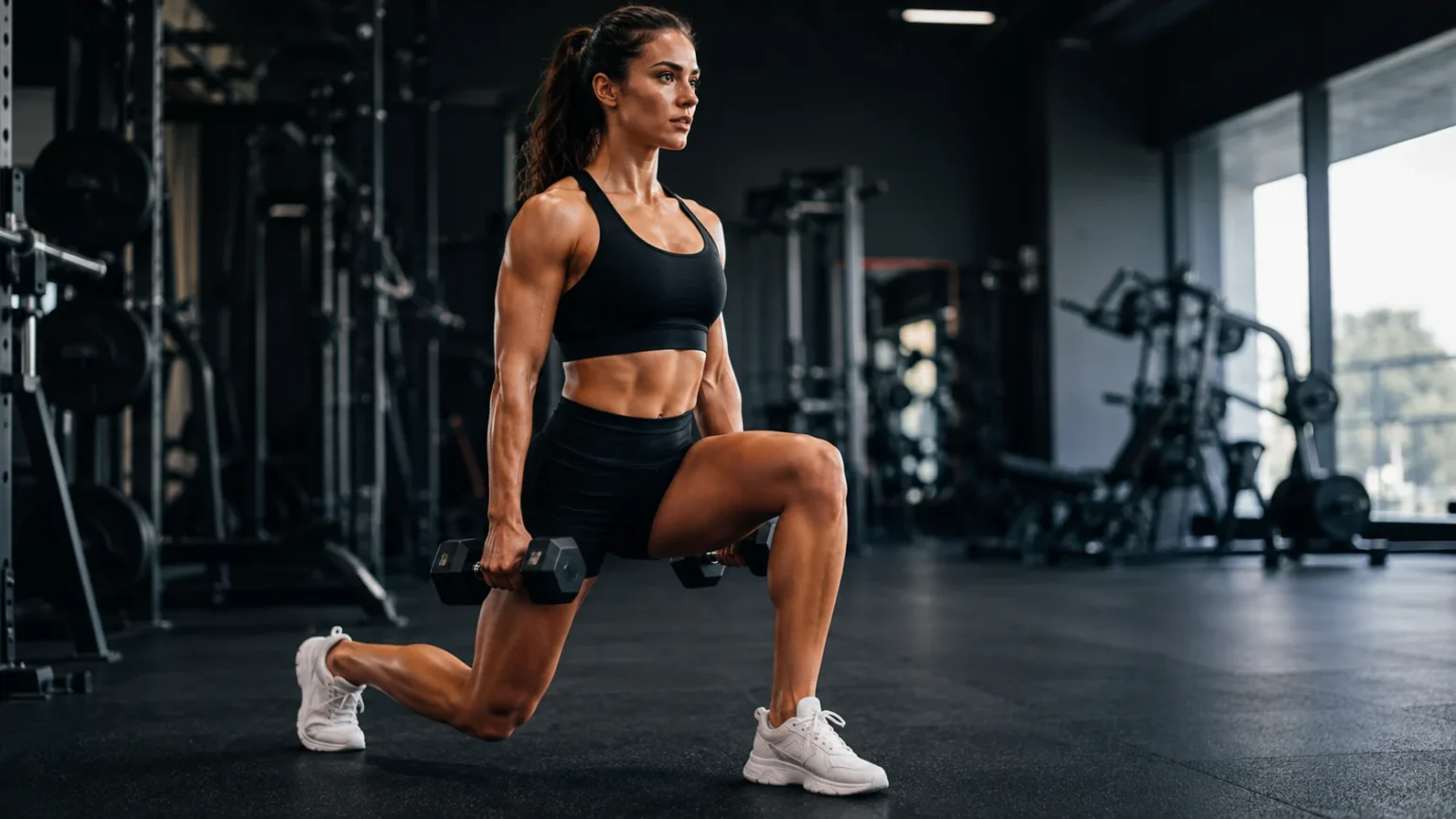

Split Squat: Benefits, Proper Form & Mistakes to Avoid
The split squat is one of the most useful lower-body exercises for building stronger legs without needing a complicated setup. Unlike a traditional squat, your feet remain in a staggered stance throughout the movement, allowing each leg to handle more individual work while also challenging balance and stability.
Split squats primarily train the quadriceps, glutes, and other muscles surrounding the hips and legs. Because one leg works harder at a time, the exercise can also reveal strength differences that may remain less obvious during bilateral movements such as regular squats or leg presses.
The exercise is also highly adaptable. Beginners can perform bodyweight split squats while holding onto support, while experienced lifters can use dumbbells, kettlebells, barbells, longer ranges of motion, pauses, or elevated variations to make the movement considerably more challenging.
However, getting the setup right matters. An awkward stance, unstable foot position, excessive forward movement, or poor control can make split squats uncomfortable. Learning proper split squat form allows you to get more benefit from the exercise while reducing unnecessary stress on your knees, hips, and lower back.
What Is a Split Squat?
A split squat is a stationary unilateral-style lower-body exercise performed with one foot positioned in front of the other. Unlike a walking lunge, both feet generally remain planted in the same places throughout the entire set.
From the staggered stance, you bend both knees and lower your body vertically toward the floor. The front leg usually performs most of the work, while the rear leg provides support and contributes to balance.
Although it is often categorized as a single-leg exercise, a traditional split squat still uses both legs. The front leg generally receives more load, but the rear leg remains involved rather than floating completely off the ground.
This combination makes split squats a useful bridge between bilateral squats and more demanding single-leg exercises. They provide significant unilateral training benefits without requiring the balance necessary for exercises such as pistol squats.
What Muscles Do Split Squats Work?
The split squat muscles worked include the quadriceps, gluteus maximus, hamstrings, adductors, calves, and several smaller muscles responsible for stabilizing the hips and pelvis. Your core also works to keep your trunk controlled throughout each repetition.
The quadriceps of the front leg are heavily involved as you bend and straighten the knee. The amount of quadriceps emphasis can vary depending on stance length, torso angle, depth, and whether the front knee moves farther forward.
The glutes contribute strongly as the hip extends while you stand. Using a slightly longer stance or a modest forward torso lean may increase the amount of hip flexion and make the glutes feel more involved.
Your rear leg is not simply resting. It helps maintain balance and experiences hip extension, particularly as you descend. The exact distribution of work varies between individuals because limb length, mobility, stance, and technique all influence the movement.
8 Split Squat Benefits Worth Knowing
One of the biggest split squat benefits is the ability to train each side of the body more independently. A regular squat can allow a stronger leg to compensate subtly for a weaker one, while split squats make those differences easier to notice.
They also train several major lower-body muscles at the same time. The quadriceps and glutes receive substantial work, while the adductors, hamstrings, calves, and trunk contribute to maintaining a stable and coordinated movement.
Split squats are highly scalable as well. Someone exercising at home can use body weight, while a gym lifter can add substantial resistance with dumbbells or a barbell. That makes the exercise useful across many experience levels.
Finally, split squats require relatively little equipment and floor space. They can fit into strength workouts, hypertrophy programs, athletic training, home routines, and lower-body sessions where traditional heavy squatting is not practical.
1. Split Squats Build Stronger Quadriceps
Your quadriceps straighten the knee as you rise from the bottom of a split squat. Because the front leg handles a large percentage of the workload, the movement can create a strong quadriceps training stimulus even with relatively moderate external weight.
Allowing the front knee to move naturally forward can increase knee flexion and quadriceps involvement. Your knee does not need to remain perfectly behind your toes, provided the movement is controlled and comfortable.
For quad-focused split squats, a relatively upright torso and moderate stance often work well. Elevating the front heel slightly may also make deeper knee flexion more accessible for some lifters.
The goal should still be comfortable movement rather than forcing one exact position. If excessive knee travel causes pain or instability, adjust your stance, depth, or resistance until you find a range you can control.
2. Split Squats Can Build Your Glutes
The gluteus maximus plays an important role in extending the hip as you return to standing. A split squat that allows sufficient hip flexion can therefore provide a strong challenge for the glutes.
A slightly longer stance and modest forward torso lean may increase hip involvement for some people. This does not mean you should bend excessively at the waist; your trunk should remain braced and controlled.
Depth can matter as well. Lowering through a comfortable range allows the glutes to work while lengthened, provided you maintain stability and avoid forcing beyond your available mobility.
For glute-focused split squats, prioritize control and gradual resistance progression rather than exaggerated technique. A well-performed standard split squat can already provide substantial glute work.
3. Split Squats Help Address Strength Imbalances
Most people have some difference between their left and right sides. One leg may naturally feel stronger, more coordinated, or more stable because of sports history, injuries, daily habits, or simple individual variation.
Bilateral exercises can sometimes hide these differences because both legs work together. During a split squat, each side must complete its own set, making differences in strength or control much easier to identify.
If one side is noticeably weaker, begin your sets with that leg and avoid doing extra repetitions on the stronger side simply because you can. Over time, consistent unilateral training may help reduce manageable differences.
Perfect symmetry is not required for healthy movement. The goal is to prevent large strength discrepancies from going unnoticed while developing useful control on both sides.
4. Split Squats Improve Balance and Stability
A staggered stance is less stable than standing with both feet side by side. Your hips, feet, ankles, and core must therefore work continuously to keep your body controlled during the exercise.
This makes the split squat for balance useful even before additional weight is introduced. Beginners may initially notice that staying upright is more difficult than producing enough muscular force to complete the repetition.
Balance usually improves with practice. Keeping your feet slightly apart side-to-side rather than positioning them on one narrow line can immediately make the stance feel more stable.
For strength development, do not turn the exercise into a balance contest. Holding onto a rack or stable support can sometimes allow you to train the target muscles harder without wasting energy trying not to fall sideways.
5. Split Squats Train Each Leg With Less Total Load
Because one leg performs a large amount of the work, split squats can challenge the lower body without requiring the same total external load you might use during a heavy bilateral squat.
This can be useful when training at home with limited equipment. A pair of moderate dumbbells may create a challenging split squat even if those same weights would feel relatively light during a conventional squat.
Lower absolute load can also be practical for lifters who want additional leg volume without placing another heavily loaded barbell across their back.
That does not mean split squats are automatically easier on every joint or suitable for every injury. It simply means substantial muscular effort can be created without requiring extremely heavy external resistance.
6. Split Squats Can Improve Hip Mobility
The staggered stance places the rear hip in extension as you descend. This can expose you to a useful range of motion through the hip flexors while the front hip moves into flexion.
Regularly performing split squats through a controlled range may make this position feel more comfortable over time. The exercise therefore combines strength and mobility instead of treating them as completely separate qualities.
You should not force the rear hip into an extreme stretch, however. If you feel sharp pinching, pain, or excessive tension through the front of the hip, shorten your stance or reduce your depth.
Useful hip mobility develops through controlled movement. The deepest or longest stance is not automatically the best if you cannot maintain a stable pelvis and comfortable joint position.
7. Split Squats Can Support Athletic Movement
Running, sprinting, climbing stairs, jumping, and changing direction all involve moments where one leg contributes more force than the other. Split squats allow athletes to train lower-body strength in a staggered position that shares some characteristics with those movements.
The exercise is not identical to sprinting or jumping, so it should not replace sport-specific training. Instead, it can strengthen the muscles that support many athletic actions.
Athletes can progress the movement through heavier loading, controlled pauses, increased range, or eventually more dynamic unilateral exercises when appropriate.
For general fitness, you do not need to be an athlete to benefit. Daily activities such as climbing stairs, stepping onto a curb, or rising from a kneeling position also require effective one-leg-dominant strength.
8. Split Squats Are Easy to Progress
A bodyweight split squat may be challenging for a beginner, but it can eventually become relatively easy. Fortunately, the movement offers many ways to increase difficulty without replacing the exercise.
Adding dumbbells is one of the simplest options. You can hold a weight in each hand, hold one weight goblet-style, or use contralateral loading where resistance is held on the side opposite the working leg.
You can also slow the lowering phase, pause at the bottom, elevate the front foot, or increase the range of motion. Each modification changes the training challenge without requiring dramatically heavier weights.
The Bulgarian split squat, where the rear foot is elevated, provides another popular progression. However, the standard split squat should be mastered first because elevation adds extra balance and mobility demands.
How to Do a Split Squat With Proper Form
Begin by standing tall and stepping one foot forward while the other remains behind you. Keep some space between your feet horizontally, as though they were standing on separate railway tracks rather than balancing on a tightrope.
Place most of your attention on the front leg and keep the front foot firmly planted. Brace your midsection, maintain a comfortable torso position, and allow the heel of the rear foot to remain lifted.
Lower your body by bending both knees, allowing the rear knee to travel toward the floor. Your front knee can move naturally while staying aligned with the general direction of your toes.
Once you reach a comfortable depth, press through the front foot and extend your hip and knee to return to standing. Complete your planned repetitions before switching sides rather than changing legs after every rep.
How Far Apart Should Your Feet Be?
Your split squat stance should be long enough that you can descend without feeling crowded but not so long that you struggle to control your hips or rear leg.
A useful starting point is approximately one normal walking stride, then adjust from there. Taller people or those with longer legs may naturally prefer a larger distance.
If the stance is too short, the exercise may feel compressed and your rear knee may move awkwardly. If it is excessively long, you may struggle to lower vertically or maintain comfortable hip positioning.
Experiment until both knees can bend smoothly while the front foot stays planted. Your stance is correct when it supports strong, repeatable movement rather than matching an exact distance from someone else’s workout.
Should Your Front Knee Go Over Your Toes?
Yes, your front knee can move forward past your toes during a split squat if the position is comfortable and controlled. Knees naturally move forward during many ordinary activities, including climbing stairs and getting up from a chair.
Trying to force your shin perfectly vertical can sometimes make the movement unnecessarily awkward. It may also shift more work toward the hips when your actual training goal is quadriceps development.
The more important issue is whether the knee tracks smoothly with the foot and whether the movement causes pain. Significant uncontrolled collapse inward is generally a bigger technique concern than simply allowing forward knee travel.
If you have an existing knee condition, your optimal range may differ. Use a comfortable depth and seek individualized professional advice when pain persists instead of relying on a universal internet rule.
How Deep Should You Go in a Split Squat?
A good starting point is lowering until your rear knee approaches the floor while you maintain balance and control. You do not need to physically slam the rear knee into the ground.
Your front knee and hip should bend through a range that feels strong rather than painful. Some people can comfortably descend much deeper than others because ankle mobility, hip structure, limb length, and training experience differ.
Greater range of motion can increase muscular challenge, but only when you can control it. Forcing depth while your heel lifts, torso collapses, or pelvis twists does not automatically make the exercise better.
Depth can gradually improve as strength and mobility increase. Use the range you own today, then expand it over time rather than forcing yourself immediately into the deepest possible position.
Should You Lean Forward During Split Squats?
A completely vertical torso is not required. A modest forward lean can be natural and may increase the amount of work performed around the hip and glutes.
For more quadriceps emphasis, many lifters prefer a slightly more upright torso. For greater hip involvement, a controlled forward lean can be useful, especially when combined with an appropriate stance.
The important word is controlled. Folding excessively at the waist or allowing the weight to pull your chest toward the floor can reduce stability and place unnecessary stress on your lower back.
Choose your torso angle deliberately based on comfort and training goal. Your spine should remain controlled and your trunk should move as a stable unit rather than collapsing during the bottom half of each repetition.
Split Squat vs Lunge: What’s the Difference?
The biggest difference between a split squat and lunge is movement of the feet. During a traditional split squat, the feet remain planted throughout the set, while a lunge usually involves stepping into or out of the position.
Because the stance is stationary, split squats often make it easier to focus purely on lowering and standing. This can be useful for beginners who find coordinating a forward or walking lunge difficult.
Lunges add more deceleration and balance demands because the body must control the step. Walking lunges also require more space and involve continuous transitions from one leg to the other.
Neither exercise is universally superior. Split squats may be easier for controlled strength training, while lunges can provide additional movement variety and coordination depending on your goals.
Split Squat vs Bulgarian Split Squat
A Bulgarian split squat is a split-squat variation in which the rear foot is elevated on a bench, box, or other stable surface. This generally increases the amount of work performed by the front leg.
Elevating the rear foot can also increase the mobility and balance demands of the exercise. Some people feel a strong stretch through the rear hip, while others find the position uncomfortable.
A standard split squat is usually easier to learn because both feet remain in contact with the floor. That makes it a good starting point before progressing to rear-foot-elevated versions.
You do not need to switch to Bulgarian split squats simply because they are more difficult. Standard weighted split squats can continue building strength and muscle when they are progressively overloaded.
Split Squat vs Regular Squat
A regular squat trains both legs together, while a split squat places more emphasis on one side at a time. Both exercises can effectively train the quadriceps and glutes.
Traditional squats usually allow heavier total loading and may be better suited to goals involving maximum bilateral squat strength. Split squats require less overall resistance to make each working leg feel challenged.
Using both can create a balanced lower-body program. A lifter might perform squats as the main strength exercise and use split squats later for unilateral volume.
You can also prioritize split squats when equipment is limited or when you want additional unilateral training. Exercise selection should serve your goals rather than follow a rule that one movement must replace the other.
Dumbbell Split Squat: How to Add Weight
Once bodyweight repetitions feel controlled, dumbbell split squats are one of the easiest progressions. Hold one dumbbell in each hand and allow your arms to hang naturally at your sides.
Set your feet before lifting heavy weights. Establish a stable stance, brace your trunk, and then complete your repetitions without changing the distance between your feet.
The dumbbells should move vertically with your body rather than swinging forward and backward. Keep your shoulders controlled and avoid allowing the weights to pull your torso out of position.
Increase resistance gradually when you can complete all planned repetitions with consistent form. A small weight increase can feel significant because most of the work is concentrated on the front leg.
Can You Do Split Squats With a Barbell?
Yes. Barbell split squats can provide a strong strength and hypertrophy stimulus for experienced lifters who already have good balance and technique.
The bar may be positioned across the upper back in a similar way to a barbell squat. Because balance becomes more important, using a rack with properly positioned safety equipment is sensible.
Barbell loading allows heavier resistance but makes it harder to simply drop the weight when balance is lost. Beginners usually benefit from mastering bodyweight and dumbbell variations first.
Heavier does not automatically mean more effective. If barbell loading turns every set into a balance challenge, dumbbells or supported split squats may allow you to train the target muscles more productively.
8 Common Split Squat Mistakes to Avoid
The most common split squat mistakes involve stance setup, balance, knee control, depth, and load selection. Small changes in these areas can completely alter how stable the exercise feels.
Standing with the feet directly behind one another is a frequent issue. A narrow tightrope stance reduces side-to-side stability and makes wobbling far more likely.
Other problems include pushing excessively from the rear leg, allowing the front heel to lift, collapsing the front knee inward, and choosing resistance that is too heavy to control.
The goal is not to make every repetition look identical across different people. Good form means using a stance and range that allow your joints to move comfortably while the target muscles remain responsible for the work.
Mistake #1: Using a Tightrope Stance
Placing the rear foot directly behind the front foot creates an unnecessarily narrow base of support. This often turns the exercise into a balance drill rather than productive leg training.
Instead, maintain some horizontal distance between your feet. Imagine standing on two separate tracks rather than one painted line running straight through the middle of your body.
This small adjustment can immediately reduce wobbling. It also makes it easier to keep the pelvis facing forward without constantly fighting side-to-side movement.
Do not confuse instability with effectiveness. Your legs can be trained extremely hard while holding a stable position, and greater stability often allows more useful resistance and better muscular effort.
Mistake #2: Setting Your Feet Too Close Together
An overly short stance can make the movement feel cramped. Your rear knee may have difficulty descending comfortably, while the front leg may not have enough space to move through a useful range.
If you constantly feel pushed forward or cannot lower without your rear leg becoming awkward, move the feet slightly farther apart from front to back.
Do not overcorrect by taking the longest possible stance. Excessive distance can make the rear hip uncomfortable and cause your body to travel forward rather than downward.
A good setup usually feels balanced between these extremes. Make small stance adjustments until the movement becomes smooth rather than automatically taking the biggest step you can.
Mistake #3: Pushing Too Much With the Back Leg
The rear leg naturally contributes to a split squat, but it should not become the primary driver when your goal is training the front leg.
If you push aggressively from the rear toes, the exercise may feel easier while reducing the unilateral challenge that makes split squats useful.
Think of the rear leg as a supportive kickstand. Keep enough contact to maintain balance but allow the front leg to perform most of the work.
One useful test is to perform a few supported repetitions while intentionally focusing on front-foot pressure. You may immediately notice a stronger quadriceps and glute contraction.
Mistake #4: Letting the Front Knee Collapse Inward
During the descent and ascent, your front knee should generally remain controlled in relation to your foot. Significant inward collapse can reduce stability.
Do not aggressively force the knee outward either. The goal is smooth alignment rather than creating an exaggerated position that feels unnatural.
If your knee repeatedly collapses when resistance becomes heavier, reduce the load. The problem may reflect fatigue, insufficient control, or simply using more weight than you can currently manage.
Practicing slower bodyweight repetitions can also help improve awareness. Good knee control should become automatic before you chase heavier dumbbells.
Mistake #5: Allowing the Front Heel to Lift
Your front foot should generally remain firmly connected to the ground throughout the split squat. Repeated heel lifting can reduce stability and shift your center of pressure forward.
A stance that is too short or limited ankle mobility may contribute. Adjusting your setup or reducing depth can often make maintaining full-foot contact easier.
Think about keeping pressure through the heel, base of the big toe, and base of the little toe. This creates a stable tripod foot without forcing all your weight onto the heel.
If you intentionally use a small heel elevation to emphasize the quadriceps, that is different from the heel accidentally peeling off the floor during every repetition.
Mistake #6: Falling Forward at the Bottom
Some forward torso lean is normal, but losing control and collapsing toward the floor is different. This often happens when the load becomes too heavy.
Your torso should maintain approximately the angle you selected at the beginning of the repetition. If your chest suddenly drops as you approach the bottom, reduce the resistance or depth.
Bracing the core can help maintain control. Imagine keeping your ribs and pelvis connected rather than allowing your lower back to overarch or your torso to fold.
Good technique is not about remaining rigid. It is about maintaining intentional positions while your hips and knees perform the movement.
Mistake #7: Rushing Every Repetition
Split squats require balance and coordination, which makes uncontrolled speed especially problematic for beginners. Dropping quickly into the bottom position can hide technique problems.
Try using a controlled two- or three-second lowering phase while learning. This gives you time to notice whether your knee, foot, and pelvis remain stable.
Stand with purpose rather than bouncing out of the bottom. Momentum can make repetitions easier without necessarily improving strength through the entire range.
Once you have consistent technique, tempo can be adjusted to suit your training goal. Speed should be deliberate rather than the result of trying to finish an uncomfortable set as quickly as possible.
Mistake #8: Using Too Much Weight Too Soon
Split squats can feel surprisingly difficult with relatively light weights. Do not judge the exercise by how small the dumbbells look compared with what you use for regular squats.
Heavy loading can quickly cause balance problems, shortened range, knee instability, and excessive pushing from the back leg.
Choose a weight that allows every repetition to look reasonably similar. The last few reps should feel challenging without turning into completely different movements.
Progress gradually through repetitions and load. Adding five pounds while maintaining excellent form is more useful than doubling the resistance and losing the movement you were trying to train.
Are Split Squats Good for Beginners?
Yes. Split squats for beginners can be an excellent way to develop leg strength, balance, and awareness, although the exercise may initially feel unfamiliar.
Start with body weight and use a wall, railing, chair, or squat rack for support. Holding onto something stable is not cheating; it can help you learn the leg movement without balance becoming the limiting factor.
Begin with a comfortable range rather than trying to touch your rear knee to the floor immediately. As your control improves, gradually increase depth.
Once bodyweight sets feel easy, add light dumbbells or increase repetitions. There is no reason to jump immediately to Bulgarian split squats simply because they appear more advanced.
How Many Split Squats Should You Do?
The ideal number of split squat reps depends on your goal, experience, and resistance. For general strength and muscle building, approximately 6 to 15 controlled repetitions per leg can work well in many programs.
Beginners may start with 2 to 3 sets of 8 to 12 repetitions per side using body weight. Experienced lifters may use heavier loads and lower repetition ranges or lighter loads and higher repetitions.
Because each leg must complete its own work, split squats can become tiring quickly. You do not need enormous numbers of sets to create a challenging lower-body stimulus.
Stop the set when technique begins deteriorating significantly. Completing extra repetitions while stumbling, shortening depth, or pushing mostly from the rear leg adds less value than ending with good form.
How Often Should You Do Split Squats?
Split squats can appear one to three times per week depending on your total lower-body training volume. The appropriate frequency depends on how heavily you perform them and what other exercises your program includes.
Heavy dumbbell or barbell split squats may require more recovery than light bodyweight repetitions. Your quadriceps and glutes need enough time to recover before another demanding training session.
If you already perform squats, leg presses, lunges, and deadlift variations, consider total workload rather than evaluating split squats in isolation.
More frequency does not guarantee faster progress. Consistent high-quality training followed by adequate recovery is generally more useful than repeatedly training sore muscles simply because an exercise feels productive.
Are Split Squats Good for Building Muscle?
Yes. Split squats for muscle growth can be highly effective because they allow the quadriceps and glutes to work through a substantial range while carrying meaningful resistance.
Like any hypertrophy exercise, they need progressive overload. Your body has little reason to continue adapting if you perform exactly the same easy weight and repetitions indefinitely.
You can progress by adding weight, performing more repetitions, increasing controlled range of motion, or adding sets when appropriate.
Nutrition and recovery matter too. Muscle growth requires sufficient protein, overall energy, sleep, and consistency in addition to a well-designed training stimulus.
Can Split Squats Help Grow Your Glutes?
Yes. Split squats train the gluteus maximus significantly, particularly when the hip moves through a useful range and the front leg remains responsible for most of the work.
A somewhat longer stride and modest torso lean may increase glute involvement for some lifters by producing more hip flexion.
However, you do not need an extreme stance. If your rear hip becomes uncomfortable or balance deteriorates, the supposed glute advantage may not be worth the poor setup.
For complete glute development, combine split squats with other movements such as hip hinges, hip thrusts, squats, or step-ups rather than expecting one exercise to do everything.
Are Split Squats Good for Knee Strength?
Split squats can strengthen the quadriceps and other muscles surrounding the knee when performed through an appropriate range.
Because the movement can be adjusted easily, you can modify stance, depth, support, and resistance based on what feels comfortable.
Knee movement itself is not something to fear. Bending the knee under progressively managed resistance is a normal part of strengthening the lower body.
However, persistent or sharp knee pain should not be ignored. If split squats repeatedly hurt despite reasonable modifications, have the issue assessed by an appropriate healthcare or rehabilitation professional.
What If Split Squats Hurt Your Knees?
First, reduce the resistance and shorten the range of motion. Pain that appears only under heavy load may indicate that you progressed faster than your current capacity.
Experiment with stance length and torso angle. A slightly longer stance may reduce the amount of knee flexion required, while a shorter stance may increase it.
Holding onto support can also make the movement more controlled. Removing unnecessary balance demands allows you to focus on finding a comfortable movement path.
If pain is sharp, worsening, accompanied by swelling or instability, or persists outside training, stop relying on technique changes alone and seek professional assessment.
Supported Split Squats: An Underrated Variation
A supported split squat involves lightly holding a stable object while performing the exercise. This simple modification can make the movement dramatically more stable.
Improved stability often allows you to focus harder on the front leg. Instead of ending a set because you are wobbling, you may reach muscular fatigue in the quadriceps and glutes first.
Supported variations are excellent for beginners, but they are not only beginner exercises. Experienced lifters can use support while holding a heavy dumbbell in the opposite hand.
When muscle development is the priority, stability can be an advantage. Your muscles do not receive extra credit because you nearly fall over during each repetition.
Front-Foot-Elevated Split Squats
The front-foot-elevated split squat places the front foot on a small platform or weight plate. This can allow the front hip and knee to move through a greater range before the rear knee reaches the floor.
The increased range may make the quadriceps and glutes work through more length, which can create a challenging hypertrophy stimulus with relatively moderate weight.
Start with a small elevation rather than immediately using a tall box. Too much height can make setup awkward and require more mobility than you currently have.
Maintain the same basic principles as the regular split squat: stable front foot, controlled knee movement, balanced stance, and gradual progression.
How to Add Split Squats to Your Leg Workout
If split squats are one of your primary strength exercises, place them relatively early in the workout when you are fresh. This allows you to use more resistance and maintain better technique.
If you already perform heavy squats or deadlift variations, split squats can work well as a secondary movement later in the session.
A simple lower-body workout might include a squat, split squat, Romanian deadlift, leg curl, and calf exercise. The exact combination should reflect your goals and available equipment.
Do not add split squats on top of unlimited existing leg volume. Replace or reorganize exercises when necessary so total training remains recoverable.
Split Squat: The Bottom Line
The split squat is a versatile lower-body exercise that primarily strengthens the quadriceps and glutes while also challenging balance, hip stability, and coordination.
Its stationary staggered stance makes it easier to learn than many moving lunge variations while still giving each leg a significant individual training stimulus.
Good technique starts with a stable stance, comfortable stride length, controlled knee movement, planted front foot, and a range of motion you can manage without pain.
Start with body weight if necessary, add support when balance limits you, and gradually increase resistance as your strength improves. Consistent progression matters far more than immediately attempting the most difficult variation.
Frequently Asked Questions About Split Squats
Split squats look simple, but small differences in stance, torso position, depth, and loading can make the exercise feel completely different from one person to another.
There is no single perfect stride length or knee position that everyone must copy. Individual proportions and mobility influence what comfortable split squat form looks like.
The exercise can be adapted toward quadriceps or glute emphasis, but both muscle groups remain involved regardless of minor technique changes.
The following questions cover some of the most common concerns people have about split squats, muscle growth, knee position, and exercise selection.
Are split squats better than lunges?
Neither is universally better. Split squats keep the feet stationary and are often easier for controlled strength work, while lunges add stepping, coordination, and movement between repetitions.
What muscles do split squats work most?
Split squats mainly target the quadriceps and glutes. The hamstrings, adductors, calves, hip stabilizers, and core also help control the movement.
Do split squats build glutes?
Yes. Split squats can effectively train the glutes, especially when performed through a comfortable range with progressive resistance and good front-leg control.
Should your knee go past your toes during a split squat?
It can. Forward knee travel is normal when it is controlled and comfortable. Focus more on stable foot contact and smooth knee tracking than trying to keep the shin perfectly vertical.
How many split squats should beginners do?
Beginners can start with 2–3 sets of around 8–12 controlled repetitions per leg using body weight or light resistance, then progress gradually as balance and strength improve.