
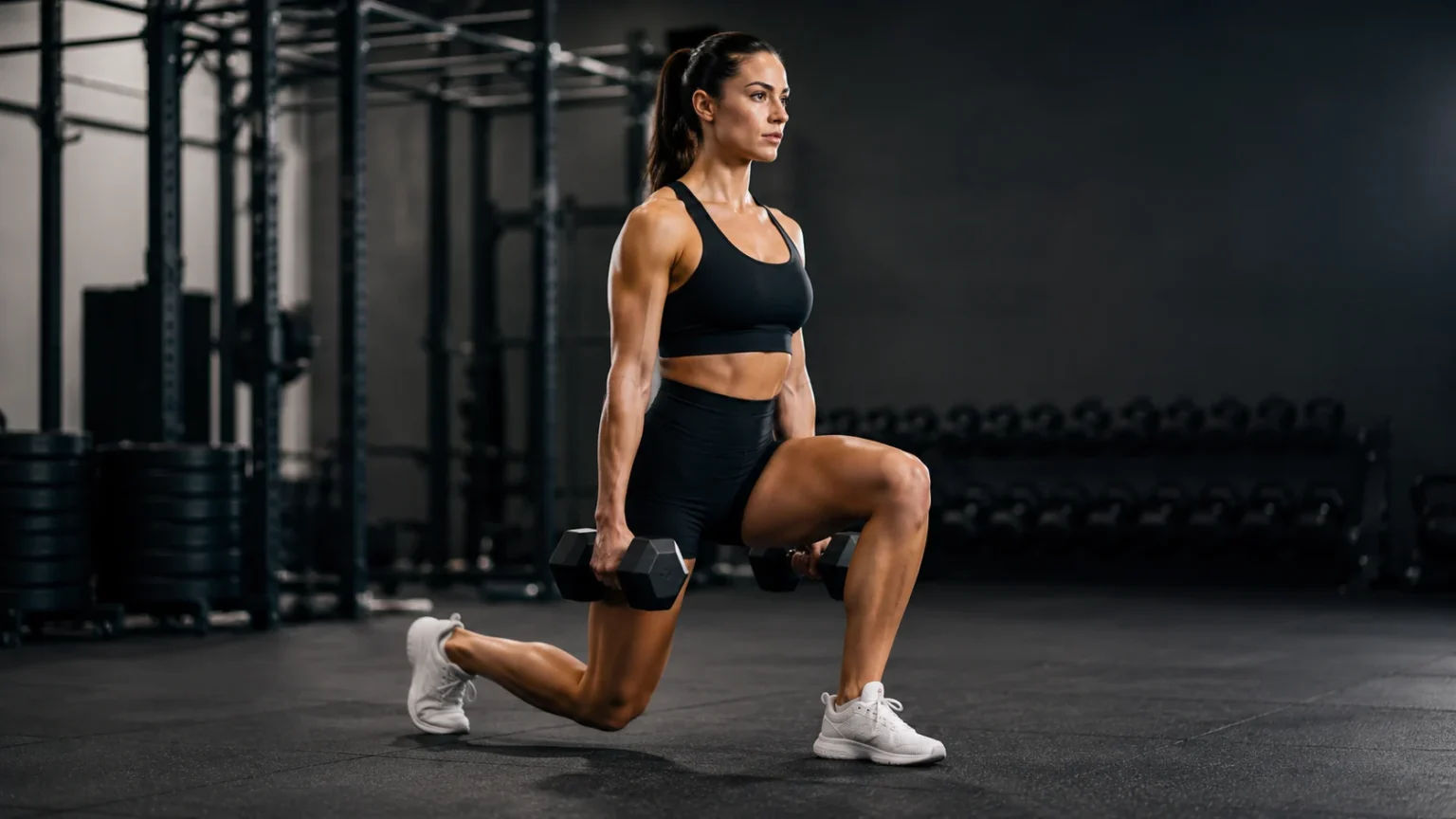

Split Squat: Build Stronger Legs With Better Form
The split squat is one of the most effective lower-body exercises for building strong legs, improving balance, and correcting strength differences between your left and right sides. Unlike many traditional leg exercises, it challenges one leg at a time while keeping both feet planted, making it valuable for beginners, athletes, and experienced lifters.
Although the exercise may look similar to a lunge, the movement has a different rhythm and purpose. Your feet remain in the same split stance throughout the set, allowing you to concentrate on controlled knee and hip movement. This stable setup makes it easier to develop strength while learning proper single-leg mechanics.
Split squats can strengthen your quadriceps, glutes, hamstrings, and supporting hip muscles without requiring complicated equipment. They can be performed using only body weight or progressed with dumbbells, kettlebells, barbells, resistance bands, or elevated positions as your strength and confidence improve.
Getting the benefits, however, depends heavily on technique. Foot placement, torso position, knee tracking, depth, and weight distribution all influence how the exercise feels and which muscles work hardest. Understanding these details can turn a basic split squat into a powerful part of your lower-body training routine.
What Is a Split Squat?
A split squat is a unilateral lower-body strength exercise performed with one foot positioned in front of the other. Rather than stepping forward or backward on every repetition, you maintain the same stance while lowering your body toward the floor and then pushing yourself back to the starting position.
Most of the work is performed by the front leg, although the rear leg provides balance and contributes some support. During the lowering phase, your front knee and hip bend while your rear knee moves toward the ground. You then drive through the front foot to return to the top.
Because the stance remains fixed, the split squat generally requires less dynamic balance than a walking or forward lunge. This can make it an approachable introduction to unilateral leg training before progressing to more demanding movements such as Bulgarian split squats, walking lunges, or single-leg squats.
The exercise can also be adjusted according to your training goals. Changing your stride length, torso angle, loading method, or range of motion can shift more emphasis toward the quadriceps or glutes. That versatility explains why split squat variations regularly appear in strength, hypertrophy, athletic, and rehabilitation-style training programs.
What Muscles Do Split Squats Work?
The quadriceps are among the primary split squat muscles worked, particularly as you straighten the front knee while rising. These muscles on the front of the thigh play an important role in knee extension and absorb considerable tension during the controlled lowering portion of each repetition.
Your gluteus maximus also works strongly during the exercise because it helps extend the hip as you push upward. A slightly longer stance and moderate forward torso lean can generally increase hip involvement, which is why split squats are frequently included in glute-focused lower-body workouts.
The hamstrings assist with hip stability and movement, while smaller muscles around the hips help keep your pelvis and legs properly aligned. Your adductors, commonly called the inner-thigh muscles, also contribute to stability and force production as you move through a comfortable range of motion.
Split squats additionally require your core and trunk muscles to maintain posture. When you add dumbbells or other external resistance, these stabilizing demands become more noticeable. The result is an exercise that trains major leg muscles while simultaneously challenging coordination, balance, and whole-body control.
Why Split Squat Benefits Go Beyond Bigger Legs
One of the biggest split squat benefits is the ability to train each leg independently. During bilateral exercises such as squats, a stronger leg can sometimes compensate for a weaker side. Split squats reduce that opportunity and allow you to identify noticeable differences in strength, control, or mobility.
Training one side at a time can also provide a strong muscle-building stimulus without requiring extremely heavy loads. Because the front leg handles much of the work, lighter dumbbells may feel surprisingly challenging. This makes split squats useful when heavy barbell training is unavailable or simply does not suit your current program.
The exercise also develops balance and coordination by challenging your body in a staggered stance. These qualities can transfer well to everyday movements and many sports, where people frequently push, run, jump, or change direction from positions in which one leg carries more responsibility than the other.
Split squats can additionally help improve hip and ankle control through a useful range of motion when performed correctly. Rather than treating them only as a bodybuilding movement, think of them as a combination of unilateral leg strength, stability, mobility, and movement-quality training in one relatively simple exercise.
How to Do a Split Squat With Proper Form
Start by standing tall and placing one foot comfortably in front of you while moving the other foot backward. Keep your feet roughly hip-width apart rather than positioning them directly on one narrow line. A slightly wider base usually provides better balance and makes the exercise feel more natural.
Once your stance feels secure, keep your front foot completely planted and allow your rear heel to stay raised. Brace your core gently and maintain a controlled torso position. Begin lowering yourself vertically by bending both knees while allowing the rear knee to travel toward the floor.
Continue descending until you reach a depth you can control without losing your balance or changing your foot position. Your front knee should generally track in the same direction as your toes rather than collapsing sharply inward. Keep pressure distributed comfortably across the front foot throughout the repetition.
From the bottom position, push through your front foot and extend your knee and hip until you return to the starting position. Avoid rushing into the next repetition. Complete the desired number of reps on one side before switching legs so that each side receives similar training volume.
Find the Right Split Squat Stance
A comfortable split squat stance is essential because positioning your feet too close together can make the movement cramped. If your stance is excessively short, your rear knee may struggle to descend naturally and you may feel unnecessary pressure or instability as you approach the bottom.
Taking an extremely long stride creates a different problem. You may find it difficult to maintain control or reach a useful depth without compensating through your pelvis or lower back. Your ideal stance should allow both knees to bend smoothly while your front foot remains stable.
Your stance can also influence muscle emphasis. A relatively shorter stance with a more upright torso often increases the demand placed on the quadriceps, while a somewhat longer stance may allow greater hip involvement and create a stronger sensation in the glutes.
There is no single perfect stride length that works for every person because limb proportions, mobility, training history, and goals differ. Instead of copying someone else’s exact position, adjust your feet until you can move smoothly, maintain balance, and feel the intended muscles doing the work.
Common Split Squat Mistakes That Reduce Results
One frequent mistake is placing both feet almost directly behind one another, as if standing on a tightrope. This unnecessarily reduces your base of support and can cause excessive wobbling. Keeping some side-to-side distance between your feet usually creates a more stable and productive starting position.
Another common problem is pushing excessively through the rear leg. Although the back leg helps with stability, the front leg should typically perform most of the work. If you constantly launch yourself upward using your rear foot, you reduce the unilateral challenge that makes the exercise valuable.
Allowing the front knee to collapse inward is another technique issue worth correcting. Rather than obsessing over preventing any forward knee movement, focus more on maintaining controlled alignment. Your knee can naturally travel forward when necessary while continuing to track approximately with the direction of your toes.
Speed can also undermine split squat form. Dropping quickly into the bottom and bouncing back up reduces control and may make your stance less stable. Lowering smoothly, briefly establishing control near the bottom, and driving upward deliberately usually produces better muscle tension and movement quality.
Split Squat vs Lunge: What Is the Difference?
The biggest distinction when comparing a split squat vs lunge is movement of the feet. During a traditional split squat, your feet stay planted until the set is finished. During many lunge variations, you step forward, backward, or across the body before returning to another position.
Because your stance remains fixed, split squats usually provide more stability and allow you to focus closely on strength and muscle tension. Lunges introduce an additional stepping component, creating greater demands on coordination, braking, balance, and transitions between positions.
Neither exercise is automatically superior. Split squats can be excellent for controlled unilateral strength and hypertrophy, while lunges may be particularly useful when you want a more dynamic movement challenge. Both can strengthen the quads, glutes, and surrounding lower-body muscles when performed effectively.
Many training programs benefit from using both exercises at different times. A beginner might first develop control through static split squats before introducing reverse lunges. An experienced lifter might use split squats for heavier strength work and walking lunges as higher-repetition accessory training.
Bulgarian Split Squat vs Regular Split Squat
A Bulgarian split squat is a more challenging variation in which the rear foot is elevated on a bench or another stable platform. Elevating the rear leg typically increases the balance requirement while allowing the front leg to perform a large amount of work through a deeper range.
The standard split squat keeps both feet connected to the floor, making it easier to stabilize your body and learn the basic movement. For this reason, beginners often benefit from developing confidence with regular split squats before moving to the rear-foot-elevated version.
Bulgarian split squats can be especially effective when your goal is developing significant unilateral leg strength and muscle. However, increased difficulty does not automatically make them better for everyone. Some people find the elevated rear-foot position uncomfortable or unnecessarily demanding on their balance.
If regular split squats already challenge your legs effectively, there is no need to rush progression. Build strong technique first, gradually increase resistance, and experiment with Bulgarian split squats when you can maintain good control. Exercise progression should improve the training stimulus rather than simply make movement more complicated.
Split Squat Variations for Different Training Goals
The bodyweight split squat is the simplest place to begin. Without external weight, you can concentrate on stance, balance, knee tracking, depth, and tempo. Beginners may hold a wall, rail, or stable object lightly if balance prevents them from performing controlled repetitions.
A dumbbell split squat provides an easy way to increase resistance once bodyweight repetitions become comfortable. You can hold one dumbbell in each hand or load only one side for an additional stability challenge. Dumbbells also make it straightforward to increase resistance gradually over several weeks.
Front-foot-elevated split squats increase the potential range of motion by placing the front foot on a small, stable platform. This variation can produce a substantial stretch and muscular challenge when mobility allows. Start with a low elevation rather than immediately trying to create the deepest possible movement.
The rear-foot-elevated or Bulgarian variation increases unilateral demands further and can become a major lower-body strength exercise. Regardless of which variation you choose, the basic principles remain consistent: maintain control, use an appropriate stance, load progressively, and prioritize quality repetitions over unnecessary complexity.
How to Make Split Squats More Quad Focused
If your goal is building the quadriceps, consider using a moderately shorter stance that still allows comfortable movement. Remaining relatively upright can also increase knee flexion and place substantial tension through the front thigh without requiring you to deliberately force the knee into an unnatural position.
Allow the front knee to move naturally forward as your heel remains planted. The idea that your knee must never travel beyond your toes is overly simplistic because normal lower-body movement varies according to individual anatomy. Controlled knee travel can be completely normal during properly performed squatting patterns.
Maintaining a controlled descent is particularly valuable for quad development. Taking roughly two or three seconds to lower yourself can increase time under tension and make lighter resistance challenging. You do not need to move artificially slowly, but you should remain in control throughout the eccentric phase.
Progression remains important regardless of technique adjustments. Over time, gradually increase repetitions, resistance, range of motion, or overall training quality. Your quadriceps grow from repeated exposure to meaningful tension and sufficient recovery, not from searching for one magical split squat variation.
How to Make Split Squats More Glute Focused
For greater glute involvement, experimenting with a slightly longer stance can increase hip flexion during the lowering phase. A controlled forward torso lean may also shift more work toward the hip extensors while still keeping the spine and pelvis in a strong, comfortable position.
Think about lowering your body under control and then using the front leg to drive yourself upward. You should not need to exaggerate the movement or push your hips excessively backward. Small adjustments to stance and torso position can significantly change how the exercise feels.
A front-foot-elevated split squat can also be valuable for glute training because the elevation may allow additional hip range of motion. The extra depth should only be used when you can maintain control. More range is useful only when your technique remains stable and comfortable.
Remember that both the quadriceps and glutes continue working regardless of which variation you choose. A movement becoming more glute focused does not mean the quads suddenly stop contributing. Think in terms of changing muscular emphasis rather than completely isolating one lower-body muscle.
Are Split Squats Good for Your Knees?
Split squats can be a useful lower-body strengthening exercise when they are performed within a comfortable range and matched to your current abilities. Strengthening the quadriceps, glutes, and surrounding musculature can support overall lower-body function, but individual tolerance to specific exercises can vary considerably.
Knee movement itself should not automatically be viewed as harmful. Your knees are designed to bend and straighten under appropriate loads. During a split squat, controlled forward movement of the front knee can be normal, particularly when the heel remains planted and the movement does not cause problematic pain.
If split squats feel uncomfortable, first examine your stance, depth, resistance, and exercise variation. Reducing the range of motion or using external support for balance can sometimes make the exercise easier to control. Increasing training difficulty too quickly may also create unnecessary irritation.
Sharp, worsening, or persistent knee pain should not simply be trained through. If you have an existing injury, recent surgery, significant swelling, instability, or unexplained pain, consider getting individualized guidance from a qualified healthcare or rehabilitation professional before pushing harder with loaded unilateral exercises.
How Beginners Should Start Split Squats
Beginners should initially treat split squats as a movement skill rather than a test of strength. Start with body weight and use a stable support if necessary. Learning to control the descent and maintain consistent foot placement is more valuable than immediately adding heavy dumbbells.
Try performing several slow practice repetitions while adjusting your stance. If you constantly feel unstable, widen the distance between your feet slightly. If your legs feel cramped, increase the front-to-back distance until both knees can bend comfortably without forcing your body into an awkward position.
Once you can complete controlled bodyweight repetitions, begin adding resistance gradually. Dumbbells are often convenient because loading can be increased in small steps. Keep the weight manageable enough that your technique remains similar from the first repetition to the last.
Muscle soreness may occur when introducing a new unilateral exercise because each leg receives a concentrated workload. Avoid responding by dramatically increasing volume immediately. Allow your body to adapt and gradually build the number of sets, repetitions, or resistance across several training sessions.
How Many Split Squats Should You Do?
The right number of split squat reps and sets depends on your goal, experience, and the rest of your training program. Beginners may start with two or three manageable sets per leg, focusing primarily on consistent movement rather than reaching complete muscular exhaustion.
For general strength and muscle development, moderate repetition ranges can work extremely well. Sets somewhere around 6 to 15 controlled repetitions per leg are practical for many lifters, although effective training is not limited to one exact repetition range when resistance is appropriately challenging.
Higher repetitions can also be useful when using body weight or lighter resistance. The important factor is that the set eventually becomes challenging while form remains controlled. Performing twenty effortless repetitions offers a very different training stimulus from completing twelve demanding repetitions with appropriate resistance.
Consider your total weekly lower-body workload as well. If your program already contains squats, deadlifts, leg presses, lunges, and other demanding exercises, you may need fewer split squat sets. More volume is not automatically better when recovery and performance begin to deteriorate.
How to Progress Split Squats Without Losing Form
The simplest progression is adding repetitions while keeping the same resistance. For example, you might gradually move from eight controlled repetitions per leg toward twelve. Once the higher repetition target becomes manageable, add a small amount of resistance and begin building upward again.
You can also progress by improving range of motion. Someone who initially performs shallow bodyweight split squats may gradually develop enough control and mobility to descend farther. Increasing useful range while maintaining good positioning can provide progression without immediately adding external weight.
Tempo is another effective tool. Slowing the lowering portion or introducing a short controlled pause near the bottom can make the exercise considerably harder. These techniques are useful when equipment is limited because they create additional muscular demand without requiring heavy dumbbells or barbells.
Eventually, you can move toward advanced split squat variations such as front-foot-elevated or rear-foot-elevated split squats. Progression should remain purposeful. Choose the next variation because it helps achieve your training goal, not because a more complicated exercise looks impressive on social media.
Should You Add Weight to Split Squats?
Adding resistance makes sense once you can perform bodyweight split squats comfortably with consistent technique. External load allows you to continue applying progressive overload, which is important when your goal is increasing lower-body strength or building more muscle over time.
Dumbbells are usually one of the most convenient loading options. Holding weights by your sides keeps setup simple and makes it easy to stop a set safely. A goblet-style kettlebell or dumbbell can also work well while encouraging you to maintain a strong torso position.
Barbells can allow heavier loading but require more setup, balance, and confidence. For many people, dumbbells provide more than enough resistance to make split squats extremely challenging. You do not need the heaviest possible loading method to develop strong legs from unilateral training.
Whichever method you use, avoid increasing weight simply because you reached a certain number on paper. Add resistance when you can maintain depth, balance, knee control, and a stable stance. Progressive overload works best when the movement you are progressively loading remains technically sound.
Where Split Squats Fit Into a Leg Workout
Split squats can function as either a primary lower-body movement or an accessory exercise. Someone training at home with limited equipment may use weighted split squats as the centerpiece of a leg workout because unilateral loading makes moderate weights feel significantly more demanding.
In a gym program built around heavy squats or deadlifts, split squats often work well later in the workout. They can provide additional quad and glute volume without requiring another extremely heavy bilateral lift. This makes them useful for bodybuilding, strength, and general fitness programs.
Athletes may use split squats to improve unilateral strength alongside sprinting, jumping, and change-of-direction work. Because many sporting movements involve producing force from asymmetrical positions, developing strong and controlled individual legs can be a valuable part of physical preparation.
The best placement depends on your priorities. If improving your split squat strength is important, perform the exercise relatively early while you are fresh. If it mainly serves as supplementary leg training, place it after your primary compound exercises and use controlled moderate-to-high-quality repetitions.
Who Can Benefit Most From Split Squats?
Beginners can benefit because the basic version introduces single-leg-focused training while still allowing both feet to remain on the ground. Holding a stable support can reduce the balance challenge further, letting new exercisers concentrate on learning how their hips and knees should move.
Intermediate and advanced lifters can use weighted variations to build substantial lower-body muscle and strength. Because unilateral exercises expose each leg to high relative demand, they can make moderate loads challenging and provide a useful alternative when repeatedly adding weight to bilateral squats is undesirable.
Athletes may appreciate the exercise because it challenges leg strength and pelvic stability in a staggered position. Runners, field-sport athletes, and recreational competitors all spend significant amounts of time moving from one leg to another, making unilateral strength training highly relevant to many activities.
Split squats can also appeal to people who simply want stronger, more capable legs for everyday life. You do not need to compete in a sport or pursue bodybuilding goals to benefit from improving lower-body strength, balance, coordination, and confidence through controlled resistance training.
Build Stronger Legs One Rep at a Time
The split squat deserves more attention than it often receives. It trains the quadriceps, glutes, hamstrings, hips, and core while challenging balance and exposing differences between your legs. Few exercises deliver this combination using such a simple setup and relatively little equipment.
The key is resisting the temptation to make the movement unnecessarily complicated. Establish a comfortable stance, keep the front foot stable, allow your knees and hips to move naturally, and control every repetition. Good split squat technique creates the foundation for adding resistance safely and effectively.
As your strength improves, you can experiment with dumbbell split squats, front-foot elevation, Bulgarian split squats, different repetition ranges, and other progressions. Each variation provides a slightly different challenge while preserving the central benefit of training one leg more independently.
Whether your goal is stronger legs, bigger quads, more developed glutes, improved athletic ability, or better lower-body balance, split squats can earn a permanent place in your routine. Focus on consistent form and progressive training, and relatively simple repetitions can produce meaningful long-term results.
Frequently Asked Questions
Are split squats better than regular squats?
Neither exercise is universally better. Regular squats allow you to train both legs together with heavier loads, while split squats emphasize unilateral strength, balance, and individual leg development. Using both can create a well-rounded lower-body program.
Do split squats build glutes?
Yes. Split squats train the gluteus maximus along with the quadriceps and other lower-body muscles. A somewhat longer stance, controlled hip flexion, and appropriate forward torso lean can increase the emphasis placed on the glutes.
Should your knee go over your toes during split squats?
Some forward knee movement can be completely normal during split squats. Instead of trying to prevent it at all costs, maintain a planted heel, controlled movement, comfortable range of motion, and knee alignment that follows the direction of your toes.
Why are split squats so difficult?
Split squats concentrate much of the workload onto one leg while also demanding balance, hip stability, coordination, and core control. Because fewer muscles can share the load equally, even bodyweight or relatively light resistance can become surprisingly challenging.
How often should you do split squats?
Many people can include split squats in lower-body training one to three times per week depending on their overall workout volume, recovery, and goals. Allow enough recovery between demanding sessions so that performance and technique remain consistent.



