
How Artificial Intelligence Is Changing the Workplace
Artificial intelligence is rapidly becoming part of everyday work rather than remaining a specialized technology used only by large technology companies. Employees now use AI to write emails, summarize documents, analyze data, automate repetitive tasks, generate ideas, support customers, and improve decision-making. As these capabilities spread across industries, artificial intelligence in the workplace is changing how people perform their jobs and how organizations structure work.
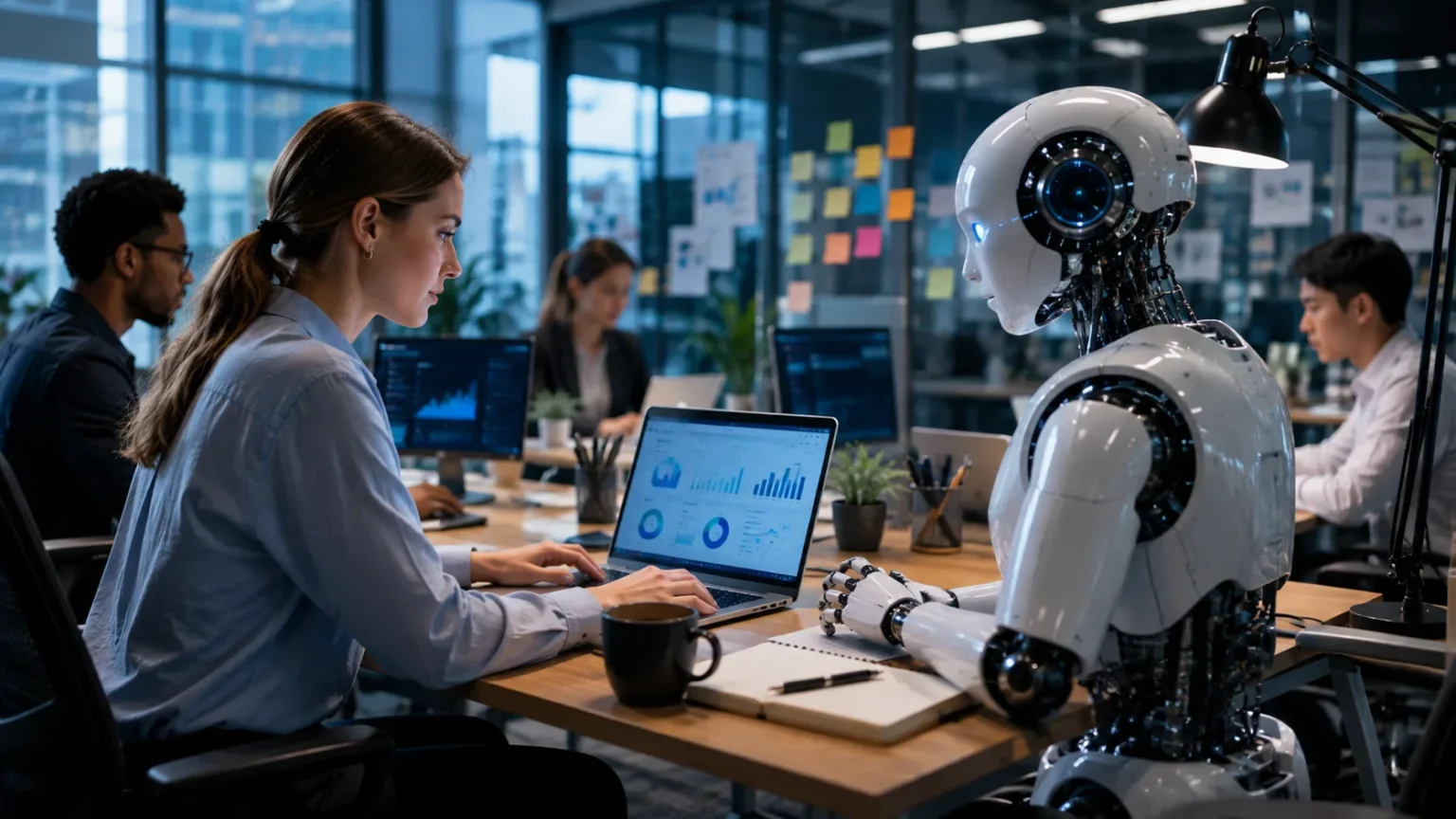
The biggest workplace change is not simply that machines can complete more tasks. AI is increasingly becoming a collaborative tool that supports employees while they work. A marketing professional can use generative AI to develop campaign ideas, a financial analyst can review large datasets more quickly, and a customer service representative can receive suggested responses while speaking with customers. These examples show how AI can increase productivity without completely removing human involvement.
At the same time, AI adoption creates understandable concerns about employment, job security, skills, privacy, and workplace fairness. Some repetitive activities can be automated, while other roles may change significantly as employees take responsibility for higher-value work. The challenge for organizations is to introduce AI in a way that improves efficiency while continuing to value human judgment, creativity, communication, and professional expertise.
This guide explains how artificial intelligence is changing the workplace, from automation and productivity to recruitment, collaboration, employee skills, cybersecurity, and the future of jobs. It also explores the opportunities and risks businesses should consider as AI becomes a more important part of modern working life.
Why AI Is Becoming Important in the Modern Workplace
AI is becoming increasingly important because organizations handle enormous amounts of information every day. Employees process emails, customer requests, documents, reports, spreadsheets, meetings, and digital workflows that can consume large amounts of time. Artificial intelligence can help sort, summarize, analyze, and organize this information more efficiently.
Another reason for rapid adoption is that AI tools have become easier to use. Employees no longer need advanced programming skills to interact with artificial intelligence. Many modern systems use conversational interfaces, allowing workers to describe what they need in natural language and receive useful results within seconds.
Businesses are also under constant pressure to improve productivity while controlling costs. AI automation can reduce time spent on routine tasks and allow employees to focus on work requiring judgment, relationships, creativity, or strategic thinking. This makes AI appealing across industries ranging from healthcare and finance to retail, marketing, manufacturing, and professional services.
The growing availability of generative AI has accelerated this transition. AI can now create drafts, summarize information, generate code, analyze documents, and support brainstorming in ways that were previously difficult to automate. Technology platforms like The Tech AI also help readers explore emerging AI technologies and their practical applications. As these capabilities become integrated into familiar workplace software, AI is increasingly becoming part of normal daily workflows.
AI Is Automating Repetitive Workplace Tasks
One of the clearest ways AI is changing the workplace is through automation. Many employees spend significant time completing repetitive activities such as data entry, document classification, scheduling, report preparation, or basic customer communication. AI can help complete portions of these tasks faster.
Automation is particularly useful when a process follows predictable patterns. For example, an AI system can categorize incoming support tickets, extract information from invoices, identify important details in documents, or route customer requests to the appropriate department. Employees can then focus on situations requiring more complex judgment.
This does not necessarily mean that entire jobs disappear when one task becomes automated. Most occupations contain a combination of routine and non-routine responsibilities. AI may automate certain activities while leaving employees responsible for interpretation, communication, problem-solving, quality control, and decision-making.
Businesses should therefore evaluate jobs at the task level rather than assuming automation affects every part of a role equally. The most productive approach often involves using AI for repetitive work while allowing people to concentrate on activities where human knowledge and experience provide greater value.
AI Is Increasing Employee Productivity
Artificial intelligence can significantly reduce the time required to complete information-heavy work. Employees can use AI assistants to summarize long reports, extract action items from meeting notes, create first drafts, organize research, or transform raw information into clearer formats.
Professionals who regularly write can benefit particularly from these tools. AI can help draft emails, reports, proposals, presentations, and internal documentation. Instead of beginning with a blank page, employees can create an initial version quickly and then refine it according to their expertise and organizational requirements.
Data-related work is also becoming easier. AI-assisted tools can help users identify patterns, create summaries, and interact with complex information more intuitively. This can make analytical capabilities accessible to employees who may not have advanced technical backgrounds.
However, productivity should not be measured only by how much content employees produce. Faster output has limited value if accuracy or quality declines. Businesses should encourage employees to review AI-generated work carefully so productivity improvements do not create additional errors or unnecessary information.
Generative AI Is Changing Knowledge Work
Knowledge workers spend much of their time reading, writing, researching, analyzing, and communicating. Generative AI can support nearly all of these activities, which explains why office-based professions are experiencing significant changes.
A lawyer might use AI to organize research before reviewing original material, while a consultant may use it to structure a presentation. Marketers can brainstorm campaign ideas, and human resources professionals can draft policy language or training materials. These applications reduce preparation time.
Generative AI can also help employees explore ideas. Workers can ask an AI assistant to challenge an assumption, compare different approaches, or suggest questions they may have overlooked. This makes AI useful not only for producing content but also for supporting structured thinking.
The important limitation is that generative AI can produce incorrect or misleading information. Employees remain responsible for verifying facts and applying professional judgment. In higher-risk fields, AI-generated outputs should support rather than replace appropriate human review.
AI Is Transforming Workplace Communication
Communication takes up a significant portion of the modern workday. Employees write emails, participate in meetings, prepare reports, and collaborate through messaging platforms. AI can reduce the time required to manage these communication activities.
AI writing assistants can help employees improve clarity, shorten lengthy messages, adjust tone, or translate communication into other languages. This can be especially valuable for multinational teams and professionals who regularly communicate across different audiences.
Meeting tools can also use AI to transcribe discussions, summarize decisions, and identify action items. Instead of manually reviewing long meeting notes, employees can quickly understand the most important outcomes and responsibilities.
However, excessive AI-generated communication can create problems if workplaces become flooded with unnecessary content. Organizations should encourage clear and purposeful communication rather than simply increasing the volume of messages employees can produce.
AI Is Improving Workplace Collaboration
Modern teams often operate across offices, countries, and time zones. Artificial intelligence can support collaboration by making information easier to share, organize, and understand.
For example, an AI assistant can summarize project updates for employees who were not present at a meeting. It can also organize documentation, identify outstanding tasks, and provide quick explanations of complex material.
AI-powered knowledge systems can make internal information easier to locate. Employees may be able to ask questions about company procedures or project documentation instead of manually searching through large collections of files.
These tools work best when organizational information is accurate and well maintained. AI cannot fix a poorly organized workplace knowledge base by itself. Companies still need clear documentation, access controls, and information-management practices.
AI Is Changing Customer Service Roles
Customer service is one of the areas where AI adoption is particularly visible. Chatbots and virtual assistants can answer common questions, help users navigate services, and handle simple requests without requiring a human agent for every interaction.
This automation can reduce wait times and allow customer support teams to focus on complicated or sensitive problems. AI can also suggest responses during live conversations, helping agents find information faster.
Customer service employees may therefore spend less time answering repetitive questions and more time dealing with situations requiring empathy, negotiation, or complex problem-solving.
Businesses should avoid using automation in situations where customers clearly need human assistance. Poorly designed AI support can create frustration when users become trapped in automated systems without a reliable way to reach a person.
AI Is Reshaping Marketing and Content Creation
Marketing teams are increasingly using AI for brainstorming, content development, audience research, campaign planning, and performance analysis. Generative AI can produce ideas quickly and help marketers explore multiple creative directions.
Content teams can use artificial intelligence to create outlines, improve headlines, summarize research, or develop first drafts. AI can also help organize keyword themes and identify questions audiences may be interested in.
However, publishing large amounts of generic AI-generated content is unlikely to build meaningful audience trust. Marketing still depends heavily on originality, customer understanding, brand positioning, accurate information, and real experience.
The strongest approach is usually AI-assisted content creation. Technology handles repetitive preparation, while humans provide strategy, expertise, storytelling, and final editorial judgment.
AI Is Changing Software Development
Software developers increasingly use AI coding assistants to generate code suggestions, explain unfamiliar functions, create tests, and troubleshoot technical problems.
Routine coding tasks can sometimes be completed more quickly because developers no longer need to manually write every predictable function or search documentation repeatedly.
AI can also help junior developers learn by explaining concepts and providing examples. However, relying too heavily on generated code can prevent programmers from developing the deeper understanding needed to identify problems.
Generated code should always be reviewed, tested, and checked for security weaknesses. AI can accelerate software development, but responsibility for quality and reliability remains with human developers.
AI Is Supporting Better Business Decisions
Organizations generate large amounts of data but often struggle to transform that information into useful decisions. AI can help identify patterns and summarize information more quickly.
Managers may use AI-assisted analytics to understand customer behavior, operational performance, financial trends, or sales activity. This can reduce the time required to interpret complex information.
AI can also support forecasting by analyzing historical patterns. Businesses may use predictive tools to estimate demand, identify potential risks, or optimize inventory.
However, AI recommendations should not be treated as unquestionable answers. Data can contain bias, incomplete information, or historical patterns that no longer apply. Human decision-makers must consider context and consequences.
AI Is Changing Recruitment and Hiring
AI tools can assist human resources teams with parts of the recruitment process. Systems may help organize applications, schedule interviews, draft job descriptions, or identify information within resumes.
Automation can reduce administrative work when companies receive large numbers of applications. Recruiters can spend more time speaking with candidates and evaluating suitability.
However, hiring decisions involve significant ethical and fairness considerations. Algorithms trained on historical hiring data may reproduce existing patterns or disadvantages if they are not carefully designed and monitored.
Businesses should maintain meaningful human oversight when using AI in recruitment. Candidates deserve fair evaluation, and organizations should understand how automated systems influence important employment decisions.
AI Is Changing Employee Training
Traditional workplace training often provides the same material to everyone, regardless of previous knowledge. AI has the potential to make employee development more personalized.
An AI learning assistant can explain concepts at different difficulty levels, generate practice questions, or recommend material based on an employee’s needs.
Employees can also use AI for just-in-time learning. Instead of waiting for a formal course, they can ask questions while working and receive immediate explanations.
Organizations should still verify training material and provide expert guidance. AI-generated educational content can occasionally contain inaccuracies, particularly in specialized fields.
AI Is Creating Demand for New Workplace Skills
As AI becomes more common, employees increasingly need to understand how to work effectively with intelligent systems. This does not mean everyone must become an AI engineer.
One valuable skill is the ability to provide clear instructions. Employees who can explain objectives, context, constraints, and desired outcomes generally receive more useful AI results.
Critical thinking is becoming equally important. Workers need to evaluate AI-generated content, identify questionable information, and know when additional verification is required.
Domain expertise may become even more valuable because knowledgeable employees can judge whether AI output actually makes sense. Technology can generate possibilities quickly, but expertise determines which results are appropriate.
Will Artificial Intelligence Replace Jobs?
The relationship between AI and employment is more complex than simply saying that artificial intelligence will replace workers. AI is capable of automating certain tasks, but jobs usually contain many different activities.
Roles involving repetitive information processing may experience significant change. Employees may spend less time on routine administration and more time on judgment, customer relationships, supervision, or creative problem-solving.
Some occupations may shrink as automation improves, while new roles and responsibilities can emerge around AI development, governance, implementation, auditing, training, and oversight.
Workers can prepare by focusing on adaptable skills and learning how AI affects their specific field. The ability to combine professional expertise with AI tools may become increasingly valuable.
Which Jobs Are Most Likely to Change Because of AI?
Jobs involving large amounts of routine digital work are particularly likely to change. Administrative support, customer service, data processing, basic content production, and some analytical activities can be partially automated.
Knowledge-based professions will also change because generative AI can assist with writing, research, coding, and information analysis. However, these roles often involve complex judgment that remains difficult to automate completely.
Jobs requiring physical presence, interpersonal trust, or unpredictable real-world activity may experience AI differently. Technology may support workers rather than directly replace their main responsibilities.
The level of change will vary by industry and organization. The same occupation can use AI very differently depending on regulations, customer expectations, technology, and business models.
Human Skills Are Becoming More Valuable
As machines become better at routine information processing, distinctly human capabilities may become more important. Communication, empathy, leadership, creativity, negotiation, and judgment remain difficult to automate fully.
Employees who can understand people and build relationships bring value that goes beyond producing information quickly. Customer-facing and leadership roles depend heavily on trust and context.
Critical thinking is also essential because AI does not automatically understand organizational priorities or ethical consequences. Humans must decide which goals should be pursued and how decisions affect different stakeholders.
The future workplace is therefore likely to reward combinations of technical comfort and strong human abilities. Employees who can use AI effectively while maintaining interpersonal and strategic skills may be particularly valuable.
AI Is Changing Management and Leadership
Managers can use AI to summarize information, prepare reports, organize projects, and identify operational patterns. This can reduce administrative workload.
AI may also help leaders compare options or explore scenarios before making decisions. However, leadership involves responsibilities that cannot simply be delegated to an algorithm.
Managers still need to motivate employees, handle conflict, build trust, communicate priorities, and make difficult judgments when information is incomplete.
Leaders should also create clear expectations for responsible AI use. Employees need to understand which tools are approved, what information can be shared, and when human review is mandatory.
AI and Remote Work
AI can make remote and hybrid work easier by improving communication, documentation, scheduling, and knowledge sharing.
Meeting assistants can summarize calls and action items, while AI-powered search can help distributed employees find internal information without contacting colleagues repeatedly.
Translation tools can improve communication between international teams, making collaboration across languages more practical.
However, remote AI usage also raises concerns about security and confidential information. Organizations should establish policies governing which data employees can enter into external AI systems.
AI and Workplace Cybersecurity
Artificial intelligence is becoming important in cybersecurity because organizations generate more security information than human teams can manually review.
AI-assisted security platforms can help identify suspicious activity, prioritize alerts, and detect unusual patterns across devices, identities, and networks.
At the same time, attackers can also use AI to create more convincing phishing messages, impersonation attempts, and social engineering campaigns.
Employees therefore need updated cybersecurity training. Traditional advice such as looking only for poor grammar is less reliable when AI can produce polished fraudulent messages.
Privacy Concerns Around Workplace AI
AI tools may process documents, conversations, employee information, customer records, and other workplace data. This creates important privacy considerations.
Employees should avoid entering confidential information into AI systems unless those systems have been approved for the purpose. Businesses should understand how vendors store and process submitted data.
Workplace monitoring technologies also require careful consideration. AI should not automatically become a justification for excessive surveillance of employees.
Organizations need transparent policies explaining where AI is used and what information it processes. Trust is easier to maintain when employees understand how workplace technology affects them.
Bias and Fairness in Workplace AI
AI systems learn patterns from data, and historical data can contain existing social or organizational biases. Automated decisions can therefore reproduce unfair patterns.
This is particularly important when AI affects hiring, promotion, performance evaluation, compensation, or access to workplace opportunities.
Businesses should test high-impact AI systems and maintain human oversight rather than assuming automated decisions are inherently objective.
Employees should also have meaningful ways to question important decisions. Responsible AI requires accountability, transparency, and clear responsibility for outcomes.
The Risks of Over-Relying on AI
One workplace risk is assuming that AI-generated information is automatically correct. Generative systems can occasionally invent facts or misunderstand context.
Over-reliance can also reduce employee skills if people stop practicing important tasks themselves. Workers need enough understanding to recognize when AI results are incorrect.
Automation may introduce additional risk when systems are allowed to take actions without appropriate review. A small mistake can spread quickly when automated across a large workflow.
Organizations should determine which tasks can be safely automated and which require human approval. Higher-risk decisions generally need stronger oversight.
How Businesses Can Introduce AI Responsibly
Businesses should begin with specific problems rather than adopting AI simply because it is popular. A useful starting question is which repetitive or information-heavy tasks currently consume unnecessary time.
Small pilot projects allow organizations to measure whether AI actually improves productivity before deploying it widely.
Companies should also create clear guidelines around privacy, security, accuracy, and acceptable use. Employees need to know when AI is appropriate and when additional review is required.
Training is equally important. Giving employees access to powerful tools without teaching them how to use those tools responsibly can create avoidable problems.
How Employees Can Prepare for an AI-Driven Workplace
Employees should begin by understanding how AI affects their specific profession. Different roles will experience automation in different ways.
Learning how to use relevant AI tools can provide immediate benefits. Workers can experiment with drafting, summarization, research, analysis, and other low-risk tasks.
At the same time, employees should strengthen skills AI cannot easily replicate, including communication, leadership, critical thinking, creativity, and domain expertise.
Continuous learning will become increasingly important as tools change. Workers who remain adaptable can respond more effectively than those who focus exclusively on one technology.
Benefits of Artificial Intelligence in the Workplace
One major benefit is improved efficiency. AI can reduce the time employees spend on repetitive administrative and information-processing tasks.
Another benefit is accessibility. Employees can receive assistance with writing, analysis, translation, and technical questions without requiring specialized support for every small task.
AI can also improve consistency by helping organizations follow standardized processes and organize information more systematically.
Perhaps most importantly, automation can give employees additional time for higher-value activities. The real benefit is not simply working faster but creating more room for meaningful work.
Challenges of AI in the Workplace
AI adoption can create uncertainty among employees who worry about job security or changing responsibilities. Poor communication may increase anxiety and resistance.
Accuracy remains another challenge because AI systems can generate incorrect or incomplete information. Organizations need review processes appropriate to the risk involved.
Privacy, cybersecurity, bias, and intellectual property concerns must also be considered before AI is integrated into sensitive workflows.
Finally, businesses may adopt too many AI tools without a clear strategy. Technology provides little value when employees do not understand why they are using it or how it improves their work.
What Will the AI-Powered Workplace Look Like?
The future workplace is likely to include AI directly inside familiar software rather than requiring employees to use separate applications for every task.
Workers may interact with intelligent assistants capable of searching internal knowledge, summarizing conversations, drafting documents, and supporting multi-step workflows.
Job roles may become more focused on supervision, judgment, and collaboration as AI handles larger portions of routine information processing.
The exact outcome will vary by profession, but one principle is likely to remain important: organizations will need people who understand both their field and how to use AI responsibly.
Final Thoughts
Understanding how artificial intelligence is changing the workplace requires looking beyond simple predictions about job replacement. AI is already changing individual tasks, workflows, communication, learning, decision-making, and collaboration.
For many employees, the most immediate impact will be AI assistance rather than complete automation. Workers can use intelligent systems to reduce repetitive effort and focus more attention on complex responsibilities.
Businesses need to manage this transition thoughtfully. Privacy, security, accuracy, fairness, and employee development should receive as much attention as productivity.
The future of work will likely be shaped by people and AI working together. Organizations and employees that learn how to combine technology with human judgment, creativity, expertise, and empathy will be better prepared for continued workplace change.
Frequently Asked Questions
How is artificial intelligence changing the workplace?
AI is automating routine tasks, supporting employees with writing and analysis, improving customer service, assisting decision-making, and changing the skills required for many jobs.
Will AI replace employees in the workplace?
AI can automate parts of many jobs, but most roles include responsibilities that require human judgment, communication, creativity, or physical skills. Many jobs are more likely to change than disappear completely.
What workplace skills will be important because of AI?
Critical thinking, AI literacy, communication, creativity, adaptability, domain expertise, leadership, and the ability to evaluate AI-generated information will become increasingly valuable.
What are the risks of using AI at work?
Major risks include inaccurate information, privacy problems, cybersecurity threats, biased decisions, intellectual property concerns, and excessive dependence on automation.
How can businesses prepare for AI in the workplace?
Businesses should identify useful applications, test AI through controlled projects, train employees, protect sensitive data, establish responsible-use policies, and maintain human oversight.