

House Centipede: Are They Dangerous & How to Remove Them
House centipedes can be alarming when they suddenly race across a bathroom floor, basement wall, or bedroom at night. Their long legs, quick movements, and unusual appearance make them look far more dangerous than they usually are. The common house centipede, Scutigera coleoptrata, is primarily a predator of insects and other small arthropods rather than a pest that damages furniture, food, or buildings. In fact, it often feeds on cockroaches, silverfish, spiders, flies, and other unwanted household creatures.
Seeing an occasional house centipede usually does not mean your home is infested or unsafe. Large numbers, however, can indicate excess moisture and a steady supply of other insects for them to eat. The best way to remove house centipedes is therefore not simply killing every one you see but addressing humidity, hiding places, entry points, and other pests. This guide explains whether house centipedes are dangerous, what attracts them, how to remove them, and how to keep them from returning.
What Is a House Centipede?
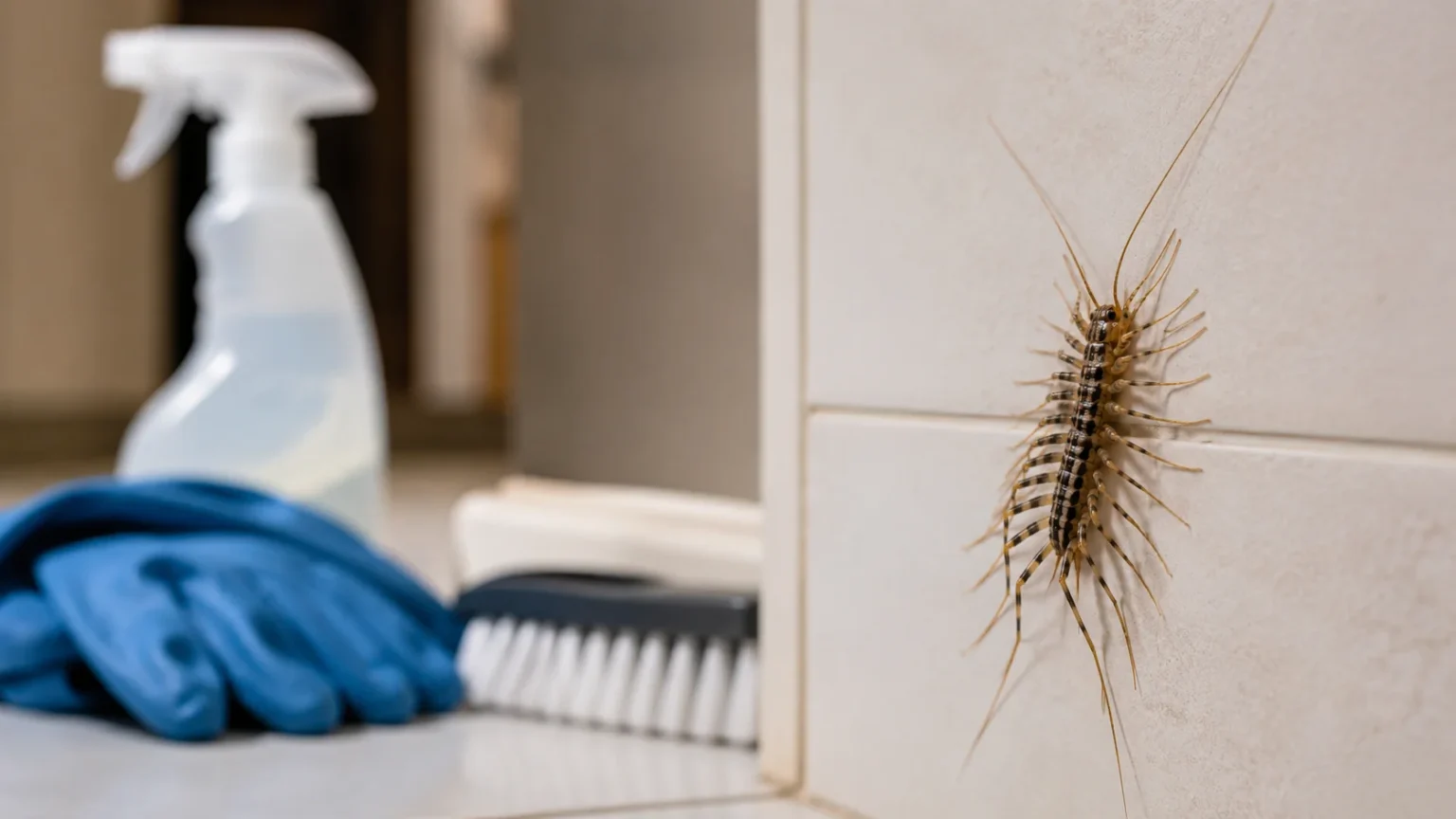
The house centipede is a fast-moving arthropod commonly found inside homes and other buildings. It belongs to the class Chilopoda rather than the insect class, even though people often casually call it an insect. Adult house centipedes have 15 pairs of legs, one pair on each body segment. Their elongated bodies are generally yellowish or brownish with darker stripes, while their very long legs usually have alternating light and dark markings.
An adult’s body is typically about one to one-and-a-half inches long, but the long legs and antennae can make the animal appear three to four inches across. The final pair of legs can be especially long, particularly in females. These exaggerated proportions contribute to the frightening appearance that causes many homeowners to assume house centipedes are highly venomous or aggressive. Their size can look much larger when they are running quickly across a wall or floor.
House centipedes are nocturnal predators. During the day, they usually remain hidden in dark cracks, basements, crawl spaces, bathrooms, utility rooms, closets, or other protected locations. At night, they come out to search for prey. Their many long legs allow them to move surprisingly fast, making them one of the quickest arthropods commonly encountered indoors. Speed helps them catch insects and escape potential threats, including humans.
Unlike many insects found indoors, house centipedes do not normally feed on stored food, clothing, paper, wood, or furniture. They eat living prey such as silverfish, cockroaches, moths, flies, crickets, spiders, and other small arthropods. Penn State Extension describes them primarily as nuisance organisms that can actually reduce populations of other pests. Their presence becomes more concerning when large numbers suggest another pest population is supplying them with abundant food.
House centipedes prefer environments that provide both moisture and prey. Basements, bathrooms, laundry rooms, crawl spaces, and areas around floor drains are common locations. They may enter through foundation cracks, gaps around plumbing, drains, windows, sump openings, or other small access points. Understanding these preferences is important because successful control usually involves making the building less attractive rather than depending exclusively on pesticides.
Are House Centipedes Dangerous?
House centipedes are generally not considered dangerous to people. University extension guidance consistently describes them as primarily nuisance organisms rather than significant household health threats. They naturally prefer to run away when disturbed rather than approach or attack humans. Their intimidating appearance therefore creates much more concern than their actual behavior typically justifies.
Like other centipedes, house centipedes possess modified front appendages called forcipules that contain venom. They use these structures to capture and subdue small prey rather than to hunt people. A centipede could potentially bite if trapped against the skin or deliberately handled, but successful bites from common house centipedes are uncommon. Their small mouthparts make penetrating human skin difficult compared with larger centipede species.
House centipedes are not known for spreading household diseases in the way cockroaches, mosquitoes, fleas, or ticks can. They also do not establish colonies inside food packages or contaminate stored foods through feeding. This makes their health significance relatively low. The primary problem for most homeowners is simply seeing a large, fast-moving arthropod unexpectedly, especially at night.
They are also unlikely to damage the structure of your home. House centipedes do not eat wood like termites, fabrics like clothes moth larvae, or stored grains like pantry pests. They may hide inside wall voids or cracks, but living there does not mean they are chewing through the building. Structural damage found near an area with centipedes usually has another cause.
Pets may occasionally chase or eat house centipedes, but the centipede usually tries to escape rather than fight. It is still sensible to discourage pets from playing with unfamiliar arthropods because bites or mouth irritation are possible. If a pet develops significant swelling, excessive drooling, vomiting, breathing trouble, or unusual behavior after interacting with any arthropod, veterinary advice is appropriate.
Do House Centipedes Bite Humans?
House centipedes are capable of biting, but bites are rare. They do not normally seek humans as prey and usually flee quickly when they detect movement. University of Kentucky Extension notes that house centipedes present only a minimal bite hazard because their forcipules often have difficulty piercing human skin. Most encounters end with the centipede disappearing into a crack before a person can even approach it.
A bite is most likely to occur when someone tries to grab, crush, or trap a centipede directly against the skin. For this reason, picking one up with bare hands is unnecessary. If you want to remove a centipede alive, trapping it beneath a container and sliding stiff paper underneath is safer. A vacuum can also remove unwanted individuals without requiring direct contact.
When a bite occurs, symptoms are usually localized. University of Minnesota Extension notes that swelling may occur but pain generally should not be severe with common household centipedes. Mild redness, tenderness, itching, or temporary swelling could also occur around the site. Larger tropical centipede species can produce more painful bites, so identifying the actual animal matters when discussing severity.
For a mild suspected bite, wash the area gently with soap and water and avoid scratching. A wrapped cold pack can help reduce temporary swelling and discomfort. Symptoms should gradually improve rather than become increasingly painful or inflamed. Anyone with worsening redness, pus, severe swelling, persistent pain, or signs of infection should seek medical advice.
Emergency care is appropriate if breathing difficulty, widespread hives, facial or throat swelling, fainting, or another severe allergic-type reaction develops after any bite or sting. Such reactions are unusual with house centipedes but should never be ignored. Children and people with significant allergy histories may also deserve more cautious evaluation when the exact biting animal is uncertain.
Why Are House Centipedes in Your Home?
Moisture is one of the biggest reasons house centipedes remain inside a building. They lose moisture easily and therefore favor damp environments such as basements, bathrooms, crawl spaces, laundry rooms, and areas around plumbing. A house with persistent condensation, leaking pipes, poor drainage, or high basement humidity can create an ideal environment. Reducing moisture is therefore one of the most effective long-term control strategies.
Food is equally important. House centipedes need other arthropods to survive, so a noticeable centipede population usually means prey is available. Silverfish, cockroaches, spiders, flies, carpet beetle larvae, moths, crickets, and other small organisms can all become food. Penn State Extension specifically advises homeowners to investigate underlying arthropod populations when centipedes become numerous.
Entry points provide the third part of the problem. Centipedes may enter through cracks in concrete foundations, gaps around pipes, spaces beneath doors, poorly screened vents, basement drains, sump-pump openings, and damaged window frames. They need only small openings to move between outside environments, wall voids, and living areas. Older buildings with numerous foundation gaps may therefore experience more frequent sightings.
Outdoor landscaping can also create favorable conditions close to the foundation. Thick mulch, leaf litter, compost, stones, decaying wood, and dense vegetation hold moisture and support many small arthropods. Centipedes living in these protected areas may eventually enter the home. University of Minnesota Extension recommends reducing moist organic material and allowing soil near foundations to dry more effectively.
Seasonal weather can influence sightings as well. Heavy rain may drive arthropods away from saturated outdoor habitats, while very dry conditions can encourage them to seek moisture indoors. Changes in temperature may also send prey insects and centipedes into protected structures. A sudden sighting therefore does not always indicate that a large population has been living inside your house for months.
Signs You May Have a House Centipede Problem
Seeing one centipede occasionally is the most obvious sign, but it does not necessarily indicate an infestation. House centipedes are solitary hunters rather than social insects that establish colonies like ants or termites. A single animal may simply have wandered indoors. The concern increases when centipedes appear repeatedly in multiple rooms or are seen frequently over several weeks.
Regular sightings at night can indicate that several individuals are hiding inside the building. House centipedes generally remain concealed during daylight and become active when the environment is dark and quiet. Turning on a basement or bathroom light and repeatedly seeing them run for shelter suggests the location provides appropriate moisture and food. This is a reason to investigate environmental conditions rather than simply spray the visible animal.
Sticky monitoring traps can help determine where activity is concentrated. Penn State Extension recommends insect monitors as a way to identify both centipedes and the other arthropods that may be feeding them. Place traps along walls, behind storage items, near basement corners, beneath sinks, or other places where activity has been observed. Keep traps inaccessible to pets and children according to product instructions.
Large numbers of silverfish, cockroaches, spiders, or other insects are another indirect clue. House centipedes will not remain in high numbers where food is scarce. Finding many predators and prey together suggests the building is providing a broader indoor ecosystem. Solving the prey infestation often reduces centipede numbers naturally because their food supply disappears.
Persistent dampness completes the pattern. Condensation on pipes, musty basement smells, visible leaks, damp cardboard, mold growth, or consistently high humidity can all indicate environmental conditions that favor centipedes and other pests. If centipedes are appearing frequently, moisture inspection should happen alongside pest inspection. Structural leaks and drainage problems may ultimately matter more than any insecticide.
Are House Centipedes Actually Beneficial?
House centipedes can be beneficial because they are natural predators of several household pests. Their diet may include silverfish, small cockroaches, flies, moths, crickets, spiders, and other arthropods. Penn State Extension notes that they feed on many pest insects and are generally of little concern to homeowners. In biological terms, the centipede you see may actually be hunting pests you would consider more troublesome.
Unlike cockroaches, house centipedes are not searching your cupboards for food scraps. Unlike termites, they do not consume structural wood. Unlike clothes moth larvae, they do not eat natural-fiber clothing. Their entire reason for hunting through your basement or bathroom is finding animal prey. This means they occupy a very different role from many organisms commonly called household pests.
Some homeowners therefore choose to tolerate an occasional house centipede. If sightings are rare and nobody in the household is particularly bothered, immediate chemical control may be unnecessary. University of Minnesota Extension recommends tolerating centipedes when possible and using pesticides only when nonchemical control measures are insufficient.
However, describing them as beneficial does not mean a home should contain dozens of them. A large population can signal excessive indoor humidity or a significant prey population. The centipedes may be helping reduce other pests, but their abundance tells you that environmental conditions require attention. Think of frequent sightings as an indicator rather than simply the entire problem.
People who dislike centipedes do not need to keep them indoors simply because they eat insects. Removing visible individuals and making the home less hospitable is completely reasonable. The goal is usually to reduce moisture and prey so neither centipedes nor the pests they consume thrive indoors. This produces a cleaner long-term solution than choosing one predator as your household pest-control system.
How to Get Rid of House Centipedes Indoors
Start by physically removing the individuals you can see. A vacuum is one of the easiest options because it requires no chemical treatment or direct handling. Empty the vacuum afterward according to the manufacturer’s recommendations. You can also trap a centipede beneath a container and release it outside if you prefer not to kill it. For occasional sightings, these methods may be all that is necessary.
Next, reduce humidity. Use a dehumidifier in damp basements or other persistently humid areas and repair leaking pipes, dripping fixtures, foundation seepage, or poor ventilation. Penn State Extension specifically identifies humidity reduction as a major management tactic. A drier environment also discourages silverfish, cockroaches, and other organisms that can serve as centipede prey.
Remove unnecessary hiding places. Cardboard boxes sitting directly on basement slabs can trap moisture and provide protected spaces for centipedes and their prey. Replace long-term cardboard storage with durable containers where practical, reduce piles of paper, and keep floor areas accessible for cleaning. Clutter reduction makes inspection easier and removes protected spaces that arthropods use during daylight.
Use sticky traps strategically rather than scattering them randomly. Place monitors along walls because many crawling arthropods travel along edges rather than crossing open rooms. Areas behind appliances, near plumbing, under basement shelving, and beside storage spaces can be productive locations. The catches can reveal whether another pest such as silverfish or cockroaches is supporting the centipede population.
Finally, address the prey. Cockroaches, flies, pantry pests, spiders, and other arthropods may require separate control methods. Food sanitation, trash management, cleaning, moisture reduction, and sealing entry points can reduce multiple species at once. When the centipede’s food disappears, the building becomes far less attractive, often making direct centipede treatment unnecessary.
How to Prevent House Centipedes From Coming Back
Seal exterior cracks and gaps that provide access into the home. Inspect foundation walls, door frames, utility penetrations, window edges, siding transitions, and openings around pipes or cables. Use appropriate caulk or other building materials for small gaps and repair larger structural openings properly. University of Minnesota Extension recommends sealing cracks around doors, windows, and exterior walls as part of centipede prevention.
Basement drains and sump areas deserve particular attention. Penn State notes that house centipedes can enter through sump openings, dry drains, concrete cracks, and gaps around plumbing. Screening appropriate openings and ensuring drain traps function properly can reduce entry without interfering with drainage or ventilation. If you are unsure how to modify plumbing or sump equipment safely, use a qualified professional.
Manage outdoor moisture near the foundation. Keep gutters functioning, direct downspouts away from the building, and correct grading that allows rainwater to collect against basement walls. Avoid excessive irrigation immediately beside the foundation. When the soil remains constantly wet, it supports many arthropods that may eventually migrate indoors.
Reduce leaf litter, thick mulch, wood debris, and dense vegetation touching the house. University of Minnesota Extension recommends trimming foundation plantings so soil dries more quickly and removing decaying organic material near the structure. You do not need to create a completely bare landscape, but minimizing persistently damp hiding places immediately against the building can help.
Continue monitoring after sightings decline. A few sticky traps placed in previous problem areas can reveal whether centipedes or prey insects are returning. Preventive pest management works best when small environmental problems are corrected before large populations develop. Maintaining dryness, sanitation, and sealed entry points provides more lasting protection than repeatedly spraying insects after they appear.
Natural and Nonchemical Ways to Remove House Centipedes
Vacuuming is one of the simplest nonchemical approaches. It instantly removes visible centipedes and can also collect spiders, insect debris, egg cases from other pests, and dust from hiding areas. Regular vacuuming along basement edges, closets, storage rooms, and behind accessible furniture reduces both prey and shelter. For a small number of centipedes, this may be more practical than any pesticide.
Sticky traps are another useful tool. They do not eliminate the environmental cause of centipedes, but they can capture wandering individuals and show where activity is concentrated. University of Minnesota and Penn State Extension both recommend monitoring traps as part of centipede management. The insects caught alongside centipedes can also reveal what food source needs to be controlled.
Lowering humidity is arguably the most important “natural” control. Dehumidifiers, exhaust fans, leak repair, drainage improvements, and better airflow make basements and bathrooms less suitable for moisture-dependent arthropods. Aim to fix the source of persistent dampness rather than masking musty odors with fragrance products. Moisture control can simultaneously reduce mold risk and populations of several household pests.
Physical exclusion provides another pesticide-free solution. Door sweeps, intact window screens, caulked gaps, repaired mortar, and properly sealed pipe penetrations prevent pests from entering rather than killing them afterward. Exclusion is particularly effective when outdoor centipedes repeatedly wander inside. It can also reduce ants, spiders, cockroaches, and other organisms that use the same entry points.
Be cautious with internet remedies involving essential oils, strong household chemicals, bleach, or homemade pesticide mixtures. A substance smelling unpleasant to an arthropod does not mean it provides reliable long-term control, and mixing household chemicals can create dangerous fumes or surface damage. Proven environmental management is safer and generally more effective than improvised “natural pesticide” recipes.
Should You Kill a House Centipede?
You do not have to kill every house centipede you encounter. An occasional individual is unlikely to damage your property or harm anyone, and it may be hunting other pests. If you are comfortable doing so, trapping it and releasing it outdoors is a reasonable option. The decision is largely about personal comfort rather than an urgent safety requirement.
Killing one centipede also does not solve the conditions that attracted it. If moisture, cracks, and abundant prey remain, another individual may appear later. This is why repeated smashing or spraying can become frustrating. Effective control focuses on changing the indoor environment so centipedes have fewer reasons to stay.
If centipedes cause significant fear, removing visible individuals is understandable. Vacuuming provides a fast method without leaving pesticide residue on floors or walls. Sticky traps can remove additional animals that appear at night. These methods work particularly well when combined with moisture reduction and prey control.
A very large number of centipedes should encourage investigation rather than simply more killing. Numerous predators usually indicate that enough insects or spiders exist to support them. Look for cockroach droppings, silverfish, flies, stored-product pests, or other arthropods. Professional pest inspection may be useful when the underlying prey species is difficult to identify.
The goal of household pest management should generally be reducing unwanted organisms to an acceptable level with the least unnecessary risk. Because house centipedes are low-risk predators, aggressive chemical treatment is often disproportionate to the problem. Environmental correction usually provides a more durable solution and can improve the building beyond simply removing centipedes.
When Are Pesticides Necessary?
Pesticides are usually not the first choice for a few house centipedes. University of Minnesota Extension recommends starting with moisture control, exclusion, clutter reduction, trapping, and control of prey populations. Chemical treatment may become appropriate when centipedes remain numerous despite these measures. Even then, treating environmental causes remains necessary because pesticides alone may provide only temporary relief.
If you use a pesticide, choose a product specifically labeled for centipedes and for the location where you intend to apply it. Follow every label instruction regarding application sites, protective equipment, ventilation, pets, children, food surfaces, and re-entry. Never assume that applying extra product improves effectiveness. The pesticide label is the controlling safety instruction for the particular formulation.
Crack-and-crevice treatment is generally more sensible than indiscriminately spraying entire living surfaces. Centipedes hide along baseboards, foundation gaps, utility penetrations, wall voids, and other protected areas. Penn State Extension notes that labeled dust or spray products may be applied to suspected harborages when necessary. Treatment works best after humidity and food sources have already been reduced.
Avoid using outdoor pesticides indoors unless the label specifically permits that use. Similarly, products labeled for certain structural areas should not be applied to mattresses, clothing, countertops, toys, or other surfaces unless those uses are explicitly allowed. Never mix pesticide concentrates with household cleaners or transfer pesticides into unlabeled food or beverage containers. Safe handling matters more than trying to create a stronger treatment.
A licensed pest-control professional is often the better option for persistent infestations, complicated buildings, or households where pesticide exposure is a particular concern. Professionals can identify prey species, moisture issues, entry routes, and appropriate treatment sites. Ask whether the company uses integrated pest management rather than relying entirely on routine spraying. Addressing the reason centipedes are present usually delivers the best long-term result.
House Centipede vs. Millipede: How to Tell the Difference
House centipedes and millipedes are frequently confused because both have elongated bodies and many legs. Centipedes generally have one pair of legs per body segment, while millipedes usually have two pairs on many body segments. House centipedes also have exceptionally long, slender legs extending well away from the body. Their appearance is therefore much more “feathery” than the compact shape of common millipedes.
Movement is another easy clue. House centipedes are predators and can move extremely quickly when disturbed. Millipedes usually travel slowly and may curl into a tight spiral when threatened. If an animal races rapidly across a basement wall with long legs extending sideways, it is much more likely to be a house centipede than a millipede.
Their diets also differ. House centipedes hunt living insects and other arthropods. Millipedes generally feed on decaying plant material and are important decomposers outdoors. University of Minnesota Extension notes that both are associated with moist environments, but they play very different ecological roles.
Their defenses differ as well. Centipedes use venomous forcipules to capture prey and can potentially bite when handled. Millipedes do not bite in the same way but may release defensive chemicals when disturbed, and those secretions can irritate human skin or eyes. Neither common household group generally represents a major threat when simply left alone.
Control strategies overlap because both favor moisture. Drying damp areas, repairing leaks, removing decaying organic matter, and sealing entry points can reduce sightings of either organism. Correct identification still matters because repeated house-centipede activity may indicate a prey-insect problem, whereas recurring millipedes often point more directly toward moist outdoor organic material and migration into the structure.
When to Call a Pest Control Professional
Professional help may be worthwhile when house centipedes appear every day despite repeated cleaning and moisture control. Frequent sightings suggest that conditions somewhere in the building continue to support them. A pest professional can inspect basements, crawl spaces, wall voids, plumbing areas, and exterior entry points that homeowners may overlook. They can also identify whether another pest population is driving the problem.
Call for help when cockroaches or another significant prey pest appears alongside the centipedes. Removing the centipede without treating the prey leaves the underlying infestation untouched. A trained technician can use monitoring, identification, sanitation recommendations, exclusion, and targeted treatments to address both levels of the problem. This is more effective than repeatedly spraying every arthropod independently.
Water problems may require a different type of professional. Persistent basement moisture, leaking foundations, plumbing failures, or drainage problems can continue producing pest issues no matter how much pesticide is applied. A plumber, drainage contractor, waterproofing specialist, or building professional may therefore be as important as an exterminator. Pest activity sometimes provides an early clue that the structure has an environmental problem.
Professional intervention is also useful when someone in the home has severe insect anxiety and repeated sightings are interfering with sleep or daily life. A thorough inspection can determine whether there is actually a large population and create a practical prevention plan. Knowing where the animals are coming from often reduces uncertainty more effectively than random DIY treatments.
Choose a pest company willing to explain its approach. Ask what species they found, what prey is present, which moisture or structural issues contribute, and whether chemical treatment is truly necessary. Integrated pest management combines inspection, prevention, sanitation, exclusion, monitoring, and targeted pesticides only when needed. That approach is well suited to house centipedes because environmental conditions are central to the problem.
Conclusion
House centipedes look intimidating, but common indoor species are generally far less dangerous than their appearance suggests. They are fast-moving predators that hunt other arthropods rather than feeding on people, food, clothing, or building materials. Bites are possible but uncommon, and common house centipedes usually have difficulty piercing human skin. Their primary impact in most homes is psychological discomfort rather than physical danger.
An occasional house centipede does not necessarily indicate an infestation. These predators can wander indoors through drains, foundation cracks, gaps around plumbing, windows, and other openings. Frequent sightings are more meaningful because they suggest abundant prey, excessive moisture, or both. Instead of focusing only on the centipedes, determine what conditions allow them to remain inside.
Moisture reduction is one of the most effective control measures. Repair leaks, improve ventilation, use dehumidifiers where necessary, and correct exterior drainage problems. Remove damp cardboard and excess clutter from basements and storage areas. These changes make the building less favorable for house centipedes and many of the insects they eat.
Physical removal, sticky traps, exclusion, and prey control should generally come before pesticides. Seal foundation cracks, improve door and window barriers, screen appropriate openings, and remove moist organic debris near the foundation. If chemical control becomes necessary, use only products labeled for the intended pest and location and follow every label instruction. A professional can help when environmental control alone does not solve the problem.
Ultimately, house centipedes are better understood as an indicator of household conditions than as a major threat themselves. Their presence tells you that moisture, shelter, entry points, or prey may be available. Correct those conditions and centipede numbers usually decline naturally. A dry, sealed, well-maintained home with few prey insects is the most effective long-term defense.
FAQs About House Centipedes
Are house centipedes dangerous?
House centipedes are generally considered harmless nuisance arthropods rather than dangerous household pests. They normally flee from people and do not damage food, clothing, furniture, or building materials.
Can house centipedes bite you?
Yes, they are physically capable of biting, but bites are rare. Common house centipedes have relatively small forcipules and often cannot easily pierce human skin.
What happens if a house centipede bites you?
A successful bite may cause localized pain, redness, or swelling. Wash the area and monitor it, and seek medical care for severe symptoms, worsening inflammation, breathing problems, or a significant allergic reaction.
Are house centipedes poisonous?
House centipedes use venom to subdue small prey, but they are not considered a serious poisoning threat to people under normal household conditions. They generally use their venom for hunting insects rather than attacking humans.
Why do I suddenly have house centipedes?
They may be attracted by high humidity, leaking water, hiding places, entry gaps, and abundant prey insects. Seasonal weather changes can also cause centipedes to move indoors.
Do house centipedes mean my house is dirty?
Not necessarily. They are more strongly associated with moisture, shelter, entry points, and available prey than ordinary cleanliness alone.
Why are house centipedes usually found in bathrooms?
Bathrooms provide moisture, dark hiding spaces, plumbing gaps, and sometimes insects for them to eat. Reducing persistent humidity and sealing openings can make the area less attractive.
Why are house centipedes in my basement?
Basements are often cool, dark, and humid, which creates ideal conditions for house centipedes and their prey. Dehumidification, leak repair, clutter reduction, and foundation sealing can reduce activity.
What do house centipedes eat?
They prey on spiders, silverfish, cockroaches, flies, moths, crickets, and various other small arthropods. Their diet is one reason extension experts consider occasional individuals potentially beneficial.
Should I kill house centipedes?
You do not need to kill an occasional house centipede because it generally poses little danger and may eat other pests. If you do not want it indoors, vacuum it or capture and release it outside.
Does seeing one house centipede mean there are more?
Not necessarily. One individual may have wandered inside, although repeated sightings can indicate suitable humidity and a population of prey insects.
Are house centipedes a sign of cockroaches?
Not always, but cockroaches are one possible prey species. Numerous centipedes should encourage inspection for roaches, silverfish, spiders, and other arthropods.
How do I get rid of house centipedes naturally?
Reduce humidity, repair leaks, vacuum visible centipedes, use sticky monitors, reduce clutter, seal cracks, and eliminate prey insects. These nonchemical methods address the conditions that allow centipedes to survive.
What smell keeps house centipedes away?
There is no scent-based home remedy as reliable as moisture control, exclusion, and prey reduction. Essential-oil remedies are often promoted online, but their long-term effectiveness is much less dependable.
Do house centipedes crawl on beds?
They can theoretically wander across almost any accessible surface, but beds are not their preferred habitat. They generally stay near damp, protected locations where insects and other prey are available.
Can house centipedes climb walls?
Yes. Their long legs allow them to move quickly across floors, walls, and other surfaces, which is why they are often noticed racing along basement or bathroom walls.
Do house centipedes come through drains?
They may appear around drains and can use certain drain or sump openings as access routes. Penn State Extension recommends addressing dry floor drains and sump openings where appropriate.
How do I keep house centipedes out permanently?
Seal entry points, maintain low indoor humidity, remove outdoor debris near the foundation, control other insects, and repair leaks or drainage problems. Long-term prevention depends on removing food, moisture, and shelter.
Are house centipedes harmful to pets?
They normally try to escape pets rather than attack them. Still, discourage pets from eating or playing with arthropods and seek veterinary advice if significant swelling, drooling, vomiting, or breathing difficulty occurs afterward.
When should I call pest control for house centipedes?
Consider professional help when sightings are frequent, prey insects are abundant, moisture problems are difficult to identify, or nonchemical control does not reduce activity. A professional inspection can uncover the underlying reason they are thriving indoors.