
What Does ACK Mean? Acknowledgment in Networking
If you have ever looked at a packet capture, studied TCP, or worked with network troubleshooting tools, you may have seen the abbreviation ACK appear repeatedly. In networking, ACK generally means acknowledgment, a message or flag used to confirm that data has been received successfully. It plays an essential role in reliable communication because sending information across a network does not automatically guarantee that it reaches the destination correctly. Packets can be delayed, lost, duplicated, or arrive out of order. Acknowledgments help devices determine what has arrived and what may need to be transmitted again. Understanding ACK is therefore fundamental to understanding how reliable network protocols such as TCP work.
The concept sounds technical, but the basic idea is similar to everyday communication. Imagine sending someone an important message and receiving a reply saying, “Got it.” That reply serves as an acknowledgment that your message arrived. Network devices perform a similar process automatically, but they use sequence numbers, acknowledgment numbers, timers, and protocol rules rather than conversational language. ACK packets and ACK flags allow computers to coordinate data transfer efficiently while minimizing unnecessary retransmissions. Once you understand this mechanism, concepts such as TCP handshakes, packet loss, retransmission, flow control, and network troubleshooting become much easier to understand.
What Does ACK Mean in Networking?
ACK stands for acknowledgment and indicates that a receiving device has successfully received data or another expected network message. It is commonly associated with the Transmission Control Protocol, better known as TCP, which provides reliable communication between devices. When one computer sends TCP data, the receiving computer normally sends acknowledgment information back to confirm how much data has arrived. This feedback lets the sender know that communication is progressing correctly. Without acknowledgments, the sender would have difficulty determining whether packets reached their destination. ACK therefore contributes directly to TCP reliability, error recovery, and orderly data delivery.
An ACK is not usually a separate piece of application data such as an email, web page, or file. Instead, acknowledgment information is carried inside protocol headers that networking devices use to coordinate communication. In TCP, an ACK flag in the header indicates that the acknowledgment number field contains valid information. That acknowledgment number helps the sender understand which bytes have already been received successfully. TCP can therefore continue transmitting new data while keeping track of information that has not yet been acknowledged. This process happens rapidly and automatically, often thousands of times during a network session. Users typically never notice the acknowledgments unless they inspect traffic with a packet analysis tool.
ACK is especially important because networks are not perfect communication environments. Routers can become congested, wireless signals can weaken, packets can be dropped, and paths between devices can change. A reliable protocol must therefore have a method for detecting when expected data appears to be missing. TCP uses acknowledgment information combined with timers and sequence numbers to identify potential packet loss. If required data is not acknowledged within the expected conditions, the sender may retransmit it. This recovery mechanism helps applications receive a complete stream of data even when individual packets experience problems during transmission.
The meaning of ACK can vary slightly depending on the protocol or technical context. In TCP, it is strongly associated with acknowledgment numbers and reliable byte-stream communication. Other networking, messaging, storage, or hardware systems may also use acknowledgment messages to confirm that a command, packet, frame, or transaction has been accepted. The underlying concept remains largely the same: one side sends something, and the other side confirms receipt or processing. However, the exact rules surrounding acknowledgment timing and behavior depend on the protocol being used. Networking professionals therefore interpret ACK within the specific communication system they are analyzing.
It is also useful to understand that an acknowledgment does not always mean an entire task has been completed. A TCP ACK may confirm that network data reached the receiving TCP stack, but that does not necessarily mean an application fully processed the information. For example, a server may acknowledge receiving bytes before an application finishes saving or responding to the associated request. This distinction becomes important during troubleshooting because network delivery and application processing are separate stages. Seeing ACK packets can confirm that communication is happening at the transport layer. It does not automatically prove that every higher-level application function is working correctly.
How Does ACK Work in TCP?
TCP creates a reliable connection between two endpoints and keeps track of the data being exchanged. Instead of treating every packet as an isolated message, TCP presents applications with an ordered stream of bytes. Each portion of this byte stream is associated with sequence information so the receiver can determine where data belongs. When data arrives correctly, the receiver returns an acknowledgment indicating the next byte it expects to receive. The sender uses this information to determine which transmitted bytes have been successfully acknowledged. This interaction continues throughout the TCP connection, allowing both devices to maintain an organized view of the communication.
Consider a simplified example where a sender begins transmitting data with sequence number 1000 and sends 500 bytes. If the receiver obtains all 500 bytes correctly, it may respond with acknowledgment number 1500. The important idea is that the acknowledgment number usually indicates the next expected byte, rather than simply repeating the number of the packet that arrived. The sender can therefore infer that the bytes preceding 1500 have been received. This cumulative acknowledgment system reduces the amount of acknowledgment information that needs to be exchanged. It also allows TCP to manage large data transfers efficiently while keeping track of missing information.
TCP does not necessarily send one acknowledgment for every individual packet immediately. Depending on the implementation and network conditions, a receiver may use mechanisms such as delayed acknowledgments to reduce unnecessary overhead. This allows an ACK to potentially cover more than one segment of received data. The objective is to maintain reliable communication without generating excessive acknowledgment traffic. Modern TCP implementations also use sophisticated algorithms to balance throughput, latency, congestion control, and reliability. Although these mechanisms are more advanced, the underlying principle remains straightforward. The receiver continually provides enough feedback for the sender to know which portions of the byte stream have arrived.
Acknowledgment information can often be carried together with outgoing data rather than always requiring a separate packet. This process is sometimes described as piggybacking the acknowledgment onto data traveling in the opposite direction. For example, when a client and server are both exchanging information, a TCP segment can contain application data while also carrying an acknowledgment number. Combining these functions reduces unnecessary network traffic and makes communication more efficient. Packet captures therefore frequently show ACK flags on packets that also contain useful data. An ACK flag does not automatically mean that a packet contains nothing except an acknowledgment.
The ACK process operates together with several other TCP mechanisms rather than functioning independently. Sequence numbers identify positions in the data stream, while acknowledgment numbers communicate what has arrived. Retransmission mechanisms help recover missing data, and receive windows help prevent a sender from overwhelming the receiver. Congestion-control algorithms adjust transmission behavior when the network appears overloaded. Together, these features allow TCP to offer reliable and ordered communication over an underlying IP network that does not guarantee delivery by itself. ACK is therefore one important part of a broader reliability system rather than a standalone networking feature.
ACK and the TCP Three-Way Handshake
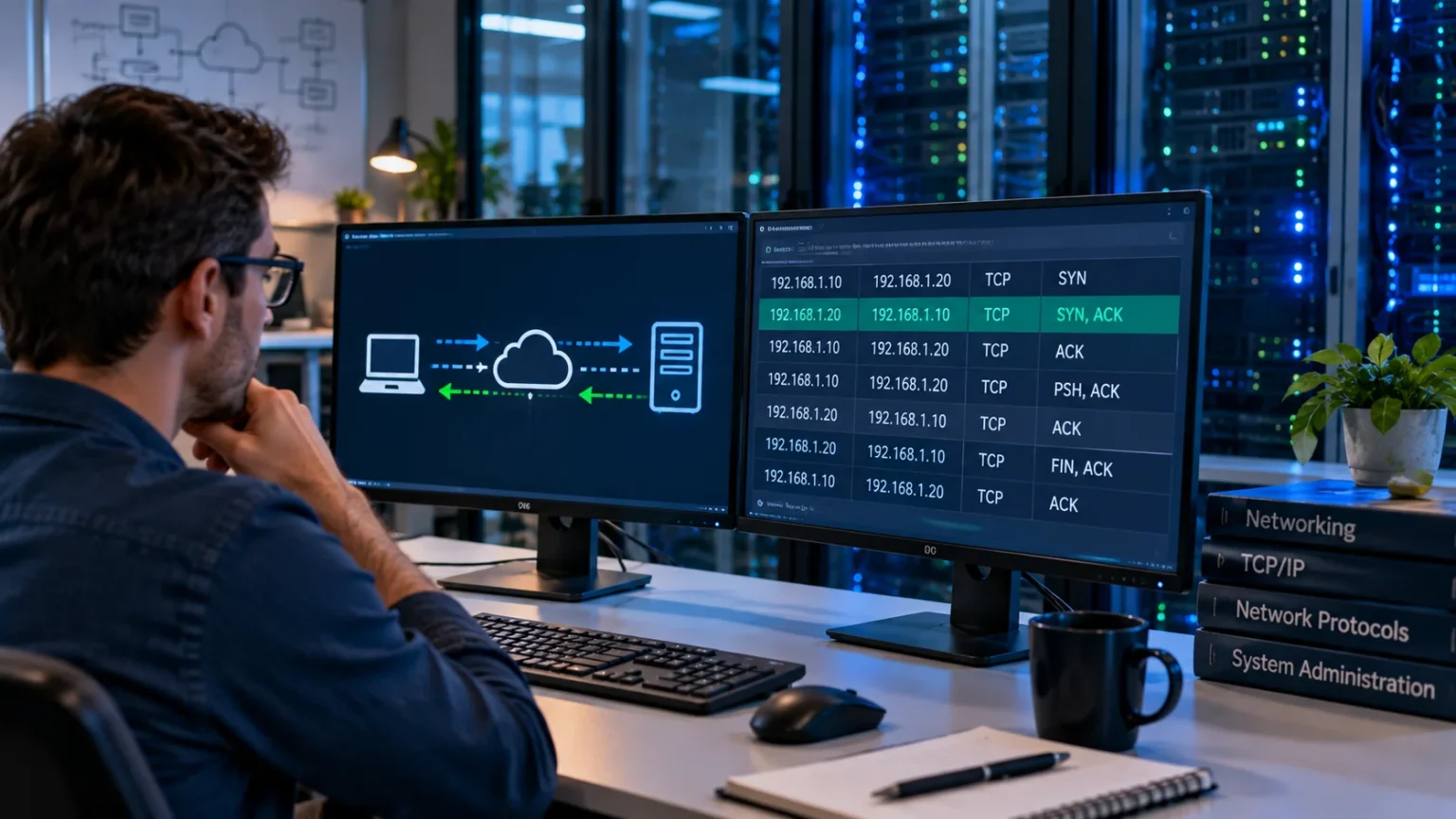
ACK plays an important role before normal TCP application data is even exchanged. TCP typically establishes a connection through a process known as the three-way handshake. The handshake allows two endpoints to confirm that they can communicate and synchronize important connection information. It commonly involves packets identified by the SYN and ACK flags. The three basic steps are usually described as SYN, SYN-ACK, and ACK. Once this exchange completes successfully, the TCP connection is established and application data can begin flowing between the client and server.
The first step occurs when the initiating device sends a TCP segment with the SYN flag set. SYN means synchronize, and the packet communicates information needed to begin establishing the connection. It includes an initial sequence number that will be used to track data within the TCP session. At this point, the initiating device is essentially asking whether the destination is available and willing to establish a TCP connection on the requested port. The destination must respond appropriately before the session can proceed. If no response arrives, the initiator may retry before eventually deciding that the connection attempt has failed.
In the second step, the destination normally responds with a SYN-ACK when it accepts the connection request. This packet performs two jobs at the same time. The SYN portion communicates the destination’s own initial sequence information, while the ACK portion acknowledges the initiating side’s synchronization request. The client now knows that the server received its original SYN and is prepared to establish communication. At the same time, the client receives the sequence information necessary to acknowledge the server’s side of the connection. This exchange demonstrates how ACK can be combined with another TCP control flag in the same packet.
The final step occurs when the initiating device returns an ACK to the destination. This acknowledgment confirms receipt of the server’s SYN information and completes the basic three-way handshake. Both sides now have the sequence information required to exchange TCP data reliably. From the application’s perspective, a usable connection can then be established and normal communication can proceed. This handshake process happens extremely quickly on healthy networks and often completes before users notice any delay. However, network engineers frequently examine handshake packets when diagnosing connection failures, firewall problems, latency, or unreachable services.
Understanding the handshake can make packet captures much easier to interpret. Repeated SYN packets without a SYN-ACK may suggest that requests are being dropped, the destination is unreachable, or a firewall is blocking traffic. A SYN followed by a reset can indicate that the host is reachable but the requested service may not be accepting connections. A completed SYN, SYN-ACK, and ACK sequence shows that basic TCP connection establishment succeeded. Problems may still occur afterward at the application layer, but the handshake helps narrow down where troubleshooting should begin. ACK therefore provides useful diagnostic information in addition to supporting reliable communication.
Sequence Numbers, ACK Numbers, and TCP Windows
Sequence numbers are central to understanding what an ACK actually confirms. TCP treats application data as an ordered byte stream and assigns sequence positions to that stream. When segments travel across a network, they may experience different delays or take different paths. Sequence numbers allow the receiver to reconstruct data in the correct order even if segments do not arrive exactly as transmitted. They also help both endpoints identify missing or duplicate data. An acknowledgment number then communicates which portion of the sequence has been received and what sequence position the receiver expects next.
Suppose a receiver expects byte number 5000 and successfully receives data covering bytes 5000 through 5999. It can then send an acknowledgment indicating that byte 6000 is expected next. From the sender’s perspective, this tells it that the earlier byte range arrived successfully. If another segment arrives containing later data while an earlier portion is missing, acknowledgment behavior can help reveal the gap. The exact packet-level behavior depends on TCP features and implementation details. Still, the general relationship between sequence numbers and acknowledgment numbers makes reliable ordered delivery possible. Without this numbering system, recovering from packet loss would be considerably more difficult.
TCP also uses a receive window to support flow control. A receiving device has limited memory and processing capacity, so the sender should not transmit unlimited amounts of unacknowledged information. The receiver advertises how much additional data it is currently prepared to accept. The sender uses this advertised window when determining how much data can remain in transit before further acknowledgment is required. This mechanism helps prevent a fast sender from overwhelming a slower receiver. ACK packets often contain updated window information, making acknowledgment traffic important for both reliability and flow control.
Flow control should not be confused with congestion control, although both influence transmission speed. Flow control protects the receiving endpoint from receiving data faster than it can handle. Congestion control attempts to prevent excessive traffic from overwhelming the network path itself. TCP uses acknowledgment patterns as one source of information when adjusting congestion behavior. Successful ACKs generally indicate continuing progress, while packet loss or unusual acknowledgment patterns may cause the sender to reduce its transmission rate. These mechanisms have evolved significantly over time, but acknowledgments remain fundamental signals in TCP performance management.
Packet analysis tools often display sequence numbers, acknowledgment numbers, TCP window sizes, and flags together because these fields are closely related. Looking at only the ACK flag provides limited information when diagnosing a complex performance issue. A network professional may also examine timing, duplicate acknowledgments, retransmissions, round-trip time, window scaling, and application behavior. Together, these details can reveal whether a slowdown is caused by packet loss, receiver limitations, congestion, or application delays. Learning how ACK numbers relate to sequence numbers is therefore an important step toward understanding deeper TCP troubleshooting. It turns what initially looks like random packet information into a logical conversation between two endpoints.
ACK, Packet Loss, and TCP Retransmissions
One of the most important reasons TCP uses acknowledgments is to detect and recover from data that does not arrive as expected. IP networks can drop packets for many reasons, including congestion, unstable wireless links, faulty equipment, overloaded interfaces, or routing problems. TCP cannot simply assume that every transmitted segment reached the destination. Instead, it tracks outstanding data and watches the acknowledgment information returned by the receiver. If expected acknowledgment progress does not occur, the sender may conclude that certain data needs to be retransmitted. This automatic recovery process is one reason applications can often continue working even when occasional packet loss occurs.
TCP uses retransmission timers to help determine when data may have been lost. After transmitting information, the sender expects acknowledgment progress within a period influenced by observed network timing. If acknowledgment does not arrive appropriately, a retransmission timeout can occur and the sender may send the missing data again. TCP dynamically adapts timing because a connection across a nearby local network behaves differently from one traveling across a high-latency global path. Setting retransmission timing too aggressively would create unnecessary duplicate traffic. Waiting too long, however, would make applications feel unresponsive whenever genuine packet loss occurs.
Duplicate acknowledgments can provide another clue that data is missing. Imagine that several segments are transmitted in order but one segment disappears along the path. Later segments may still reach the receiver, but the receiver continues indicating that it expects data beginning at the missing sequence position. The sender may therefore receive repeated acknowledgment information pointing toward the same gap. TCP implementations can use this behavior to trigger a fast retransmission before waiting for a full timeout. Recovering missing data more quickly can significantly improve performance, particularly on connections where waiting for a timeout would introduce noticeable delay.
Retransmissions are normal in small amounts and do not automatically indicate that a network is severely broken. Real networks occasionally lose packets, especially across wireless, mobile, or busy internet connections. Problems become more noticeable when retransmissions happen frequently enough to reduce throughput, increase latency, or interrupt applications. Users may experience slow downloads, buffering, delayed web pages, unstable remote sessions, or poor application responsiveness. Network professionals often examine retransmission percentages together with latency and packet-loss measurements. ACK patterns can help them determine whether the communication problem is occurring between endpoints rather than simply assuming the server or application is slow.
A common troubleshooting mistake is treating every retransmission warning in a packet analyzer as proof of packet loss. Capture conditions can sometimes make traffic appear incomplete even when the actual network delivered packets correctly. For example, a capture device might miss packets because of high traffic volume, hardware limitations, offloading features, or where the capture was performed. Accurate diagnosis therefore requires context. Engineers compare both sides of a connection when possible, inspect timing, review interface statistics, and consider the application symptoms. ACK behavior provides powerful evidence, but it should be interpreted alongside the rest of the network conversation.
ACK vs NACK and Other Networking Signals
ACK is commonly contrasted with NACK, which generally means negative acknowledgment. An ACK communicates successful receipt or acceptance, while a NACK indicates that something was not received correctly or that a request could not be accepted as expected. However, not every networking protocol uses explicit NACK messages. TCP, for example, primarily relies on acknowledgment numbers, retransmission behavior, and related mechanisms rather than using a simple universal NACK flag in its standard header. Other communication systems may use negative acknowledgments more directly. The exact meaning of ACK and NACK therefore depends on the protocol or technology being discussed.
TCP’s acknowledgment behavior is particularly efficient because ACK numbers can cumulatively represent successfully received portions of the byte stream. Rather than responding with a separate positive confirmation for every tiny piece of information, a receiver can indicate how far continuous reception has progressed. If a gap appears, repeated acknowledgment information can help the sender recognize the missing data. More advanced TCP features can provide additional information about received segments beyond the basic cumulative acknowledgment. These capabilities improve recovery efficiency on networks where multiple segments might be lost. The overall goal remains to minimize unnecessary retransmission while preserving reliable delivery.
ACK should also be distinguished from the SYN flag used when beginning a TCP connection. SYN helps synchronize sequence information during connection establishment, while ACK confirms received sequence information. As explained in the three-way handshake, the two flags can appear together in a SYN-ACK packet. Another TCP flag, FIN, is commonly associated with orderly connection termination. RST, or reset, can be used to abruptly reject or terminate a connection under certain circumstances. Understanding these flags together makes it easier to interpret the lifecycle of a TCP session from connection establishment through data transfer and eventual termination.
The phrase acknowledgment also appears outside traditional TCP networking. Messaging systems may require consumers to acknowledge that messages have been successfully processed before those messages are removed from a queue. Wireless communication standards use acknowledgment mechanisms to improve reliability over radio connections. Storage systems, industrial protocols, APIs, and distributed applications can also implement confirmation mechanisms that resemble networking ACKs. Despite differences in implementation, they solve a similar problem: the sender needs evidence that the receiving side successfully handled some unit of communication. Learning the basic ACK concept therefore provides knowledge that transfers to many other areas of computing.
It is important not to assume that an ACK always means the same level of success in every system. One protocol might use acknowledgment to mean that data reached a device, while another may mean that a command was accepted or fully processed. Applications can also implement their own acknowledgments on top of TCP. For example, TCP may confirm that bytes reached a server while an application response later confirms that a transaction was actually completed. This layered design explains why troubleshooting requires understanding which component produced the acknowledgment. Network-layer success, transport-layer success, and application-level success can represent different stages of the same digital transaction.
Why ACK Matters for Network Performance and Troubleshooting
ACK packets provide valuable clues when diagnosing slow or unreliable connections. A healthy TCP session normally shows consistent progress in sequence and acknowledgment numbers as data moves between endpoints. Large delays between transmission and acknowledgment can indicate network latency, congestion, packet loss, receiver limitations, or other performance issues. Packet analyzers allow administrators to inspect these patterns and measure how quickly communication progresses. This information helps distinguish network problems from application problems. Rather than simply concluding that “the internet is slow,” engineers can examine the actual TCP conversation and identify where delays begin appearing.
Round-trip time is closely connected to acknowledgment behavior. The sender can observe how long it takes for transmitted data to result in expected acknowledgment progress. Longer round-trip times naturally affect how quickly some interactions can occur, particularly when applications require many sequential request-and-response exchanges. A connection between devices in the same building may have very low latency, while communication between continents can take considerably longer even when the network is working correctly. TCP algorithms account for changing network timing when managing retransmissions and congestion. ACK information therefore contributes to both reliability and performance adaptation during an active connection.
ACK behavior can also expose receiver-side limitations. If a receiving device advertises a very small TCP window or temporarily indicates that it cannot accept additional data, the sender may need to slow or stop transmission. This does not necessarily mean that the physical network is congested. The receiving system may be overloaded, have limited buffer space, or be processing incoming data too slowly. Packet analysis can help distinguish this type of flow-control limitation from network packet loss. Administrators can then investigate the correct component instead of unnecessarily replacing network hardware or increasing bandwidth.
Security devices can also influence ACK behavior. Firewalls, load balancers, intrusion prevention systems, network address translation devices, and proxies may all sit between communicating endpoints. Incorrect rules or overloaded devices can drop or delay packets, creating incomplete handshakes and retransmissions. When troubleshooting, engineers may compare captures taken on different sides of these systems to identify where communication stops. A SYN leaving one interface but never reaching the destination points toward a different problem than a completed handshake followed by an application timeout. ACK packets help establish exactly how far a TCP conversation progressed before failure.
For beginners, the most useful troubleshooting approach is to avoid interpreting ACK in isolation. Start by identifying the client and server, the relevant TCP ports, and whether the three-way handshake completed successfully. Then examine sequence and acknowledgment progress, retransmissions, resets, window behavior, and timing between packets. Finally, compare the network evidence with what the application actually experienced. This structured approach prevents premature conclusions and makes packet captures easier to understand. Once ACK is viewed as part of an ongoing conversation rather than a mysterious abbreviation, TCP troubleshooting becomes much more logical and approachable.
Practical ACK Examples You May See in Networking
A web browsing session provides a straightforward example of ACK in everyday networking. When you open a website that uses a TCP-based connection, your device first establishes communication with the remote server. TCP acknowledgments then help confirm that pieces of transmitted data are reaching their destinations. The browser and server may exchange many segments while loading HTML, application resources, or other information. Users simply see the page loading, while TCP handles much of the underlying reliability automatically. This process illustrates how acknowledgment mechanisms support common internet activities without requiring users to understand or manage individual packets.
File transfers provide another clear example because large amounts of data must arrive correctly. Imagine downloading a large document or software package from a remote server. TCP divides the byte stream into manageable segments for transmission across the network. The receiving computer acknowledges progress, allowing the sending server to continue transmitting while keeping track of outstanding information. If a segment disappears during transit, TCP can retransmit the necessary data rather than restarting the entire download. This reliability is especially valuable when transferring large files over long-distance or occasionally unstable network paths.
Remote access applications also depend heavily on reliable network communication. During an SSH or similar TCP-based session, commands and responses travel between the user’s device and the remote system. Excessive latency, packet loss, or retransmissions can make typing feel delayed even when the connection technically remains active. Examining ACK timing may reveal whether network conditions are contributing to the poor experience. A stable acknowledgment pattern with minimal delay may instead suggest that the application or remote host is overloaded. ACK analysis therefore helps administrators separate network responsiveness from server-side performance.
A failed connection attempt provides another useful scenario. Suppose a client repeatedly sends SYN packets toward a server but receives no SYN-ACK response. This could indicate filtering, packet loss, incorrect routing, or an unreachable destination. If the server instead sends a reset, the network path may be working while the requested TCP service is unavailable or rejecting the connection. If the complete handshake occurs but the application still fails, investigation can move higher in the protocol stack. Reading ACK and other TCP flags together helps engineers narrow the location of a failure much faster.
ACK can even help explain why a connection seems functional while performance remains poor. A user may successfully connect to a server, proving that the basic handshake works, but experience repeated pauses during data transfer. Packet analysis could reveal duplicate acknowledgments, retransmissions, large latency variations, or receive-window limitations. Each pattern suggests a different area for investigation. This is why ACK is more than a technical abbreviation found in packet captures. It is an essential piece of feedback that helps TCP maintain reliability and gives network professionals visibility into how a connection is actually behaving.
Frequently Asked Questions
What does ACK stand for in networking?
ACK stands for acknowledgment. It is used to confirm that expected data or protocol information has been received successfully.
What does the ACK flag mean in TCP?
The TCP ACK flag indicates that the acknowledgment number field is valid. That number generally tells the sender which byte the receiver expects next and therefore confirms receipt of earlier data.
What is the difference between ACK and SYN?
SYN is primarily used to synchronize sequence information when establishing a TCP connection, while ACK confirms received information. During the TCP three-way handshake, the server commonly responds to a SYN with a SYN-ACK.
Does ACK mean a packet was successfully received?
In TCP, acknowledgment information indicates successful progress in receiving the byte stream. However, a TCP ACK confirms transport-layer receipt and does not necessarily mean that the application has completely processed the associated data.
What happens if an ACK is not received?
If expected acknowledgment progress does not occur, TCP may eventually retransmit outstanding data. Timers, duplicate acknowledgment patterns, sequence numbers, and congestion-control mechanisms help determine when retransmission is appropriate.