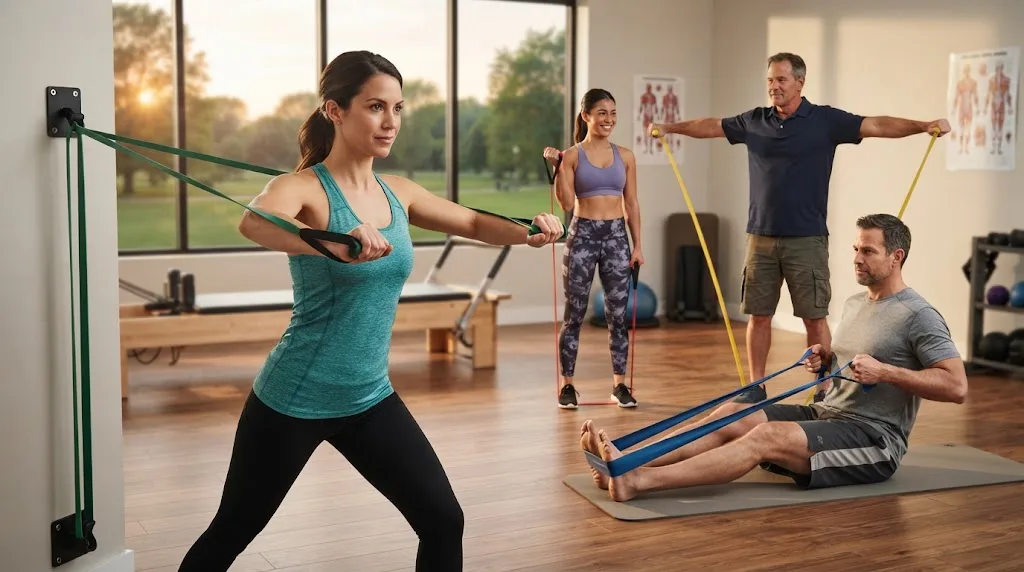

Stretch band exercises use elastic resistance bands to strengthen muscles, improve mobility, and add controlled resistance to everyday movements. Bands come in different shapes and resistance levels, including flat therapy bands, loop bands, and longer bands with handles. They can be used for upper-body, lower-body, core, flexibility, and rehabilitation-style exercises without requiring heavy gym equipment.
Unlike free weights, resistance bands create tension that changes as the band stretches. The farther you pull the band, the more resistance you generally feel, which encourages controlled movement throughout the exercise. This makes bands useful for beginners learning proper form as well as experienced exercisers who want another way to challenge muscles.
Stretch bands are also lightweight, inexpensive, and easy to carry. You can use them at home, in a gym, while traveling, or outdoors with relatively little space. Because exercises can be modified by changing band resistance, body position, or range of motion, one set of bands can support many different fitness levels.
Key Benefits of Stretch Band Exercises
One of the biggest benefits of resistance band training is that it can strengthen muscles without requiring heavy weights. Bands can challenge the shoulders, arms, chest, back, hips, glutes, and legs through a wide range of movements. Increasing resistance gradually allows muscles to adapt over time while giving you control over how demanding each exercise feels.
Stretch band exercises can also improve stability and movement control. Because the band constantly pulls against your body, smaller stabilizing muscles often have to work alongside the larger muscle groups. This can make resistance bands useful for improving coordination during movements such as rows, squats, side steps, presses, and controlled shoulder exercises.
Another advantage is convenience. A small collection of bands can provide dozens of exercises while taking up almost no storage space. People who do not enjoy crowded gyms or expensive equipment can still build a structured resistance-training routine, while athletes can use bands as an additional tool for warm-ups, accessory work, and mobility exercises.
How to Choose the Right Resistance Band
Start with a resistance level that allows you to perform each exercise with smooth and controlled technique. If you have to jerk the band, shorten the movement dramatically, or hold your breath to finish a repetition, the resistance may be too strong. The final repetitions should feel challenging without forcing you to lose control of your posture.
Different exercises may require different bands. Your legs and back can usually handle more resistance than smaller muscle groups such as the shoulders or arms. Keeping several resistance levels available makes it easier to adjust each movement appropriately rather than trying to use the same band for your entire workout.
You should also inspect the band before exercising. Look for small tears, cracks, damaged handles, or areas where the material has become unusually thin. Resistance bands can snap when heavily stretched if they are damaged, so replacing worn bands is a simple but important safety habit.
Upper-Body Stretch Band Exercises
Band rows are a useful exercise for strengthening the upper back and arms. Anchor the band securely in front of you, hold the ends, and pull your elbows backward while keeping your shoulders relaxed. Pause briefly when your hands reach the sides of your body, then slowly return to the starting position without allowing the band to pull you forward suddenly.
For a resistance band chest press, secure the band behind you at approximately chest level. Hold one end in each hand and press forward until your arms are comfortably extended, keeping your wrists straight and shoulders controlled. Return slowly until you feel mild tension across the chest and shoulders, then repeat without allowing your elbows to move excessively behind your body.
Biceps curls and shoulder external rotations can also be performed with bands. For curls, stand on the center of the band and bend your elbows while keeping them close to your sides. For external rotation, use lighter resistance and move slowly, because the smaller shoulder muscles usually respond better to controlled resistance than aggressive pulling.
Lower-Body Stretch Band Exercises
Banded squats can strengthen the thighs, glutes, and hips while encouraging better awareness of knee position. Place a loop band above the knees and stand with your feet at a comfortable width. Lower into a squat while gently pressing the knees outward against the band, then drive through your feet to return to standing without allowing the knees to collapse inward.
Lateral band walks are another effective exercise for the glute and hip muscles. Place a loop band around the thighs or lower legs, bend your knees slightly, and take controlled sideways steps. Keep constant tension in the band and avoid dragging the trailing foot, because slow, deliberate steps usually provide more useful resistance than moving quickly.
Glute bridges can also be made more challenging with a loop band above the knees. Lie on your back with your knees bent, press your feet into the floor, and lift your hips while keeping gentle outward pressure against the band. Pause at the top, squeeze the glutes, and lower slowly rather than arching the lower back to gain extra height.
Stretch Band Exercises for the Core
Resistance bands can train the core by asking the trunk to resist rotation rather than repeatedly bending or twisting. A Pallof press is a good example: anchor a band beside your body, hold it at chest level, and press your hands forward while resisting the band’s attempt to rotate you. Keep your hips and shoulders facing forward throughout the movement.
Standing band rotations can be added when you want to train controlled trunk movement. Anchor the band around chest height, hold it with both hands, and rotate through a comfortable range without jerking. The movement should come from coordinated trunk and hip rotation rather than forcing the lower back to twist as far as possible.
Core training should involve both control and appropriate relaxation. Constantly gripping the abdominal and pelvic muscles throughout every movement can create unnecessary tension for some people, so learning how to relax pelvic floor muscles may complement a balanced approach. Breathe normally and brace only as much as the exercise requires.
Stretch Band Exercises for Mobility and Flexibility
Bands can assist mobility exercises by giving you gentle support or resistance through a controlled range of motion. For example, a long band can be used during hamstring stretches by looping it around the foot while lying on your back. Hold the ends and gradually raise the leg until you feel a comfortable stretch without pulling aggressively.
Shoulder mobility can also benefit from light band work. Holding a wide resistance band in front of your body, you can perform slow pull-aparts or carefully move the arms through a comfortable overhead range. Keep the resistance light enough that your shoulders stay relaxed rather than forcing the movement through stiffness or pain.
Mobility work should feel controlled rather than intense. Stretching harder does not necessarily create faster progress, and painful positions may cause you to tighten instead of relax. Use the band as a tool to guide movement and gradually improve range, while avoiding excessive tension that changes your posture or creates sharp discomfort.
How to Build a Resistance Band Workout
A simple full-body workout can include one or two exercises for each major movement pattern. You might combine band squats, rows, chest presses, lateral walks, Pallof presses, and glute bridges in the same session. Beginners can start with fewer exercises and moderate resistance, then expand the routine as technique and endurance improve.
For strengthening, perform each repetition slowly enough to maintain control in both directions. A common starting point is a manageable set of repetitions that makes the final few feel challenging without causing form to break down. Rest between sets as needed rather than rushing through the workout simply to make it feel more intense.
Two or three resistance-training sessions per week can be a practical starting routine for many people, depending on overall activity and recovery. You can also use lighter bands for warm-ups or mobility work on other days. The most effective schedule is one you can perform consistently while allowing muscles enough time to recover between harder sessions.
How to Progress With Stretch Band Exercises
Progressive overload is important if your goal is to become stronger over time. Once an exercise feels easy with excellent control, you can move to a heavier band, increase repetitions, or add an additional set. Changing only one factor at a time makes it easier to judge whether your body is adapting comfortably.
You can also make an exercise more challenging by increasing the band’s stretch at the starting position. Standing farther from the anchor point during a row, for example, creates more initial tension. However, avoid stretching a band beyond the manufacturer’s recommended range because excessive tension can damage the material or make the exercise unnecessarily difficult.
Another form of progression is improving movement quality. Slowing the lowering phase, holding the hardest position briefly, or using a slightly larger comfortable range can increase difficulty without changing bands. Strength is not only about using more resistance; improved stability, control, and consistent technique are meaningful signs of progress as well.
Common Resistance Band Exercise Mistakes
Using a band that is too strong is a common mistake. Heavy resistance may make an exercise feel more productive, but it often encourages jerking, shortened range of motion, or poor joint positioning. Select a band that lets you complete the movement smoothly while keeping the targeted muscles working instead of compensating with the rest of your body.
Allowing the band to snap back quickly is another problem. The return phase of each exercise is part of the strength-building movement and should usually remain controlled. Slowly returning to the starting position maintains muscle tension and reduces the chance that the band will suddenly pull a joint into an uncomfortable position.
Poor anchoring can also create a safety risk. A band attached to an unstable chair, lightweight object, or insecure door may come loose during exercise. Always use a secure anchor designed to tolerate the direction and amount of force you are applying, and position yourself so a slipping band is less likely to strike your face.
Who Can Benefit From Resistance Band Training?
Beginners often find resistance bands helpful because they allow small adjustments in difficulty. You can start with very light resistance and focus on learning movement patterns before progressing. This can make band training less intimidating for people who are new to strength exercise or who do not yet feel comfortable using dumbbells, barbells, or gym machines.
More experienced exercisers can use bands to add variety to established workouts. Bands work well for accessory movements, warm-ups, higher-repetition sets, and exercises that emphasize muscle control. They can also be combined with traditional resistance exercises, although this should be done carefully so total training load does not increase faster than your body can tolerate.
Older adults and people returning to activity after a period of inactivity may also appreciate the flexibility of resistance bands. Exercises can often be performed while sitting, standing with support, or using a smaller range of motion. People recovering from injuries should follow guidance from a qualified healthcare or rehabilitation professional when specific movement restrictions apply.
Safety Tips for Stretch Band Exercises
Always begin with a short warm-up that increases blood flow and prepares the joints you plan to train. Easy walking, arm circles, gentle squats, or light band movements can work well. Moving directly into heavy resistance when your body feels stiff may make technique harder to control and can increase unnecessary strain.
Keep your breathing relaxed throughout the workout. Exhale during the more challenging part of an exercise and avoid holding your breath unnecessarily, especially during longer sets. If you experience dizziness, chest pain, unusual shortness of breath, or sudden weakness, stop exercising and seek appropriate medical attention rather than trying to finish the session.
Muscle fatigue is normal during resistance training, but sharp or increasing joint pain is different. Stop or modify an exercise if pain develops and does not improve after adjusting resistance or technique. Persistent symptoms, major weakness, swelling, or pain following an injury should be assessed by an appropriate healthcare professional before you continue challenging the area.
Conclusion
Stretch band exercises offer a practical way to strengthen muscles, improve mobility, and add resistance to workouts without needing bulky equipment. Bands can train the upper body, lower body, and core while also supporting flexibility and movement-control exercises. Different resistance levels make them useful for beginners as well as more experienced exercisers.
Good technique matters more than choosing the heaviest possible band. Move slowly, control both parts of each repetition, breathe normally, and use resistance that lets you maintain proper form. As exercises become easier, increase resistance, repetitions, range, or movement difficulty gradually instead of making several large changes at the same time.
Resistance bands can be used at home, at the gym, outdoors, or while traveling, making them one of the most versatile fitness tools available. Inspect your bands regularly and anchor them securely before each session. With consistent training and sensible progression, stretch band exercises can become an effective part of a balanced strength and mobility routine.
FAQs
Are stretch bands good for building muscle?
Yes. Resistance bands can build strength and muscle when exercises provide enough resistance and become progressively harder over time. Consistent training, adequate recovery, and appropriate nutrition also influence muscle development.
How often should I do resistance band exercises?
Many people can perform resistance band strength workouts two or three times per week. Frequency depends on workout intensity, fitness level, recovery, and whether you are also doing other forms of strength training.
Which resistance band is best for beginners?
A light or medium-resistance band is usually a practical starting point. Choose one that makes the final repetitions challenging while still allowing you to complete the full movement with controlled technique.
Can stretch bands replace weights?
Resistance bands can provide effective strength training for many exercises, but they do not need to replace weights completely. Bands, dumbbells, machines, and bodyweight exercises can all be combined depending on your goals and preferences.
Can I use resistance bands every day?
Light mobility or activation exercises may be performed frequently, but harder strength sessions usually require recovery. Avoid heavily training the same muscles every day if they remain tired, sore, or unable to perform normally.