

SCADA Meaning: How Industrial Control Systems Work
SCADA stands for Supervisory Control and Data Acquisition, a technology used to monitor, collect data from, and supervise industrial processes from centralized or distributed control locations. SCADA systems operate behind many services people rely on every day, including electricity distribution, water treatment, manufacturing, oil and gas transportation, rail networks, and large infrastructure facilities. Instead of requiring operators to physically inspect every pump, motor, valve, sensor, or electrical device, SCADA brings important operating information into one interface. Operators can see equipment conditions, receive alarms, analyze trends, and issue authorized control commands when intervention is required. This makes industrial operations easier to manage across large plants and geographically dispersed assets. SCADA is therefore an important part of modern industrial automation and operational technology.
A typical SCADA system combines field sensors, programmable logic controllers, remote terminal units, communication networks, supervisory servers, human-machine interfaces, and historical data systems. Each component has a particular job, but their real value comes from working together as one industrial control environment. Sensors measure physical conditions such as pressure, temperature, flow, voltage, tank level, or machine status and send those measurements to local controllers. The controllers process the information and may automatically operate equipment based on programmed logic. Relevant values are then transmitted to supervisory software where operators can monitor the process through graphical displays. This continuous movement of information helps organizations understand what is happening throughout an industrial process without relying entirely on manual observations.
Modern SCADA is also changing as industrial organizations connect operational technology with analytics platforms, edge computing, enterprise systems, and carefully controlled cloud services. Older installations were often highly isolated and used proprietary communication technologies, while newer environments increasingly support interoperable protocols, Ethernet networks, remote visualization, and advanced data analysis. This connectivity can improve productivity and decision-making, but it also makes cybersecurity, availability, network design, and access control more important. A SCADA system cannot be evaluated like ordinary office software because failures may affect physical equipment, production, public services, or worker safety. Understanding SCADA meaning therefore requires looking beyond software screens and examining the complete relationship between industrial devices, networks, people, and processes.
What Does SCADA Mean and What Is Its Main Purpose?
SCADA means Supervisory Control and Data Acquisition, and the name describes the two primary functions of the technology. Supervisory control refers to an operator’s ability to oversee a process and send higher-level commands to industrial equipment through an automated control environment. Data acquisition refers to collecting measurements and status information from sensors, controllers, meters, and other devices operating in the field. These two functions allow organizations to maintain visibility across processes that may involve hundreds or thousands of individual data points. Instead of controlling every physical action directly from a central computer, SCADA commonly supervises local control systems that perform many routine tasks automatically. This distinction is important because industrial control usually depends on several coordinated layers rather than one central computer controlling everything.
SCADA systems are especially useful when equipment is distributed across a large geographical area. An electrical utility, for example, may need to monitor substations located many kilometers apart, while a water organization may operate pumps, reservoirs, treatment facilities, and remote stations throughout an entire region. Sending employees to inspect each location continuously would be inefficient, slow, and sometimes impractical. SCADA allows information from these remote assets to reach one or more control centers through industrial communication networks. Operators can then view system conditions, identify abnormal situations, and coordinate responses more quickly. Remote supervision is one reason SCADA has historically been closely associated with utilities, pipelines, transportation systems, and other geographically dispersed infrastructure.
The word supervisory is important because SCADA usually operates above local control devices rather than replacing them. A programmable logic controller, or PLC, might continuously control a conveyor motor or regulate a manufacturing machine based on sensor input. A remote terminal unit, or RTU, may collect information from a distant pumping station and execute local commands. The SCADA system receives selected data from those devices and presents the overall process to operators. If necessary, an authorized operator may change a setpoint, start equipment, stop equipment, acknowledge an alarm, or send another permitted command. Local controllers can continue performing time-critical logic while the supervisory layer provides broader visibility and coordination.
Data acquisition is equally important because industrial decisions depend on accurate and timely information. Sensors may continually measure values such as temperature, pressure, flow rate, electrical current, vibration, speed, position, chemical concentration, or liquid level. Controllers convert those physical measurements into digital information that can be transmitted and interpreted throughout the control system. SCADA software can display current values, identify unusual conditions, store historical information, and help operators compare current performance with expected operating ranges. Some systems can also calculate derived values and generate reports for engineering or operational analysis. This ability to transform field measurements into meaningful information makes SCADA valuable for both immediate control and longer-term process improvement.
SCADA is best understood as part of the broader industrial control systems landscape rather than as one single product. Different facilities may use very different hardware, software, communication networks, interfaces, redundancy designs, and automation strategies while still describing their supervisory environment as SCADA. A small facility might use one server and a few PLCs, while a utility may operate a highly redundant architecture involving thousands of remote points. Modern systems may also integrate edge computing, historians, analytics, enterprise applications, and remote operations platforms. The specific architecture depends on operational requirements, safety considerations, availability targets, regulatory obligations, and existing equipment. What remains consistent is the central goal of acquiring operational data and providing reliable supervisory visibility and control.
Core Components of a SCADA System
Field devices are the starting point for much of the information flowing through a SCADA system. Sensors measure real-world process conditions, while actuators physically change those conditions by opening valves, moving equipment, adjusting motors, operating breakers, or performing other actions. For example, a level sensor might report how much water is stored in a tank while an electrically operated valve controls whether additional water enters it. These devices form the connection between the digital control environment and the physical industrial process. Their reliability matters because SCADA software can only make useful information available when the underlying measurements are accurate. Faulty sensors can therefore create misleading displays even when every server and communication system is operating normally.
Programmable logic controllers are another major component in industrial automation and SCADA environments. A PLC is a ruggedized computing device designed to execute control logic reliably under industrial operating conditions. It receives inputs from sensors, processes those inputs according to programmed instructions, and produces outputs that control machinery or other equipment. PLCs can perform operations extremely quickly without waiting for an operator or central SCADA server to make every decision. For example, a PLC may stop a motor automatically if a protection condition is detected or maintain a tank level within a programmed operating range. SCADA communicates with the PLC to retrieve process data and may send approved supervisory commands or updated setpoints.
Remote terminal units perform functions similar to PLCs but are traditionally associated with remote monitoring and telemetry applications. An RTU can collect signals from sensors, convert measurements into digital data, control local equipment, and communicate with a central SCADA system. RTUs are particularly valuable in locations where infrastructure is widely distributed and communications may rely on radio, cellular links, fiber, satellite, or other wide-area technologies. Modern distinctions between PLCs and RTUs are less rigid because many devices now offer overlapping capabilities. Some PLCs provide sophisticated communications and remote features, while modern RTUs may perform advanced local control. The appropriate device depends on environmental conditions, communication needs, processing requirements, power availability, and the overall architecture.
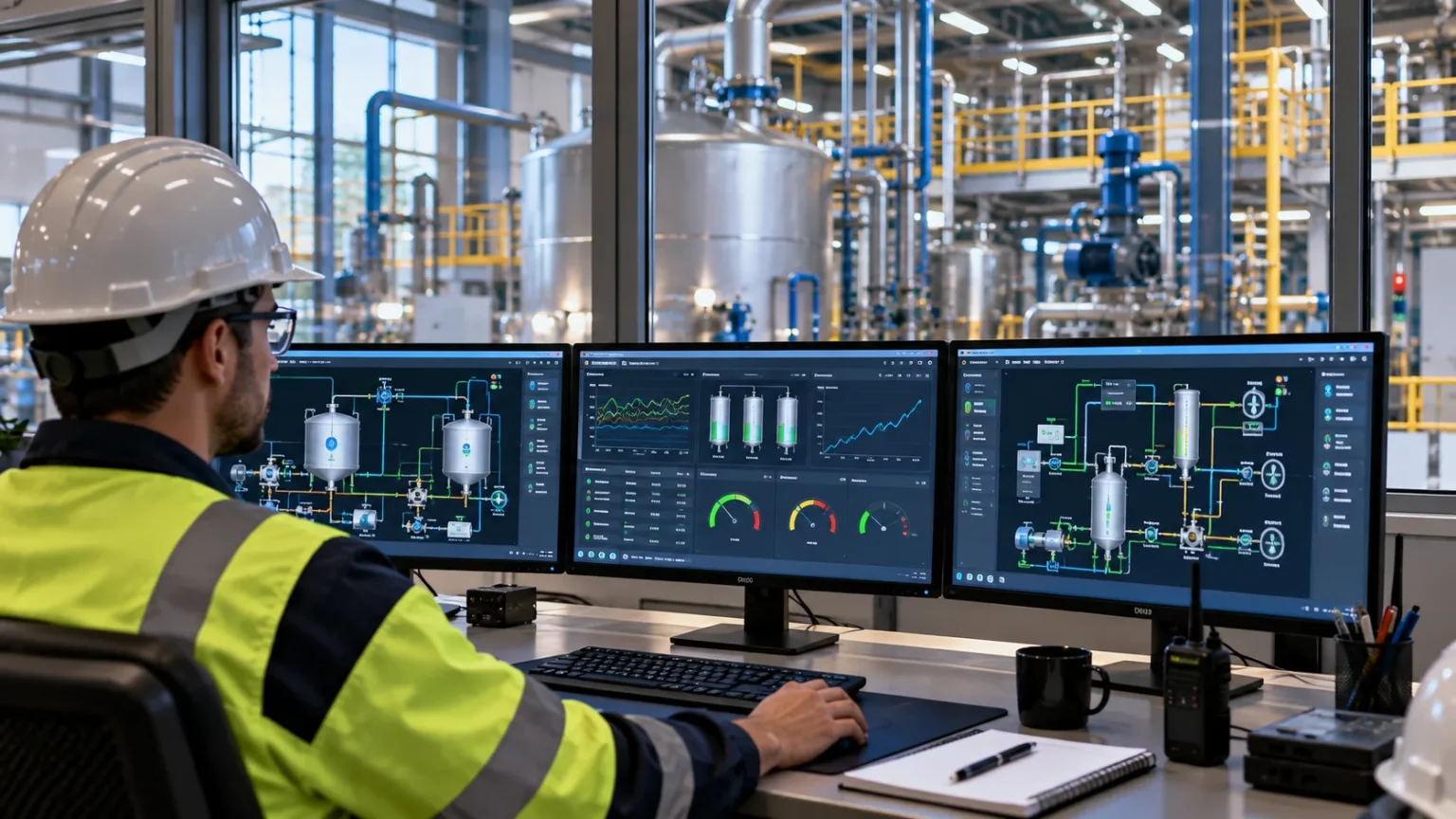
The human-machine interface, commonly called an HMI, is the part of the SCADA environment that operators interact with most directly. An HMI converts large amounts of industrial data into graphical screens that can display equipment status, process values, alarms, trends, controls, and other important information. Instead of reading thousands of raw measurements, operators may see diagrams showing pumps, tanks, pipelines, electrical feeders, machines, or other process elements. Good HMI design helps users recognize abnormal conditions quickly and understand which actions are appropriate. Poorly designed interfaces can overwhelm operators with unnecessary information or make critical alarms difficult to notice. For this reason, visualization and alarm management are important parts of effective SCADA engineering.
SCADA servers and data historians provide the supervisory and information-management layers that connect many parts of the environment. A supervisory server communicates with PLCs, RTUs, gateways, or other devices and coordinates data collection for the HMI and related applications. A historian is designed to store time-series process data so organizations can analyze what happened minutes, days, months, or even years earlier depending on retention policies. Engineers can use historical information to identify performance trends, investigate incidents, evaluate equipment behavior, and optimize production. Alarm servers, engineering workstations, communication gateways, application servers, and redundant systems may also form part of larger architectures. Together, these components turn individual industrial measurements into a coordinated operational picture.
How a SCADA System Works Step by Step
The SCADA process generally begins with a physical event taking place in the industrial environment. A temperature changes, a pump starts, a valve moves, a tank level rises, a motor experiences additional load, or electrical conditions shift within a distribution system. Sensors and field instrumentation detect these conditions and convert them into signals that controllers can understand. Depending on the system, signals may be analog, digital, or transmitted through an industrial communication network. The PLC or RTU receives these values and interprets them according to the configured control program. This first stage happens close to the physical process because many industrial decisions must occur quickly and reliably even if communication with the supervisory system is temporarily unavailable.
The local controller then performs control logic based on current inputs and predefined operating rules. Suppose a PLC monitors the water level inside a storage tank and has been programmed to keep the level within an acceptable range. If the level drops below a configured threshold, the controller may start a pump automatically without requesting permission from the central SCADA server. Once the upper target is reached, it may stop the pump again according to its control logic. These actions can happen continuously and rapidly at the local level. The PLC simultaneously makes relevant information available to the supervisory system so operators can see the pump status, tank level, alarms, operating mode, and other selected variables.
Process information is then transmitted through the industrial communication network to a SCADA server or another supervisory component. The communication path may remain inside one factory or extend across a wide geographical region depending on the installation. Industrial Ethernet, fiber-optic links, radio systems, cellular networks, serial communication, and other technologies can all play a role. The SCADA software polls controllers or receives updates using communication protocols that define how data is structured and exchanged. Modern architectures may also use gateways to translate between older equipment and newer communication standards. Reliable data transmission is critical because operators need confidence that displayed values accurately represent the current state of the process.
Once the data reaches the supervisory layer, the HMI converts it into information that an operator can understand quickly. A normal pump may appear in its expected operating state, while an abnormal condition might trigger a color change, alarm banner, audible notification, or another carefully designed alert. Operators can examine trends to determine whether pressure has been rising gradually or whether an event occurred suddenly. If intervention is necessary, an authorized user may issue a command through the HMI. The command travels through the SCADA system to the appropriate PLC, RTU, or control device, where permitted logic determines how it is executed. Important safety functions may operate independently so supervisory commands cannot override essential protections improperly.
At the same time, relevant information may be recorded by a historian or another data-management system. Historical records allow teams to reconstruct events, compare shifts, study equipment efficiency, analyze production performance, and investigate recurring alarms. Modern SCADA environments may make selected operational data available to maintenance software, energy-management systems, manufacturing execution systems, enterprise analytics, or other authorized applications. This broader integration can help organizations connect real-time plant behavior with maintenance and business decisions. However, every additional connection must be designed carefully because operational technology has different reliability and safety priorities from ordinary business IT. The complete SCADA workflow therefore combines sensing, local control, communication, visualization, storage, and controlled integration.
SCADA Communication Protocols and Industrial Networks
Communication protocols provide the rules that allow SCADA devices and software to exchange information consistently. Industrial environments contain equipment from different generations and manufacturers, so protocol compatibility is an important part of system design. Modbus is one widely recognized industrial protocol and exists in forms that can operate over serial communications or Ethernet-based networks. DNP3 is frequently associated with utilities and remote infrastructure, particularly where reliable telemetry between control centers and field locations is important. Other environments may use protocols from the IEC family, proprietary vendor technologies, or industry-specific communication standards. No single protocol is automatically best because requirements differ across manufacturing plants, electrical systems, water facilities, pipelines, and other applications.
OPC technologies have also become important for improving interoperability between industrial devices, software platforms, and higher-level applications. OPC UA, or OPC Unified Architecture, provides a structured approach for exchanging industrial information and can incorporate security and richer data models compared with many older protocols. It is commonly used where organizations want different automation products to exchange information without building a unique integration for every combination of systems. OPC UA can also support more modern industrial architectures involving edge systems and enterprise applications. However, simply selecting a newer protocol does not automatically make a control system secure or reliable. Configuration, certificate management, identity controls, segmentation, software maintenance, and architecture remain essential parts of the implementation.
MQTT is increasingly visible in industrial data architectures, especially where organizations are connecting operational technology with edge computing, analytics, and Industrial Internet of Things platforms. MQTT uses a publish-and-subscribe model in which systems can publish information to topics and authorized consumers can subscribe to the data they need. This differs from many traditional request-and-response patterns used within older industrial environments. Modern architectures may combine MQTT with structured naming approaches such as a Unified Namespace to make operational information easier to organize across systems. These approaches can improve scalability and information sharing when implemented carefully. They do not necessarily replace traditional control protocols because time-critical local automation may still depend on PLC networks and purpose-built industrial communication.
Physical communication networks are just as important as the protocols traveling across them. A manufacturing facility may primarily use industrial Ethernet and fiber, while a pipeline or water utility may need radio, cellular, microwave, satellite, or specialized wide-area communications to reach remote equipment. Network designers consider latency, bandwidth, reliability, electromagnetic interference, environmental conditions, redundancy, distance, maintenance accessibility, and cybersecurity when selecting communication methods. Some applications can tolerate brief delays in telemetry, while others require highly predictable communications. Critical control loops are often kept local so essential operations do not depend on an unreliable wide-area connection. SCADA then provides supervisory information and commands while local automation preserves basic process stability.
Legacy communication remains a major consideration because industrial equipment often stays operational for decades. A functioning PLC or RTU may have been installed long before modern Ethernet, encryption, or identity-management practices became common. Replacing every device simultaneously may be financially unrealistic and could create operational risk during migration. Organizations therefore often operate mixed environments containing modern protocols alongside older serial or proprietary technologies. Industrial gateways, protocol converters, segmented networks, and carefully controlled integration layers can help these systems coexist. Modernization is usually more successful when it recognizes operational realities instead of assuming a factory or utility can be rebuilt like a consumer IT environment. SCADA networking is ultimately about balancing interoperability, reliability, lifecycle requirements, performance, and security.
SCADA vs PLC, DCS, and Other Industrial Control Systems
SCADA and PLC are related technologies, but they are not interchangeable terms. A PLC is primarily a controller that executes automation logic close to equipment, while SCADA is the supervisory system that monitors and coordinates information from one or many controllers. The PLC may continue controlling a machine even if its connection to the SCADA server is temporarily lost, depending on how the application has been engineered. SCADA provides operators with visualization, alarms, historical data, supervisory commands, and broader process awareness. A useful way to think about the relationship is that PLCs often perform the immediate control work while SCADA helps people supervise the overall operation. Many SCADA environments therefore contain numerous PLCs rather than replacing them.
SCADA and DCS, or Distributed Control System, also share important similarities but historically developed around different operational needs. SCADA has traditionally been associated with geographically dispersed assets such as pipelines, electrical distribution networks, water infrastructure, and transportation systems. DCS platforms have often been associated with tightly integrated continuous or batch processes located within a plant, such as chemical processing, refining, pharmaceutical production, or power generation. A DCS typically coordinates many control loops through an integrated distributed architecture with strong emphasis on process control. SCADA traditionally emphasizes remote telemetry, centralized supervision, and communication with field stations. Modern products increasingly overlap, so the distinction can depend as much on architecture and operational use as on a specific software feature.
Industrial Control Systems, commonly shortened to ICS, is a broader category that can include SCADA, DCS, PLC-based automation, safety systems, and other technologies used to control industrial processes. Saying that SCADA is an ICS is therefore generally accurate, but saying every ICS is SCADA would be incorrect. Operational Technology, or OT, is an even broader term commonly used for hardware and software that detects or causes changes in physical processes, devices, and industrial environments. OT can include industrial control systems as well as supporting technologies used throughout factories and infrastructure. Understanding these layers helps avoid confusion when cybersecurity or automation discussions use several acronyms together. SCADA represents one important architecture within the larger OT ecosystem.
HMI is another term that is sometimes incorrectly treated as a synonym for SCADA. The HMI is primarily the operator-facing interface that displays process information and provides controls, while the complete SCADA system includes much more than graphical screens. Behind the HMI may be communication services, redundant servers, databases, historians, alarm systems, PLCs, RTUs, engineering workstations, and field devices. A small standalone machine can also have an HMI without being part of a large SCADA system. Likewise, a SCADA environment may contain multiple HMI stations serving different operators and locations. Separating these concepts makes troubleshooting easier because an HMI display problem does not automatically mean that the underlying PLC control process has failed.
The Industrial Internet of Things, or IIoT, overlaps with SCADA but usually emphasizes connected devices, scalable data collection, analytics, and integration with broader digital platforms. IIoT systems may collect information from machines for predictive maintenance, energy analysis, asset management, or enterprise reporting without becoming responsible for core real-time control. SCADA, by contrast, is generally focused more directly on operational monitoring and supervisory control. Modern organizations increasingly combine the two, using SCADA for dependable plant operations while forwarding selected data to edge or cloud analytics platforms. Successful integration requires clear boundaries because a business analytics service should not automatically gain unrestricted access to critical control functions. These technologies are complementary when each is used for the role it performs best.
Where SCADA Systems Are Used in the Real World
Electric power systems are one of the most familiar examples of SCADA in critical infrastructure. Utilities need visibility across substations, transmission equipment, distribution networks, breakers, transformers, meters, and other electrical assets spread across wide geographical regions. SCADA can collect electrical measurements and equipment status while allowing authorized operators to supervise network conditions from control centers. Alarms can highlight abnormal voltage, equipment faults, communication failures, or unexpected operating states that need investigation. Historical data can also help engineers analyze loads and study events after disturbances occur. Because electricity must remain highly available, utility SCADA architectures often include redundancy, specialized communications, and rigorous operational procedures designed to maintain service even when individual components fail.
Water and wastewater organizations also depend heavily on remote monitoring because their equipment may be distributed throughout cities or regions. SCADA systems can monitor reservoir levels, pumping stations, water pressure, treatment processes, chemical dosing, flow rates, and wastewater collection infrastructure. Operators can identify a failed pump or unusual tank level without traveling to the site simply to discover the problem. Automated controllers can maintain routine operations locally, while the supervisory environment provides alarms and broader coordination. Historical trends can help teams evaluate consumption patterns, equipment performance, and treatment conditions. Reliable monitoring is particularly important because water services must operate continuously and equipment failures can create environmental, operational, or public-service consequences.
Oil and gas operations use SCADA to supervise pipelines, compressor stations, pumping facilities, storage infrastructure, and other geographically dispersed assets. Long pipelines may cross remote areas where constant physical inspection is difficult, making telemetry essential for operational awareness. Sensors can report pressure, temperature, flow, valve position, equipment state, and other process conditions to centralized systems. Operators use this information to understand how the transportation network is performing and to respond to alarms or operational changes. Local safety and control systems remain important because critical actions cannot always wait for a distant command. SCADA adds the centralized visibility needed to coordinate many remote stations as part of one larger transportation or production network.
Manufacturing facilities use SCADA to monitor production lines, utilities, process equipment, packaging systems, conveyors, energy use, environmental conditions, and other plant operations. A factory may already contain many individual PLC-controlled machines, and SCADA can bring important information from those machines into one operational view. Supervisors can follow production status, equipment downtime, alarm activity, process variables, and sometimes quality-related indicators without visiting every control panel. Historians can preserve process data for analysis and continuous improvement projects. Integration with manufacturing execution systems can connect shop-floor activity with production schedules and performance reporting. This visibility helps organizations understand not only whether equipment is running but also how consistently and efficiently the larger process is operating.
SCADA also appears in transportation, building infrastructure, mining, renewable energy, food production, pharmaceutical operations, district heating, and many other environments. Rail organizations may use supervisory systems to monitor remote infrastructure and power equipment, while renewable energy operators can monitor wind turbines or solar facilities across large areas. Mining operations may supervise pumping, conveyors, ventilation, electrical distribution, and processing equipment. Large facilities can use related supervisory technologies for utilities and energy-management systems. The exact requirements differ dramatically because monitoring a wind farm is not the same as controlling a pharmaceutical manufacturing process. Nevertheless, the underlying SCADA concept remains recognizable: acquire operational data from distributed equipment, present meaningful information to operators, and provide controlled supervisory capabilities.
Benefits and Limitations of SCADA Technology
Real-time operational visibility is one of the strongest benefits associated with SCADA systems. Without centralized monitoring, teams may learn about equipment problems only after a physical inspection, customer complaint, production interruption, or major alarm at the site. SCADA allows important process conditions to be observed continuously and can notify operators when values exceed configured limits. Earlier awareness gives organizations more time to investigate abnormal behavior and respond before a minor issue becomes a larger operational event. Centralized visualization is particularly valuable when assets are difficult to access or spread over large areas. The result can be better situational awareness, faster response, and more coordinated operation across facilities and remote stations.
Historical data provides another major benefit because industrial improvement depends on understanding how equipment behaves over time rather than only seeing current conditions. A data historian can preserve temperature, flow, pressure, energy consumption, production values, alarms, and many other process variables at selected intervals. Engineers can analyze trends to identify gradual deterioration that might not be obvious during a short observation. Maintenance teams can compare equipment behavior before and after repairs, while production teams can study recurring process interruptions. Historical information can also support incident investigation by showing what happened before, during, and after an abnormal event. When data quality is strong, SCADA becomes both an operational tool and an important source of engineering knowledge.
Automation and remote supervision can also improve operational efficiency by reducing repetitive manual work. Operators no longer need to travel to every remote site solely to record a gauge reading or verify that normal equipment is operating. Routine control actions can happen automatically through PLCs and RTUs, while SCADA allows people to focus on exceptions that need judgment. Alarm systems can prioritize conditions requiring attention rather than expecting staff to watch every individual measurement continuously. Remote diagnostics can sometimes help technicians understand a problem before arriving at the equipment. These benefits can reduce unnecessary travel, shorten response times, and make specialized expertise available across multiple facilities, although appropriate procedures are still essential for safety-critical work.
SCADA does have important limitations, especially when organizations rely on poorly maintained legacy systems. Industrial equipment often has a much longer lifecycle than ordinary computers, meaning software and devices may remain in service after vendors stop providing modern updates. Proprietary components can make migrations difficult, while old communication protocols may lack security features expected in newer networks. Large SCADA projects can also be expensive because reliability, redundancy, engineering, commissioning, and operational testing require significant expertise. Integration between equipment from different manufacturers may introduce additional complexity. Organizations therefore need lifecycle planning rather than treating the initial system installation as the end of the project. Long-term maintenance is part of operating SCADA responsibly.
Another limitation is that increased connectivity can create dependencies and risks that older isolated systems did not face to the same degree. Connecting SCADA data to enterprise analytics, remote support, mobile interfaces, or cloud services can create genuine business value, but every connection changes the architecture. Network outages, software defects, configuration mistakes, unauthorized access, or compromised credentials can have more serious consequences when digital systems interact with physical processes. For this reason, reliability and safety remain central design priorities alongside convenience and analytics. SCADA should not become connected simply because connectivity is technically possible. Effective modernization asks which connections provide enough operational value to justify their complexity and then designs appropriate protections around them.
SCADA Cybersecurity and the Future of Industrial Control
SCADA cybersecurity has become increasingly important as industrial environments adopt standard networking technologies and integrate more closely with business systems. Older control systems were often designed primarily for reliability and availability rather than for exposure to modern cyber threats. Some legacy devices may use protocols with limited authentication or encryption because they were originally intended for trusted, isolated networks. Modern connectivity changes that assumption, especially when remote access, vendor support, enterprise integration, and internet-connected services become part of operations. A successful security program therefore begins by understanding which devices, applications, connections, and communication paths actually exist. Organizations cannot protect industrial assets effectively when they do not have reliable visibility into their own OT environment.
Network segmentation is a widely used principle for reducing unnecessary communication between business IT and industrial control environments. Instead of placing every server, workstation, PLC, and enterprise application on a broadly connected network, organizations can create carefully controlled zones and communication paths based on operational needs. Firewalls and other security controls can restrict traffic so only explicitly required services cross important boundaries. Remote access should also be managed deliberately rather than leaving industrial interfaces exposed unnecessarily. Strong authentication, controlled jump systems, logging, and time-limited access can help reduce risk when remote engineering or vendor support is required. The goal is not simply to isolate everything, but to make connectivity intentional, visible, and appropriate for the process.
Patch management is more complicated in SCADA than in ordinary office environments because availability and physical process safety must be considered before making changes. Installing an update on a production controller or supervisory server without testing could interrupt operations even when the patch addresses a legitimate security issue. Industrial organizations therefore commonly evaluate updates, vendor guidance, equipment compatibility, maintenance windows, and operational consequences before deployment. Compensating controls may sometimes be necessary when a legacy device cannot be updated immediately. Backups and tested recovery procedures are equally important because configuration files, PLC logic, HMI applications, and server data may be essential for restoring operations after equipment failure or a cybersecurity incident. Resilience requires preparation before disruption occurs.
Modern SCADA architectures increasingly include edge computing, centralized data integration, web-based visualization, and carefully governed cloud connections. Edge systems can process industrial information close to the plant while forwarding selected data to higher-level applications without placing every device in direct communication with enterprise services. Technologies such as OPC UA and MQTT can support more standardized data exchange when appropriately engineered. Unified Namespace concepts are also attracting interest as organizations seek consistent structures for sharing operational data across multiple applications. These approaches can make industrial information more useful for analytics, maintenance, energy management, and business decisions. However, modernization should preserve clear separation between data consumption and authority to control physical equipment.
The future of SCADA is likely to involve greater interoperability, richer analytics, artificial intelligence-assisted monitoring, edge platforms, and tighter integration between operational and enterprise information. Predictive tools may help teams detect patterns associated with equipment deterioration, while improved visualization can give operators more useful context during abnormal events. Digital twins and industrial analytics can also use SCADA and historian data to model processes and support engineering decisions. Yet human operators, deterministic local control, safety systems, and resilient communication will remain essential because industrial environments have physical consequences that ordinary software applications do not. Successful SCADA modernization will therefore combine new digital capabilities with disciplined control engineering. The objective is not maximum connectivity, but reliable, secure, and useful operational intelligence.
Frequently Asked Questions About SCADA
What does SCADA stand for?
SCADA stands for Supervisory Control and Data Acquisition. It refers to systems that collect industrial process data and provide centralized or distributed monitoring and supervisory control of equipment and infrastructure.
What is the main purpose of a SCADA system?
The main purpose of SCADA is to give operators reliable visibility into industrial processes while allowing authorized supervisory control where appropriate. It collects field data, displays current conditions, manages alarms, records historical information, and communicates with devices such as PLCs and RTUs.
What is the difference between SCADA and PLC?
A PLC primarily performs local automation by processing sensor inputs and controlling physical outputs according to programmed logic. SCADA operates at a supervisory level, collecting information from PLCs and other devices and presenting it to operators through centralized monitoring and control interfaces.
Is SCADA the same as an HMI?
No, an HMI is the operator interface used to display process information and provide controls, while SCADA describes the broader supervisory system. A SCADA environment can include HMIs, servers, historians, communication networks, PLCs, RTUs, alarms, engineering workstations, and field equipment.
Where are SCADA systems commonly used?
SCADA systems are widely used in electric utilities, water and wastewater systems, manufacturing, oil and gas pipelines, transportation, renewable energy, mining, and other industrial environments. They are particularly valuable when operators need to monitor large processes or equipment distributed across multiple locations.



