
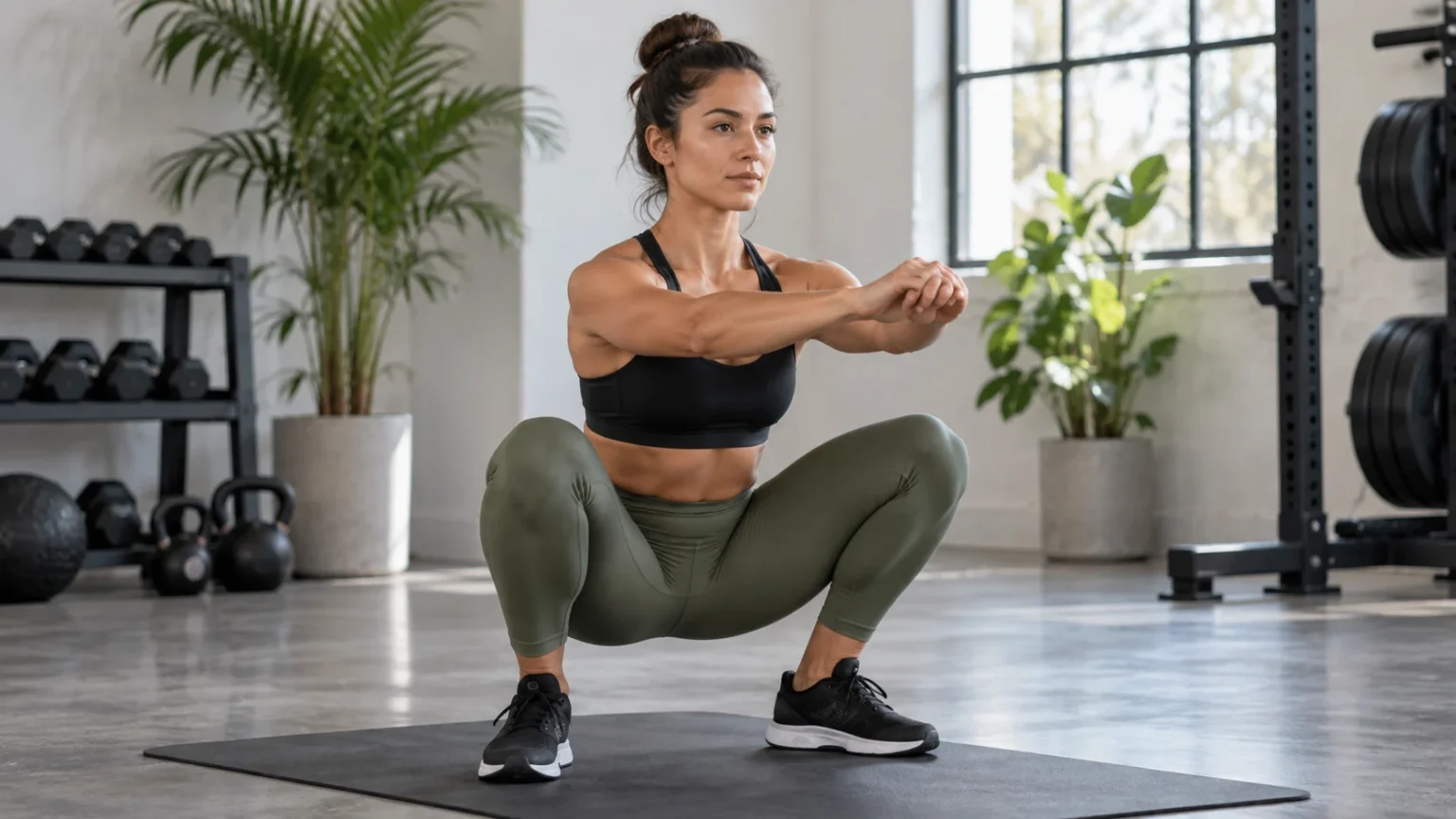

What Is a Deep Squat Hold?
A deep squat hold is a mobility and strength exercise where you lower your hips into a deep squat position and remain there for a set period. Your feet stay planted while your knees bend and your hips move close to the floor. Unlike regular squats, the goal is not repeated movement but maintaining a comfortable, controlled bottom position.
The exercise challenges several areas at the same time, including the hips, ankles, knees, lower back, and core. It can help you become more comfortable in deep hip and knee flexion while improving awareness of your lower-body positioning. Many people use it as part of a warm-up, mobility routine, or preparation for traditional squatting exercises.
A deep squat hold does not need to look identical for everyone because body proportions, flexibility, ankle mobility, and hip structure vary. Some people can naturally sit very low with upright posture, while others need assistance or a slightly wider stance. The priority should be a stable position that feels controlled rather than forcing maximum depth.
What Muscles Does a Deep Squat Hold Work?
The deep squat hold primarily involves the quadriceps, glutes, hamstrings, calves, and muscles surrounding the hips. Your quadriceps help control knee flexion, while your gluteal muscles contribute to hip stability. The calves and muscles around the ankle also work as you maintain balance with your feet firmly planted on the floor.
Your core plays an important role throughout the movement because it helps support your trunk and maintain a stable spine. The abdominal muscles and deeper stabilizers work to prevent excessive collapsing or rounding. Your back muscles also contribute by helping keep your torso controlled, especially when you try to maintain a relatively upright chest.
Although it is usually viewed as a lower-body mobility exercise, the hold also challenges coordination. Your feet, ankles, knees, hips, and trunk must work together to maintain balance. This makes the position useful for practicing movement control as well as developing tolerance for deeper squat positions during strength training and everyday activities.
Benefits of Doing a Deep Squat Hold
One of the main benefits of a deep squat hold is improved comfort in the bottom of a squat. Spending controlled time in this position can gradually help your hips and ankles tolerate a greater range of motion. This may make other exercises, such as bodyweight squats or goblet squats, feel smoother and more natural.
The exercise can also help improve lower-body mobility when stiffness limits your squat depth. Holding the position gives you time to gently explore movement at the hips, knees, and ankles rather than rushing through repetitions. With consistent practice, some people notice that they can squat more comfortably without their heels lifting or their torso excessively leaning forward.
Deep squat holds may also improve body awareness and balance. Staying still at the bottom requires you to notice where your weight is distributed and whether your knees and feet remain stable. These skills can transfer to strength exercises and everyday movements that involve bending down, getting low, or returning to standing from a crouched position.
How to Do a Deep Squat Hold Correctly
Begin by standing with your feet approximately shoulder-width apart or slightly wider. Turn your toes outward slightly if that feels more comfortable for your hips. Brace your core gently, keep your chest relaxed, and distribute your weight across your whole foot rather than shifting entirely onto your heels or toes.
Slowly bend your knees and hips as you lower yourself toward the floor. Allow your knees to track in the same general direction as your toes while keeping both feet planted. Continue descending until you reach the deepest position you can comfortably maintain without sharp pain, excessive instability, or feeling that your joints are being forced.
Once you reach the bottom, hold the position while breathing slowly and staying relaxed. Keep gentle tension through your legs and core without aggressively squeezing every muscle. When the hold is finished, press through your feet and extend your knees and hips gradually until you return to a comfortable standing position.
How Long Should You Hold a Deep Squat?
Beginners can start with short holds of around 10 to 20 seconds. This gives your ankles, hips, knees, and muscles time to adapt without creating excessive fatigue. If the position feels comfortable and controlled, you can gradually increase the duration rather than immediately trying to remain in a deep squat for several minutes.
A practical progression is to perform two or three holds and slowly increase each one toward 30 to 60 seconds. Longer holds are not automatically better because maintaining good positioning matters more than staying down for a specific number of minutes. Stop the set if your feet begin lifting or your posture becomes increasingly uncomfortable.
How long you should hold the position also depends on your goal. Shorter holds can work well during warm-ups, while slightly longer holds may be useful during dedicated mobility sessions. Consistency is usually more valuable than performing one extremely long squat hold and then avoiding the exercise because it caused excessive soreness or discomfort.
Common Deep Squat Hold Mistakes
One common mistake is allowing the heels to lift excessively from the floor. This may happen when ankle mobility is limited or when the feet are positioned too narrowly for your body. Instead of forcing your heels down, experiment with your stance and work gradually on ankle mobility while maintaining a balanced and comfortable squat.
Another mistake is forcing the knees into a position that does not feel natural. Your knees should generally follow the direction of your toes rather than collapsing significantly inward. Trying to copy someone else’s exact stance can also create unnecessary discomfort because hip structure and body proportions influence how each person naturally performs a deep squat.
Some people also force their torso perfectly upright even when their mobility does not currently allow it. A small forward lean can be normal depending on your proportions. The goal is controlled positioning rather than trying to achieve a visually perfect squat that creates strain in your hips, ankles, knees, or lower back.
What If You Cannot Get Into a Deep Squat?
If you cannot reach a deep squat comfortably, it does not necessarily mean anything is wrong. Limited ankle movement, hip stiffness, balance, exercise experience, and individual anatomy can all influence squat depth. Start with the range that feels controlled and gradually practice rather than forcing your hips toward the floor immediately.
Holding onto a sturdy support can make the exercise much easier for beginners. You can lightly grip a stable post, squat rack, or secure piece of furniture while lowering yourself. The support allows you to focus on hip and ankle movement without worrying as much about falling backward or losing your balance.
You can also place a small elevated surface beneath your heels temporarily if ankle mobility is limiting your depth. Over time, combine assisted squats with ankle and hip mobility exercises. Gradually reducing assistance can help you become more confident in the position without turning the exercise into an uncomfortable flexibility test.
How Ankle and Toe Mobility Affect Your Squat
Adequate ankle mobility helps your knees move forward naturally while your heels remain on the floor. When ankle dorsiflexion is limited, your body may compensate by lifting the heels, widening the feet considerably, or leaning farther forward. Improving ankle movement can therefore make the bottom of a squat feel more stable and comfortable.
Your feet and toes also provide an important foundation during the exercise. Try to maintain contact through the heel, base of the big toe, and base of the little toe while keeping your toes relaxed. Painful feet or toes can change how you distribute weight, which may affect your balance and overall squat technique.
If discomfort in your foot makes squatting difficult, it can be useful to understand possible causes of toe pain before continuing to load the area heavily. Persistent pain should not simply be pushed through. Addressing foot discomfort can help you return to lower-body exercises with better balance and confidence.
Deep Squat Hold for Hip Mobility
The deep squat position places the hips into substantial flexion, making it a useful movement for practicing comfortable hip range. Many people feel a gentle stretch around the inner thighs, hips, or glutes while holding the position. The sensation should remain manageable rather than becoming sharp, pinching, or increasingly painful.
You can gently shift your weight from side to side while staying in the squat to explore your hip movement. Small controlled adjustments may help you identify areas that feel particularly stiff. Avoid aggressive bouncing because mobility usually improves more effectively through repeated comfortable exposure than through forcing tissues beyond their current tolerance.
Breathing can also make the position feel easier. Slow breaths may help reduce unnecessary tension around the hips and lower back while you maintain the squat. Try allowing your muscles to relax slightly with each exhale while still keeping enough control through your legs and core to remain stable.
Deep Squat Hold for Ankle Mobility
The deep squat requires the ankle to move into dorsiflexion as your knees travel forward over your feet. If this motion is limited, you may feel your heels beginning to rise as you descend. Regular squat holds can provide gentle exposure to this position when performed within a comfortable and controlled range.
You can emphasize ankle mobility by carefully shifting your knees slightly forward while keeping your heels planted. The movement should be subtle rather than forceful. You may feel a stretch around your calves or ankles, but you should stop if the movement causes sharp pain, pinching, or an uncomfortable sensation inside the joint.
Combining deep squat holds with dedicated calf stretches and ankle mobility drills can be useful when ankle stiffness is limiting your squat. Progress gradually because mobility changes usually take consistent practice. Trying to force additional range during a single session can leave your ankles irritated rather than helping you develop better movement.
When Should You Use Deep Squat Holds?
Deep squat holds can work well during a warm-up before lower-body training. A few short holds can help you explore your squat position before exercises such as goblet squats, front squats, or bodyweight squats. Keep the holds relatively brief before strength training so your legs do not become unnecessarily tired before your working sets.
You can also include the exercise in a dedicated mobility session. In this situation, longer relaxed holds may be appropriate because you are not immediately preparing for heavy strength work. Combining the position with gentle ankle movements, hip shifts, and controlled breathing can turn it into a simple lower-body mobility routine.
Some people perform deep squat holds on rest days because the exercise requires little equipment and can be done almost anywhere. However, more is not always better. Your weekly frequency should depend on how your body responds, and you can reduce the duration if your hips, knees, or ankles become unusually sore afterward.
Are Deep Squat Holds Safe for Your Knees?
Deep knee bending can be comfortable for many people when performed gradually and within a range they can control. Your knees naturally flex deeply during various everyday activities, and depth itself does not automatically mean an exercise is harmful. The important factors are your individual health, mobility, injury history, technique, and tolerance.
You should not force yourself deeper simply because someone else can squat lower. If you experience sharp knee pain, catching, significant swelling, or instability, come out of the position rather than trying to stretch through it. Modifying squat depth or using assistance can allow you to practice the movement without unnecessarily aggravating uncomfortable symptoms.
People recovering from knee injuries or surgery may have specific restrictions regarding deep knee flexion. In those situations, follow guidance from the healthcare or rehabilitation professional familiar with your condition. A deep squat hold can be modified in many ways, so there is little benefit in forcing a depth that your knees currently cannot tolerate comfortably.
How to Progress Your Deep Squat Hold
Start by improving the quality of the position before increasing its difficulty. Your first goal might be maintaining a stable 20-second hold with your feet planted and your breathing controlled. Once that feels easy, gradually extend the duration or reduce how much support you use during assisted versions.
Another progression is adding gentle movement while remaining in the squat. You might shift your weight slightly from one foot to the other or practice small ankle movements. These variations challenge your control and mobility without requiring external weight, making them useful before progressing to more demanding squat exercises.
Eventually, you can use the mobility developed through deep squat holds during loaded movements such as goblet squats. Adding resistance should be gradual and should not compromise your comfortable range of motion. Strong squat technique develops through a combination of mobility, stability, coordination, and progressive strength rather than flexibility alone.
Conclusion
The deep squat hold is a simple exercise that can help improve comfort, mobility, balance, and control in the bottom of a squat. It challenges the hips, ankles, knees, feet, and core at the same time. Because it requires no equipment, it can easily be added to warm-ups or mobility routines.
Good technique involves keeping your feet stable, allowing your knees to follow your toes, breathing comfortably, and descending only as far as your body can control. Beginners can use support or elevate their heels temporarily when needed. Progress should come gradually rather than by forcing yourself into an uncomfortable position.
Consistent practice can help make deep squatting feel more natural, but the exercise should not cause sharp or worsening pain. Adjust your stance, shorten the hold, or reduce depth when necessary. If significant knee, hip, ankle, or foot pain continues, consider having the underlying issue assessed before repeatedly practicing deep squat holds.
FAQs
How long should I do a deep squat hold?
Beginners can start with 10 to 20 seconds and gradually work toward 30 to 60 seconds. Focus on maintaining a comfortable position rather than chasing the longest possible hold.
Should my heels stay down during a deep squat hold?
Ideally, your heels should remain comfortably supported on the floor. If they lift repeatedly, limited ankle mobility or your stance may be affecting your squat depth.
Is a deep squat hold good for hip mobility?
Yes, the position can help you practice deeper hip flexion and become more comfortable at the bottom of a squat. Move gradually and avoid forcing through pinching or sharp pain.
Can I do deep squat holds every day?
Some people tolerate short daily holds well, especially when they are used gently for mobility. Reduce the frequency if you develop persistent soreness, joint irritation, or worsening discomfort.
Why do I fall backward in a deep squat?
Limited ankle mobility, balance, body proportions, or your stance may contribute to falling backward. Holding a stable support or temporarily elevating your heels can make the position easier while you practice.



