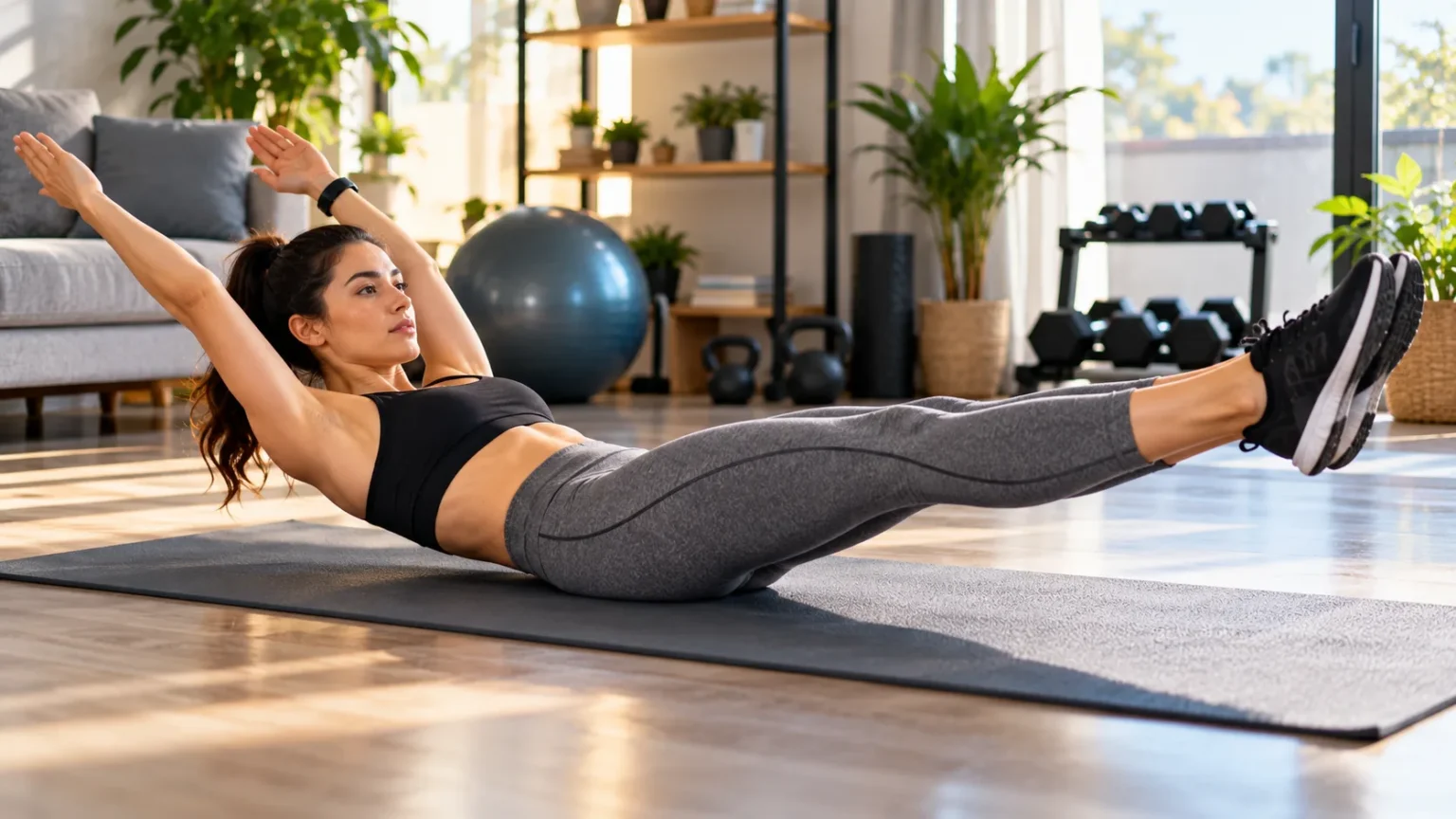

What Is a Hollow Body Hold?
The hollow body hold is an isometric core exercise that teaches you to maintain full-body tension while keeping your lower back pressed toward the floor. Instead of repeatedly bending and straightening the spine, you hold a controlled position for time. The exercise is commonly used in gymnastics, calisthenics, strength training, and general fitness because it develops strong core control with little equipment.
During the movement, your shoulders and legs are lifted from the floor while your abdominal muscles work to prevent your lower back from arching. Your body creates a slightly curved or “hollow” shape from your shoulders through your hips. Although the position looks simple, maintaining it correctly requires coordination between your abdominal muscles, hip flexors, glutes, and upper body.
The hollow hold is also useful because it teaches bracing rather than relying only on visible abdominal movement. Learning to create tension throughout the trunk can carry over to many other exercises. Pull-ups, push-ups, handstands, squats, overhead movements, and gymnastic skills often become easier to control when you understand how to maintain a stable torso.
What Muscles Does the Hollow Body Hold Work?
The primary muscles working during a hollow body hold are the abdominal muscles, particularly the rectus abdominis and deeper core stabilizers. These muscles help prevent excessive extension of the lower back while keeping the ribs and pelvis positioned correctly. The transverse abdominis and obliques also contribute by maintaining abdominal pressure and resisting unwanted movement through the trunk.
Your hip flexors help keep the legs lifted, especially when they are extended farther away from your body. The quadriceps remain active to keep the knees straight, while the glutes can help maintain pelvic control. Your shoulders and upper back also contribute when the arms are extended overhead, making the hollow hold more of a full-body exercise than a simple abdominal drill.
The exercise does not isolate one individual muscle, which is part of its value. Instead, it teaches multiple muscle groups to work together while your spine remains controlled. This coordinated tension is especially useful for athletic movements and bodyweight exercises where the trunk needs to remain stable as the arms or legs create force.
Benefits of the Hollow Body Hold
One major benefit of the hollow body hold is improved core stability. Rather than training the abdominal muscles only through repeated spinal flexion, the exercise teaches them to resist unwanted arching. This ability can help you maintain better trunk control during lifting, running, bodyweight training, and everyday activities that require your body to transfer force efficiently.
The exercise can also improve body awareness because you must pay attention to rib position, pelvic position, breathing, and lower-back contact simultaneously. Small changes in leg or arm position can dramatically increase or decrease the difficulty. This makes the hollow hold useful for learning how different parts of your body influence core tension and spinal alignment.
Another advantage is that the exercise is easy to scale and requires no equipment. Beginners can perform simplified versions with bent knees or arms by their sides, while advanced athletes can use longer lever positions and extended holds. Because the difficulty can be adjusted easily, the hollow body hold works well in warm-ups, core sessions, and strength programs.
How to Perform the Hollow Body Hold Correctly
Start by lying flat on your back with your knees bent and feet on the floor. Gently bring your ribs down and tilt your pelvis so your lower back moves toward the floor. Once you can maintain this position comfortably, lift your shoulders slightly and raise your feet while keeping your abdominal muscles engaged throughout the movement.
Next, extend your legs gradually while maintaining lower-back contact with the floor. Your legs should remain close together, and your toes can point slightly forward if that helps create full-body tension. Keep your shoulders lifted without pulling aggressively on your neck, and maintain steady breathing rather than holding your breath for the entire exercise.
As your control improves, reach your arms overhead to make the movement more challenging. A useful breakdown of hollow hold form can help reinforce how body position changes the difficulty. Stop the set when your lower back begins lifting significantly or you can no longer maintain controlled breathing and stable alignment.
Common Hollow Body Hold Mistakes
Allowing the lower back to arch away from the floor is one of the most common mistakes. This usually happens when the legs are extended too far or the exercise variation is too difficult. Instead of forcing the full position, bend your knees or bring your legs higher until you can maintain abdominal tension without losing control of your lower back.
Another mistake is lifting the head while leaving the shoulders flat. This can create unnecessary neck tension without improving core engagement. Think about gently lifting the shoulder blades rather than simply bringing your chin toward your chest, and keep your neck comfortable instead of aggressively flexing it throughout the hold.
Holding your breath can also reduce exercise quality. The hollow hold should challenge your core, but you should still be able to take controlled breaths. If breathing causes your ribs to flare dramatically or your lower back to lift, shorten the hold or use an easier variation until you can maintain position while breathing normally.
Hollow Body Hold Progressions for Beginners
Beginners can start with a bent-knee hollow hold, sometimes called a tuck hold. Lie on your back, lift your shoulders slightly, and bring your knees toward your chest while maintaining lower-back contact with the floor. Keeping the knees bent shortens the lever created by your legs, reducing the amount of force your abdominal muscles need to control.
Once the tuck position becomes comfortable, begin moving your knees slightly farther away from your chest. You can also extend one leg at a time while keeping the opposite knee bent. These small progressions allow you to increase difficulty without suddenly losing the body position that makes the hollow hold effective.
Your arms can also be used to control intensity. Keeping them alongside your body is easier than reaching them toward your knees, and reaching overhead creates a greater challenge. Progress only when you can maintain stable form, controlled breathing, and lower-back contact rather than trying to reach the hardest variation as quickly as possible.
Advanced Hollow Body Hold Variations
Once you can comfortably maintain a full hollow body hold, you can increase the challenge through movement or resistance. Hollow rocks are a popular progression in which you gently rock forward and backward while maintaining the same hollow shape. The goal is to move as one connected unit rather than allowing the hips, legs, and shoulders to move independently.
You can also add light resistance by holding a small weight overhead or placing a resistance band around your feet. These options increase the demand on your core and shoulders without requiring a completely different exercise. Resistance should remain manageable enough that your lower back stays controlled and your body position does not collapse.
Advanced athletes may combine hollow positions with pull-ups, hanging movements, handstands, or gymnastic drills. These variations require the core strength developed in the floor-based exercise to transfer into more complex movement. Progress gradually because advanced hollow work can become demanding on the hip flexors, shoulders, and trunk when volume increases too quickly.
How Long Should You Hold a Hollow Body Position?
Beginners do not need extremely long holds to benefit from the exercise. Holding a good position for 10 to 20 seconds can be more valuable than struggling through a minute with poor form. Start with several short sets and focus on maintaining consistent tension throughout each repetition rather than chasing a specific time target.
As your endurance improves, you can gradually increase the duration to 20, 30, or 40 seconds. Another option is adding additional sets while keeping each hold relatively short. This approach often helps maintain higher-quality technique because fatigue is less likely to cause excessive lower-back arching, neck tension, or uncontrolled breathing.
There is no single ideal duration for everyone because training goals and experience levels differ. Gymnasts may use longer or more advanced holds, while general fitness trainees may benefit from shorter controlled sets. The best duration is the amount of time you can maintain proper alignment without compensating or turning the exercise into an uncomfortable endurance test.
How Often Should You Do Hollow Body Holds?
Most people can include hollow body holds two to four times per week depending on training intensity and overall workload. Because the exercise is isometric and generally requires no external weight, recovery demands can be moderate. However, frequency should still be adjusted if your abdominal muscles, hip flexors, lower back, or shoulders remain unusually sore.
The hollow hold works well near the beginning of a workout as an activation drill or later as part of dedicated core training. Performing it early may help reinforce trunk control before compound exercises such as squats, pull-ups, or overhead presses. When used later, it can provide focused core work without requiring machines or complicated equipment.
More frequent practice is not automatically better. Core muscles respond to training and recovery just like other muscle groups. Focus on high-quality repetitions and gradually increase difficulty instead of performing long daily sessions that leave your hip flexors or lower back constantly fatigued.
Hollow Body Hold vs. Plank
Both the hollow body hold and plank train the core isometrically, but the positions challenge the body differently. A plank places you face down while supporting your weight through your arms and feet. The hollow hold is performed on your back and requires you to control extended arms and legs while maintaining contact between your lower back and the floor.
The hollow body hold typically places greater emphasis on controlling rib flare and pelvic position as the limbs move farther from the center of the body. A plank often involves more shoulder loading because your upper body supports a larger portion of your body weight. Both exercises can develop valuable core stability when performed with appropriate technique.
You do not necessarily need to choose one exercise over the other. Including both can expose your trunk to different stability challenges and help develop more complete core control. Your training goals, available equipment, shoulder comfort, and current ability should determine which variation receives more emphasis within your program.
How the Hollow Body Hold Improves Other Exercises
A strong hollow position can transfer directly to bodyweight movements such as pull-ups and push-ups. During these exercises, excessive arching can reduce body control and make movement less efficient. Learning to keep your ribs and pelvis better aligned can help your body move as one coordinated unit rather than allowing the trunk to collapse between the shoulders and hips.
Gymnastics and calisthenics movements rely heavily on hollow-body strength. Handstands, toes-to-bar, muscle-ups, levers, and many swinging movements require athletes to control their trunk while the arms and legs generate movement. Practicing the hollow hold on the floor provides a simpler environment in which to develop the tension required for these more advanced skills.
Traditional strength training can also benefit from better bracing awareness. Although the exact posture used in a squat or deadlift differs from a hollow hold, both require awareness of spinal position and trunk tension. The exercise can therefore serve as a teaching tool that helps people better understand how their abdominal muscles contribute to whole-body stability.
When to Modify or Avoid the Hollow Body Hold
The hollow body hold should feel challenging in your abdominal muscles, but it should not create sharp or worsening pain. If you experience significant lower-back discomfort, begin with a much easier variation and check whether you can maintain pelvic control. Extending your legs farther than your current strength allows is a common reason discomfort develops.
People with recent abdominal surgery, significant back problems, hernias, pregnancy-related restrictions, or other medical conditions may need individualized advice before performing demanding core exercises. Your healthcare professional or physiotherapist can help determine whether the movement is appropriate. General exercise guidance should not replace specific rehabilitation instructions following injury or surgery.
You should also modify the exercise if neck discomfort develops. Keeping the arms by your sides, supporting the head briefly, or performing shorter sets may reduce unnecessary tension while you build strength. If pain continues despite modifying the position, stop the exercise and seek professional assessment rather than repeatedly training through symptoms.
Conclusion
The hollow body hold is a simple but demanding core exercise that develops abdominal strength, body awareness, and full-body tension. It teaches you to control your ribs, pelvis, and lower back while your arms and legs create longer levers. These skills can transfer to strength training, calisthenics, gymnastics, and many everyday movements requiring trunk stability.
Good technique matters more than holding the hardest position for the longest possible time. Beginners can start with bent knees and easier arm positions before gradually extending the limbs. Progressing slowly allows the abdominal muscles to become stronger while reducing the tendency to compensate through the lower back, neck, or hip flexors.
For most people, a few controlled sets performed several times per week are enough to make the hollow hold useful. Keep breathing, stop when form breaks down, and choose a variation that matches your current ability. With consistent practice, the exercise can become a valuable part of a balanced core-strengthening routine.
FAQs
What is the hollow body hold good for?
The hollow body hold improves core stability, abdominal endurance, body awareness, and trunk control. It can also support exercises such as pull-ups, push-ups, handstands, and other movements requiring full-body tension.
How long should a beginner hold a hollow body hold?
Beginners can start with 10 to 20 seconds per set while maintaining correct form. Several short, controlled holds are usually more useful than one long repetition performed with excessive lower-back arching.
Should your lower back touch the floor during a hollow hold?
Your lower back should remain gently pressed toward the floor throughout the movement. If it arches significantly, shorten the lever by bending your knees or adjusting your arm position.
Can hollow body holds build abs?
Yes, hollow body holds strengthen several abdominal and core muscles through isometric tension. Visible abdominal definition, however, also depends on overall muscle development, nutrition, genetics, and body-fat levels.
Are hollow body holds safe for lower-back pain?
They may not be suitable for every type of lower-back pain. If the exercise causes or worsens discomfort, use an easier variation or seek guidance from a qualified healthcare or rehabilitation professional.