
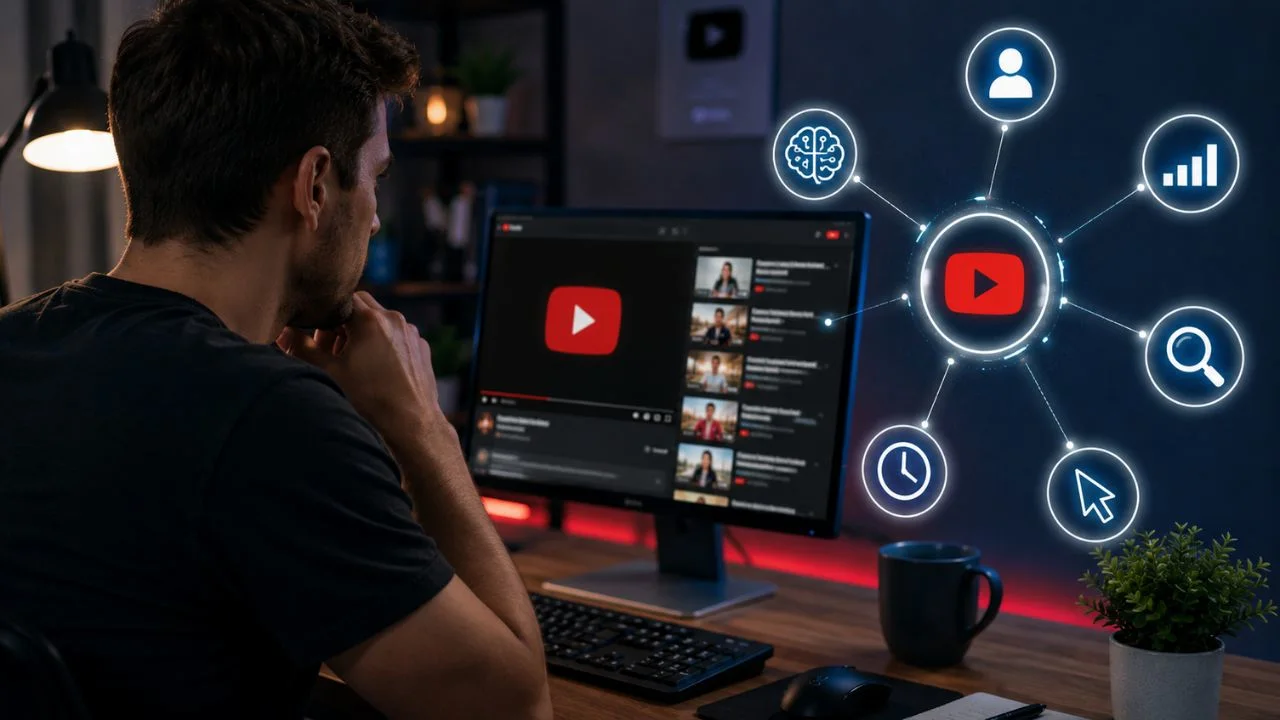

The YouTube algorithm is often described as a mysterious system that decides which creators succeed. In reality, YouTube uses multiple recommendation and discovery systems to match individual viewers with videos they may choose to watch and enjoy. The goal is not simply to promote the most popular channel or newest upload.
Recommendations appear across several areas of YouTube, including the Home feed, Up Next panel, Shorts feed, channel pages, and topic-based destination pages. Each surface serves a different viewer intention, so the same video may perform strongly in Search but receive fewer impressions on Home or Suggested Videos.
YouTube’s current official guidance describes two broad goals for its recommendation system: helping each viewer find videos they want to watch and maximizing long-term viewer satisfaction. The system considers individual viewing habits, current context, and how people respond when a particular video is offered to them.
For creators, this means there is no single trick that guarantees recommendations. Sustainable growth comes from understanding an audience, choosing ideas viewers care about, presenting those ideas with accurate titles and thumbnails, and delivering enough value to keep viewers satisfied after clicking.
What Is the YouTube Recommendation Algorithm?
The YouTube recommendation algorithm is a collection of machine-learning systems that predicts which videos may be relevant to a particular viewer at a particular moment. It does not create one universal ranking that every user sees. Two people opening YouTube at the same time can receive completely different recommendations.
The system learns from a viewer’s watch history, search activity, subscriptions, likes, dislikes, feedback, and interest in particular topics or formats. YouTube may also compare that viewer’s habits with the behavior of people who have similar interests to identify videos the person has not discovered yet.
Recommendations can also change according to context. YouTube’s official guidance states that the system may consider factors such as device type, time of day, and previous viewing habits. A person who usually watches news on a phone in the morning and entertainment on television at night may receive different suggestions in each situation.
It is therefore more accurate to think of YouTube as matching videos with viewers rather than pushing every upload toward a large audience. The platform evaluates which available videos appear most relevant and satisfying for each user when that person visits a recommendation surface.
The Algorithm Follows Viewers, Not Creators
Creators often ask whether the YouTube algorithm likes or dislikes their channels. YouTube’s current explanation encourages creators to replace that question with a more useful one: does the intended audience like this content? Recommendations are driven primarily by viewer preferences and responses rather than by a personal judgment about the creator.
When a video is shown to potential viewers, the system observes whether they choose it, ignore it, dismiss it, or mark it as uninteresting. After someone starts watching, YouTube can evaluate whether the viewer continues, leaves quickly, engages positively, or reports feeling satisfied with the experience.
This explains why two videos from the same channel can receive very different results. YouTube uses fresh performance information for individual uploads instead of assuming that every new video will perform exactly like the creator’s previous work. One unsuccessful experiment does not permanently damage a channel.
However, audience patterns can affect long-term channel performance. When viewers repeatedly ignore or leave most of a channel’s videos, future uploads may face difficulty because the available evidence suggests that the current content is not consistently meeting that audience’s expectations.
The Three Main Performance Signals: Appeal, Engagement, and Satisfaction
YouTube organizes content-performance signals into three useful categories: appeal, engagement, and satisfaction. These categories help the platform predict whether someone is likely to choose a video, continue watching it, and feel that the experience was worthwhile. The exact measurements can vary across formats.
Appeal concerns the initial decision. YouTube evaluates whether viewers choose to watch when the video is presented or whether they ignore it, dismiss it, or select “Not interested.” The topic, title, thumbnail, audience familiarity, and context can all influence this decision.
Engagement begins after the click. The system examines whether viewers remain interested, how long they watch, how much of the video they complete, and where they leave. A strong thumbnail may create the first click, but the content must quickly deliver the value that the packaging promised.
Satisfaction goes beyond total viewing time. YouTube can consider likes, dislikes, shares, viewer feedback, and post-watch satisfaction surveys. These signals help distinguish a genuinely rewarding video from content that holds attention through misleading, repetitive, or frustrating techniques.
How YouTube Personalizes Recommendations
Personalization begins with the viewer’s previous behavior. Videos watched for a meaningful amount of time can help YouTube understand preferred creators, topics, styles, and formats. Videos ignored, disliked, or marked “Not interested” can teach the system what should appear less frequently.
Search history also shapes future recommendations. Someone who repeatedly searches for beginner photography tutorials may begin seeing more photography videos on Home and Up Next. Subscriptions, likes, comments, shares, language preferences, and satisfaction responses can provide additional information about that person’s interests.
YouTube also studies interest affinity, meaning the themes and viewing patterns shared among people with similar preferences. When viewers who enjoy one set of videos frequently enjoy another creator or subject, the system may test that related content with other members of the same audience group.
Viewers have some control over this process. They can remove items from watch or search history, pause history, dislike videos, mark recommendations as uninteresting, or select “Don’t recommend channel.” These actions can influence what YouTube recommends in the future.
How Videos Are Recommended on the YouTube Home Page
The Home feed is primarily a personalized discovery surface. It can contain videos from subscribed channels, videos enjoyed by similar viewers, recently uploaded content, and older videos that the system predicts will suit the individual’s interests. It is not simply a chronological feed.
When ranking Home recommendations, YouTube evaluates how effectively a video interested and satisfied similar viewers. It also considers the current viewer’s watch and search history, familiarity with the topic or channel, and how many times that particular video has already been presented.
A video does not need to come from a large channel to appear on Home. When the topic, packaging, and viewer response indicate that an upload is relevant to a specific audience, the recommendation system may show it to people who have never previously watched that creator.
Home impressions can fluctuate even when a video’s performance metrics appear healthy. Topic demand, competing uploads, seasonality, audience size, and changing viewer interests can all affect how many suitable recommendation opportunities are available at a given time.
How Suggested Videos and Up Next Work
Suggested Videos appear beside or after the content a viewer is currently watching. The main objective is to predict which video the person is most likely to watch next. The current video is therefore an especially important signal on the Up Next surface.
YouTube often recommends videos related to the subject, creator, audience, or viewing pattern of the current content. However, Suggested Videos do not always need to cover exactly the same topic. Recommendations may also be personalized according to the individual viewer’s broader watch history.
Creators can improve their chances of earning Suggested traffic by creating connected videos that naturally satisfy the next question or interest. A tutorial explaining how to choose a camera could lead logically to videos about camera settings, lenses, lighting, or beginner photography mistakes.
Playlists, series, end screens, and clear verbal transitions can encourage viewers to continue with another relevant video. These features do not force the recommendation algorithm to select a video, but they can make the next viewing decision easier and create stronger connections among related content.
How YouTube Search Ranks Videos
YouTube Search serves a different purpose from the Home feed. A search user has entered a specific query, so the system focuses more heavily on relevance to that request. Search results are not simply ordered according to which videos have accumulated the most total views.
YouTube evaluates how closely the title, description, and actual video content match the search. It also considers which videos have generated useful engagement for that query. This means keyword relevance matters, but viewer response and content quality still influence search visibility.
Creators should use the words their intended viewers are likely to search, especially in the title, description, spoken content, and relevant on-screen information. Keywords should clarify the topic naturally rather than being repeated excessively or inserted into unrelated sections.
Search-focused videos should answer the query efficiently. A person searching “how to replace a laptop battery” expects practical instructions rather than a long personal introduction. Matching the content structure to search intent can improve retention, satisfaction, and the likelihood that viewers choose the video.
How the Shorts Algorithm Recommends Videos
The Shorts recommendation system matches viewers with short-form videos they are likely to watch and enjoy. YouTube states that it does not automatically favor one specific type or style of Short. Rankings depend on viewer personalization and the content’s performance when it is shown.
Personalization can involve previously enjoyed Shorts, preferred channels, commonly watched topics, and interaction with trending sounds or sampled audio. A viewer who frequently watches quick cooking tutorials is more likely to receive related Shorts than someone whose history focuses on gaming or comedy.
Performance signals include whether viewers choose to watch or swipe away, the average view duration, the average percentage viewed, likes, and post-watch satisfaction responses. The opening moments are therefore important because viewers can leave immediately when the content does not capture or confirm their interest.
Shorts reach is also affected by topic interest, competition, and seasonality. A Short can produce good engagement yet receive fewer impressions when competing content performs even better or when fewer people are currently interested in that particular topic.
Why Titles and Thumbnails Matter
A title and thumbnail form the packaging through which most viewers first evaluate a long-form video. Their purpose is to communicate the topic, expected value, and reason to watch. Strong packaging increases appeal by helping suitable viewers recognize that the content is relevant to them.
YouTube’s current creator guidance describes titles and thumbnails as important for communicating value, creating curiosity, and establishing clear expectations. The best packaging attracts the right audience while accurately representing what the video will deliver.
A high click-through rate is not automatically valuable when the title or thumbnail misleads viewers. If people click and quickly leave because the promised content is absent, engagement and satisfaction signals may weaken. Effective packaging and effective content must support each other.
Changing a title or thumbnail can influence performance because viewers may respond differently to the new presentation. YouTube does not reward the edit itself. The system observes how people interact after the change, so creators should avoid replacing packaging that is already working successfully.
How Watch Time and Audience Retention Influence Recommendations
Watch time helps YouTube understand whether viewers remained interested after choosing a video. However, creators should not interpret this as a requirement to make every upload as long as possible. Artificially stretching a topic can create filler and reduce satisfaction.
YouTube states that there is no universally ideal video length. A video should be long enough to deliver its intended information or entertainment value without unnecessary material. Retention data can reveal where viewers lose interest and whether the length suits the audience.
Relative watch time can be particularly useful for shorter videos because it shows the percentage completed. Absolute watch time becomes more meaningful for longer videos because a viewer may receive substantial value without finishing every minute of an extended documentary, interview, or tutorial.
Creators should examine audience-retention graphs for sharp early exits, skipped sections, repeated moments, and sustained segments. These patterns can reveal weak introductions, slow explanations, confusing transitions, or especially valuable moments that should influence future content decisions.
Why Viewer Satisfaction Matters More Than Clicks Alone
A click tells YouTube that the title and thumbnail attracted attention, but it does not prove that the video fulfilled the viewer’s expectation. Recommendation quality would decline if the system rewarded every sensational headline without considering what happened after the click.
YouTube therefore uses multiple satisfaction-related signals, including viewing behavior, likes, dislikes, shares, “Not interested” responses, and surveys asking viewers about their experience. No single signal completely determines whether a video will be recommended.
Creators can support satisfaction by delivering the promised value quickly, removing unnecessary repetition, explaining ideas clearly, and respecting the viewer’s time. Entertainment videos should deliver the expected emotion or experience, while educational content should provide accurate and understandable answers.
The most useful question is not merely, “How do I keep people watching?” It is, “How do I make the time they spend watching worthwhile?” Retention created through genuine value is more sustainable than retention created through endless delays, misleading promises, or artificial suspense.
External Factors That Affect Video Reach
Creators sometimes assume that declining impressions mean the algorithm has punished their channel. In many cases, performance changes reflect normal shifts in topic demand, competition, or seasonality rather than a hidden channel penalty.
Topic interest represents the number of people currently interested in a subject. A major event can suddenly increase demand, while a seasonal topic may decline after a holiday or buying period ends. Evergreen subjects can also experience gradual changes as audience needs evolve.
Competition affects how often a video is selected because YouTube compares it with other content that the same viewer might watch. Even a video with strong click-through rate and retention may receive fewer impressions when another available option produces stronger viewer satisfaction.
Seasonality includes holidays, school schedules, sporting periods, regional events, and changing routines. Creators should compare performance over realistic periods and consider what is happening in the audience’s life before concluding that every traffic fluctuation is caused by a technical problem.
Does Uploading More Frequently Increase Recommendations?
YouTube does not require creators to upload every day or follow a minimum posting cadence for videos to perform well. Official guidance states that growth in views is not directly correlated with the amount of time between uploads. Quality and audience connection are more important than volume alone.
A consistent schedule can still be valuable when it helps viewers know what to expect and allows the creator to maintain a recognizable presence. Consistency should mean reliably delivering useful content, not publishing rushed videos simply to satisfy an imagined algorithmic requirement.
Creators are also not automatically penalized for taking a break. YouTube reports finding no correlation between the length of an upload break and changes in views across the channels it studied, although an audience may need time to return to its previous viewing routine.
A sustainable publishing plan should reflect production capacity, audience expectations, and content complexity. One excellent weekly video may outperform several rushed uploads when it generates stronger appeal, engagement, and viewer satisfaction.
Does Publishing Time Affect Recommendations?
Publishing when viewers are active can help a video receive early attention, particularly from subscribers and regular viewers. It can also matter for time-sensitive formats such as livestreams and Premieres, where audience availability directly affects participation.
However, YouTube states that publication time is not known to influence a video’s long-term performance. The recommendation system can continue finding suitable viewers after the upload date, regardless of whether the video was released at the supposedly perfect hour.
Creators can use the “When your viewers are on YouTube” report to schedule livestreams, Premieres, community posts, or launches more conveniently. This information should support audience accessibility rather than create anxiety about missing a narrow algorithmic window.
Evergreen videos may begin slowly and gain traffic later when the topic becomes relevant, Search demand increases, or YouTube identifies a better audience match. Creators should therefore avoid judging every upload solely by its first few hours.
Do Subscribers, Likes, and Comments Control the Algorithm?
Subscriptions help YouTube understand a viewer’s channel preferences and provide creators with access to the Subscriptions feed. However, a subscriber count does not guarantee an equal number of views because people subscribe to many channels and may not watch every new upload.
Likes and dislikes contribute to recommendation decisions, but they are only part of a much larger set of signals. YouTube also learns from whether viewers choose the video, how much they watch, whether they feel satisfied, and how relevant it appears to that particular audience.
Comments can indicate community involvement and provide creators with direct feedback about viewer interests. However, generating a large number of shallow comments does not automatically guarantee widespread recommendations when the video fails to maintain attention or satisfy viewers.
Calls to like, comment, and subscribe can be useful when they are natural and relevant. The strongest long-term strategy remains creating videos that inspire genuine responses rather than treating engagement actions as buttons that mechanically unlock algorithmic reach.
Common Myths About the YouTube Algorithm
One common myth is that monetized videos receive greater recommendation priority. YouTube states that its search and recommendation systems do not use monetization status as a ranking advantage. Videos are recommended according to expected viewer satisfaction, whether advertisements are enabled or not.
Another myth is that an underperforming upload permanently damages the entire channel. YouTube relies heavily on individual-video and audience-level responses. A failed experiment does not automatically prevent future content from finding viewers, although a continued pattern of ignored videos can reduce overall channel activity.
Creators also sometimes believe that tags are a major discovery tool. YouTube’s current guidance says tags can help with common misspellings, but they are not essential for discovery. The title, thumbnail, description, content, and viewer response carry greater practical importance.
A final myth is that Shorts damage long-form recommendations. YouTube states that Shorts performance does not negatively affect long-form video recommendations. Shorts can support audience discovery, although viewers may still prefer different formats for different topics.
How Creators Can Increase Their Recommendation Potential
Begin with audience-focused video ideas rather than attempting to copy every trend. Identify the problems, questions, emotions, and entertainment experiences your current and potential viewers value. A strong idea gives the title, thumbnail, hook, and content a clear direction.
Package the idea with an accurate and compelling title and thumbnail. The viewer should understand the subject and recognize a meaningful reason to click. Curiosity can be useful, but the video must answer the expectation created by the packaging.
Deliver value immediately after the click. YouTube advises creators to keep introductions concise and reassure viewers that the content will fulfill the title and thumbnail’s promise. Use retention data to identify where the video loses attention and improve future structure.
Finally, evaluate videos through appeal, engagement, satisfaction, and traffic source rather than obsessing over one metric. A Search video, Home recommendation, Suggested Video, and Short may succeed for different reasons. Understanding those differences produces better decisions than searching for one universal algorithm hack.
Final Thoughts on How YouTube Recommends Videos
The YouTube algorithm recommends videos by predicting what each viewer is most likely to choose, watch, and enjoy. It considers personalization, content performance, viewing context, topic demand, competing videos, and the specific YouTube surface where the recommendation appears.
Home relies heavily on personal viewing history and performance among similar viewers. Up Next considers the current video and personal interests, Search focuses on query relevance and engagement, while the Shorts feed evaluates viewer preferences, viewing decisions, retention, and satisfaction.
Creators do not need to manipulate a secret formula. They need to understand an audience, develop relevant ideas, create accurate titles and thumbnails, hold attention through genuine value, and learn from the performance information available in YouTube Analytics.
The algorithm will continue evolving, but its central purpose remains consistent: connect viewers with content they are likely to value. A creator who focuses on making satisfying videos for recognizable audiences is therefore better positioned than one who constantly chases shortcuts.
Frequently Asked Questions
1. How does the YouTube algorithm decide what to recommend?
YouTube considers a viewer’s history, interests, subscriptions, feedback, and context. It also evaluates whether people choose a video, continue watching, and appear satisfied after viewing it.
2. Is watch time the most important YouTube ranking factor?
Watch time is important, but it is not the only factor. YouTube also considers appeal, retention, satisfaction, relevance, viewer feedback, competition, topic interest, and personalization.
3. Does uploading every day help the YouTube algorithm?
YouTube does not require daily uploads or a minimum posting schedule. A sustainable publishing plan focused on quality and audience value is generally more useful than rushed daily content.
4. Do YouTube Shorts hurt long-form video recommendations?
No. YouTube states that Shorts performance does not negatively affect long-form recommendations. However, individual viewers may prefer different topics and creators in short-form and long-form formats.
5. Can changing a thumbnail increase YouTube recommendations?
It can help when the new thumbnail causes suitable viewers to respond more positively. YouTube does not reward the edit itself; it reacts to changes in viewer behavior after the new packaging appears.