
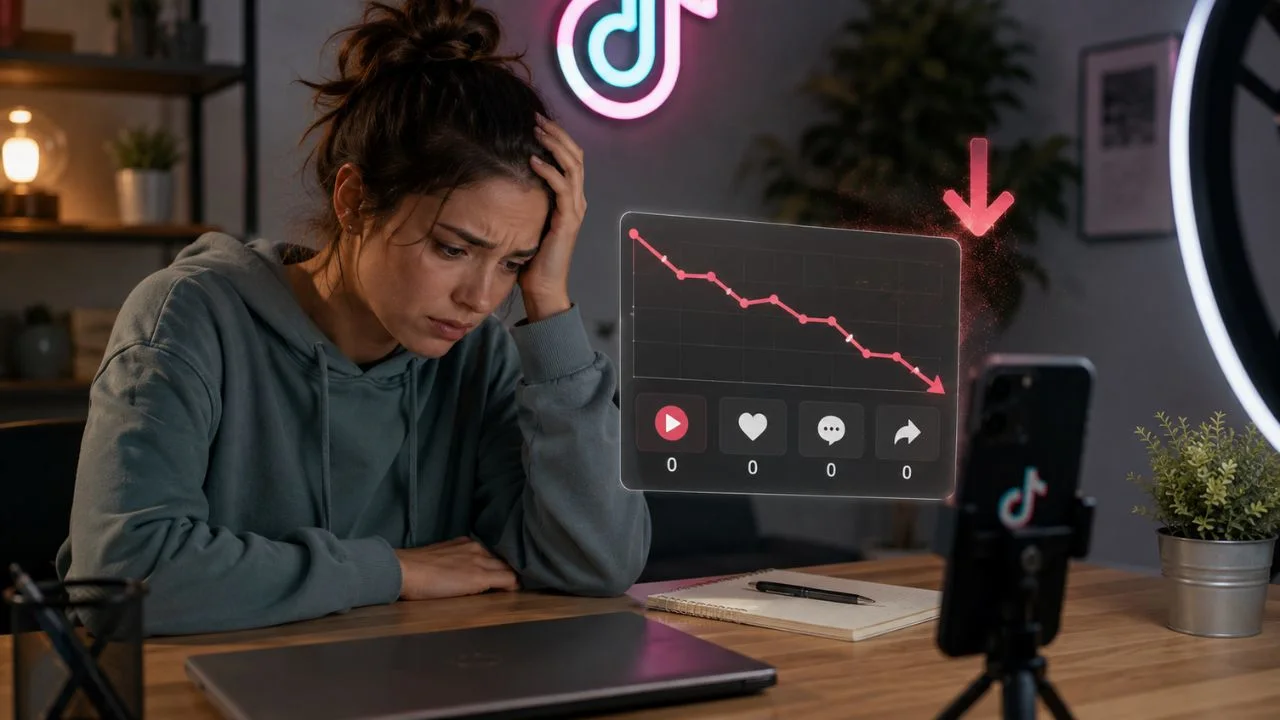

Posting a TikTok video and watching it receive only a few views can be frustrating. You may have spent time planning, recording, editing, adding captions, and selecting hashtags, only to see the post stop reaching new viewers. Low views do not necessarily mean that your account or content has permanently failed.
TikTok distributes content through personalized recommendation systems rather than showing every post equally to every user. The platform considers how people interact with content, what the video contains, and information such as language, location, and device settings. Viewer actions generally carry greater weight than most basic device or account signals.
A video can also receive limited reach because its topic has weak demand, the opening fails to hold attention, the content does not match the intended audience, or the post is unsuitable for the For You feed. Some videos simply face stronger competition or need more time to find viewers interested in the subject.
This guide explains why your TikTok videos are not getting views and how to improve your content without relying on fake engagement or misleading tricks. It covers the TikTok algorithm, watch time, audience retention, video hooks, SEO, hashtags, account status, content eligibility, originality, analytics, and a practical recovery strategy.
How TikTok Decides Which Videos to Recommend
TikTok’s recommendation systems try to predict which content each individual user is most likely to find interesting. The For You feed is therefore different for every person. A video that is highly relevant to one viewer may never be shown to another viewer with unrelated interests.
TikTok groups its main recommendation signals into user interactions, content information, and user information. Interactions may include likes, shares, comments, full watches, skips, and time spent watching. Content information can include sounds, hashtags, view numbers, and the country where the post was published.
User information may include language preferences, location, time zone, day, device type, and device settings. However, TikTok says that user interactions, including time spent watching, are generally weighted more heavily for most users than these basic contextual signals.
This means the platform is not simply rewarding accounts with the most followers. It is continually trying to match eligible posts with people who may watch and enjoy them. Improving your reach begins with making that match easier and delivering a satisfying experience after the viewer stops scrolling.
Why TikTok Views Can Fluctuate
TikTok views are rarely distributed evenly across every post. One video may reach thousands of viewers while the next receives only a small number, even when both come from the same account. Different topics, openings, audiences, and competing posts can create very different outcomes.
A video can also gain additional reach later. Search demand may increase, the subject may become relevant, or the recommendation system may identify viewers whose behavior suggests an interest in the content. Low early views do not always mean a post has reached its final audience.
TikTok itself advises creators experiencing fluctuating views to use analytics to understand content performance. The platform’s analytics tools can show information about overall views, engagement, audience activity, and individual post performance rather than forcing creators to rely entirely on assumptions.
Judge patterns across several posts rather than panicking over one disappointing result. If nearly every recent video has lost reach, investigate content eligibility, account status, retention, topic selection, and audience response. If only one post performed poorly, the problem may be specific to that particular idea or execution.
1. Your Video May Be Ineligible for the For You Feed
TikTok removes content that violates its Community Guidelines, but some permitted content may still be unsuitable for broad recommendation. Such a post can remain accessible on the creator’s profile while being excluded or limited within the For You feed.
TikTok’s For You feed eligibility standards are designed for an audience that includes people of different ages and backgrounds. Certain material may therefore be considered inappropriate for repeated or broad recommendation even when it is not serious enough to justify complete removal.
A low-view video does not automatically mean you violated a policy. TikTok explicitly notes that posts can receive few views for other reasons. Creators can review analytics and post notices to determine whether a particular upload was made ineligible for recommendation.
Open the affected post and review its analytics or additional insights for eligibility notices. When TikTok identifies a post as ineligible and you believe the decision is incorrect, use the appeal option provided in the app instead of repeatedly deleting and reposting the same material.
2. Your Account May Have a Recommendation Restriction
A single ineligible post does not necessarily mean that the entire account has been restricted. However, TikTok states that accounts repeatedly posting material considered unsuitable for the For You feed may become harder to find in both recommendations and search results.
Creators sometimes describe every sudden reach decline as a “shadowban.” This informal term can hide several different problems, including content ineligibility, account restrictions, weak audience response, reduced topic demand, technical errors, or ordinary performance fluctuations.
Instead of assuming a hidden penalty, check the account directly. TikTok provides an Account Check tool that shows restrictions or warnings affecting login access, posts, comments, profile editing, and direct messages. It can be accessed through TikTok Studio or the app’s Safety Center.
From TikTok Studio, open More tools and select Account check. You can also open Settings and privacy, select Support, enter the Safety Center, and choose Account check. A checkmark indicates no detected issue, while a warning sign indicates a concern that should be reviewed.
3. Your Opening Does Not Stop the Scroll
TikTok users make viewing decisions quickly. When the first moments are slow, confusing, visually empty, or unrelated to the promised topic, people may swipe before understanding why the video is useful. Those skips give the system less evidence that the post matches the audience.
Begin with the strongest part of the idea rather than a long greeting or unnecessary introduction. A tutorial can open with the problem or result, while a story can begin with the turning point. A product video may start by showing the benefit before explaining every feature.
TikTok’s official creative guidance for advertisers recommends introducing the content proposition within the first three seconds and prioritizing the hook within the opening six seconds. Although advertising and organic videos are not identical, the principle reflects the importance of attracting and retaining attention early.
The hook should create interest without misleading viewers. A dramatic opening that promises something the rest of the video never delivers may earn initial views but weaken retention and trust. The most effective hook makes the right audience curious and then immediately begins fulfilling the promise.
4. Viewers Are Leaving Too Early
Getting a viewer to stop scrolling is only the first part of TikTok performance. The content must then maintain attention. TikTok identifies watching in full, skipping, and time spent watching as user interactions that can influence recommendations.
Early exits may happen because the video takes too long to reach the point, repeats information, lacks visual movement, or contains an explanation that is difficult to follow. A video can also lose viewers when the hook and the actual content appear to discuss different subjects.
Review each section and ask whether it adds new information, emotion, or entertainment. Remove pauses, repeated sentences, unnecessary background details, and endings that continue after the main value has already been delivered. Faster is not always better, but every moment should have a purpose.
Use TikTok analytics to compare posts and identify patterns. If videos consistently lose viewers near the beginning, improve the hook and first explanation. If viewers leave halfway through, the structure may need clearer progression, stronger examples, or a shorter route to the promised result.
5. Your Video Is Too Long for the Idea
TikTok supports different content lengths, but a longer duration is not automatically better. A simple idea stretched across several minutes may create repetition, while a complicated tutorial compressed into a few seconds may feel rushed and incomplete.
Choose the duration according to the value being delivered. A quick visual tip may need only a short demonstration. A case study, transformation, tutorial, or personal story may require more time to become useful and satisfying.
The goal is not to make every viewer watch 100% of every video at any cost. The goal is to avoid wasting the audience’s time. A longer video can perform well when each section maintains interest, while a short video can struggle when its opening is unclear or irrelevant.
Before publishing, watch the video without editing and note every moment where your attention drops. Remove anything that does not strengthen understanding, emotion, credibility, or entertainment. The finished post should feel complete rather than artificially long or abruptly shortened.
6. Your Topic Does Not Match the Audience
A technically polished video can still receive few views when its topic does not interest the people to whom it is initially shown. TikTok uses previous interactions and similarities between users to predict which content may be relevant to each person.
When an account changes subjects constantly, the platform and the audience may struggle to understand who the content serves. A creator might post cooking tips, business advice, gaming clips, personal updates, and unrelated memes without building a recognizable reason for viewers to return.
This does not mean you can never experiment or discuss more than one subject. It means that your topics should share an understandable audience or value. A fitness creator, for example, can discuss workouts, meal preparation, recovery, motivation, and equipment because these topics can serve overlapping viewers.
Identify three to five content pillars connected to one audience. Test ideas within those pillars and track which topics attract longer viewing, saves, comments, profile visits, and followers. Clear audience positioning helps TikTok find better matches and helps users decide whether to follow.
7. You Are Choosing Topics With Little Demand
Some videos receive limited reach because relatively few users currently care about the subject. Excellent editing cannot create unlimited demand for a narrow or outdated topic. The potential audience for each video is influenced by the number of people interested in that problem, story, or trend.
Use TikTok search to examine what people are actively looking for. The wording of suggested searches, questions in comments, competitor videos, and recurring audience problems can reveal content opportunities that already have visible demand.
TikTok’s Creator Search Insights provides information about frequently searched topics, related searches, search popularity, and areas where users may be searching for content that is currently lacking. Creators can also review how their posts perform in search results.
Do not choose topics only because they are popular. A broad trend may have high demand but little connection to your audience or expertise. The strongest opportunity usually sits between audience relevance, real search interest, manageable competition, and your ability to add something useful or entertaining.
8. Your Content Does Not Match Search Intent
TikTok is not only an entertainment feed; users also search for tutorials, recommendations, products, places, explanations, reviews, and solutions. A video can miss search traffic when it contains the right keyword but fails to provide the answer that searchers expect.
TikTok says that search results can be influenced by previous user interactions, content information, and user information. For most users, the degree to which the content matches the specific search term is generally weighted more heavily than the other search factors.
State the topic clearly in the spoken introduction, on-screen text, and caption. A creator targeting “beginner home workout” should make it immediately clear that the video provides a beginner-friendly routine rather than using a vague title such as “You need to try this.”
Match the format to the question. A “how to” query needs clear steps, while a “best” query usually needs criteria or comparisons. A location search benefits from specific local context. The better your content satisfies the intended task, the more useful it can be to searchers.
9. You Are Using Hashtags Without a Clear Strategy
Hashtags can provide content information that helps TikTok understand and organize a post. TikTok lists hashtags among the signals that may influence For You recommendations and search results, but they are only one part of a much broader recommendation system.
Adding a large collection of popular hashtags does not guarantee more views. Broad tags may place the video in an extremely competitive context, while unrelated hashtags can confuse the subject and attract people who are unlikely to watch for long.
Use a small group of relevant hashtags describing the subject, audience, problem, industry, or location. A video about beginner bookkeeping for freelancers may use terms connected to bookkeeping, freelancers, business finance, and the specific accounting question being answered.
Avoid depending on generic tags such as #fyp, #viral, or #trending as your complete TikTok SEO strategy. The spoken content, visuals, on-screen text, caption, topic relevance, and viewer response provide much stronger context than a collection of vague popularity-related labels.
10. Your Caption Is Vague or Misleading
A TikTok caption can help explain the topic and give users a reason to watch, comment, save, or continue to another part of a series. A vague caption wastes this opportunity and may provide little information to the platform or potential viewers.
Write a concise description using natural language that reflects the actual video. Include the primary topic or question without repeating the same phrase unnaturally. The caption should support the content instead of making a promise the video cannot fulfill.
For educational content, the caption can summarize the outcome or identify the intended viewer. For entertainment, it may establish the situation or create curiosity. For local content, it can mention the relevant city, area, venue, or service naturally.
Do not use a misleading caption simply to increase clicks. Viewers who feel tricked may swipe, report the content, or avoid future posts. Clear expectations attract a more suitable audience and create a better chance of meaningful watch time and engagement.
11. Your Videos Look Recycled or Unoriginal
Reposting someone else’s clips without adding meaningful creative value can limit TikTok reach. The platform’s current guidelines state that unoriginal or reused material without anything new may be made ineligible for the For You feed.
Examples of ineligible reused content include clips displaying another creator’s watermark or logo and low-quality material with minimal editing. TikTok also requires creators to have the right to share protected videos, music, images, and other intellectual property.
Reactions, commentary, education, criticism, and remix formats may add original value when they contain meaningful transformation and respect applicable intellectual-property rules. Merely cropping a clip, changing its speed, adding subtitles, or placing it over unrelated gameplay may not create enough originality.
Whenever possible, use your own footage, voice, examples, demonstrations, and perspective. Original content gives viewers a reason to choose your account rather than one of many pages reposting the same material. It also reduces the risk of recommendation restrictions and copyright complaints.
12. Your Video Quality Makes the Content Difficult to Watch
TikTok content does not need expensive cinema equipment, but viewers still need to see, hear, and understand it. Poor lighting, distorted sound, tiny text, heavy compression, and distracting backgrounds can cause people to swipe even when the underlying idea is useful.
TikTok’s creative guidance recommends vertical 9:16 content, at least 720p resolution, sound or music where suitable, and keeping important content inside the interface’s safe zone. It also recommends captions or text overlays to provide context.
Check the post on a normal phone screen before publishing. Make sure text is not hidden behind captions, profile details, engagement buttons, or other interface elements. Use clear contrast and leave enough time for viewers to read each line.
Prioritize understandable audio over expensive visuals. A stable phone recording with clear speech can outperform a heavily produced video that feels distant or confusing. Improvements should make the content easier to consume rather than making every post look like a traditional advertisement.
13. You Are Copying Trends Without Adding Relevance
Trends can introduce your content to a familiar format, sound, joke, or conversation. However, joining every trend without connecting it to your audience can produce brief attention without building a sustainable content identity.
TikTok includes sounds, hashtags, user interactions, and other content information within its recommendation systems. Trends may therefore provide useful context, but viewer interest and watch behavior still influence whether the post continues reaching people.
Use a trend when you can adapt it naturally to your subject. A real estate agent might use a popular format to explain buyer mistakes, while a restaurant could adapt it to a kitchen or menu situation. The trend should strengthen the message rather than replace it.
Do not delay useful content because no trend appears suitable. Search-focused tutorials, original stories, demonstrations, and audience questions can continue generating value after a sound or meme becomes outdated. A balanced strategy combines timely content with durable subjects.
14. Your Content Feels Like an Advertisement
TikTok users often respond better to content that resembles the platform’s normal creative language rather than a traditional commercial. A video that immediately pressures viewers to buy, uses corporate slogans, or hides all useful information behind a sales pitch may encourage quick swipes.
TikTok’s business guidance recommends content made specifically for the platform, featuring people where appropriate, using a less overly polished style, and following a structure built around a hook, value proposition, and clear action.
Provide value before demanding a conversion. A business can demonstrate a product, explain a customer problem, compare options, share a result, or show behind-the-scenes expertise. Selling becomes more natural when viewers first understand why the offer is relevant.
Promotional content can still succeed, but it must be honest and engaging. Clearly disclose commercial relationships when required, avoid exaggerated promises, and make the video useful even to someone who is not ready to purchase immediately.
15. You Are Trying to Manipulate Engagement
Buying followers, views, comments, or likes does not create a genuine interested audience. Inflated metrics can make performance harder to interpret because the account appears larger while real viewers continue ignoring or leaving the content.
TikTok prohibits buying or selling engagement, using bots or scripts to inflate metrics, and trading services intended to manipulate recommendation systems. The platform may remove fake metrics, restrict accounts, exclude content from recommendations, or impose stronger enforcement.
Engagement-bait tactics can also create problems. TikTok identifies misleading promises, false incentives, and “like-for-like” behavior as forms of inauthentic engagement that may be ineligible for the For You feed.
Ask for interaction only when it makes sense. Invite viewers to share a relevant experience, choose between two options, request a follow-up topic, or save information they may need later. Genuine responses from interested users are more valuable than large numbers of empty actions.
16. You Are Not Giving Viewers a Reason to Engage
Likes and comments are not the only measures of content quality, but meaningful engagement can show that the video created a response. TikTok includes liking, sharing, commenting, watching, and skipping among the interactions used by its recommendation systems.
A video may receive little engagement because it answers the question but does not invite further thought. Add a natural conversation point, comparison, decision, or next step rather than ending immediately after delivering information.
Avoid asking generic questions unrelated to the video. “What do you think?” may generate weaker responses than “Which of these two website layouts would you trust more?” Specific prompts reduce the effort required to participate and create more useful audience feedback.
Reply to relevant comments and note repeated questions. Those questions can become future videos, follow-up explanations, or a connected series. Comments are valuable not only as engagement metrics but also as direct customer and audience research.
17. You Are Ignoring TikTok Analytics
Without analytics, creators often blame hashtags, posting times, or supposed shadowbans without evidence. Performance data can show whether the main issue is reach, early retention, overall watch time, search visibility, engagement, or audience mismatch.
TikTok recommends using its analytics dashboard when post views fluctuate. Creator Search Insights also provides search analytics for reviewing how posts perform in search and which search-focused videos generate visibility.
Compare successful and unsuccessful videos using the same criteria. Examine the topic, hook, duration, visual style, traffic source, average viewing behavior, comments, shares, and follower activity. Look for recurring differences instead of copying one viral post without understanding why it worked.
Make one meaningful improvement at a time. Test a clearer hook, more focused topic, shorter introduction, stronger example, or better search phrase. Changing every element simultaneously makes it difficult to identify which adjustment actually helped.
18. Your Posting Time Does Not Match Your Audience
Publishing time can influence how quickly existing followers encounter a post, particularly when most of them are asleep, working, or away from TikTok. However, posting at a supposedly perfect hour cannot compensate for weak content or poor audience relevance.
TikTok includes time zone and day among the user-information signals that can influence recommendations. It also states that user interactions, including time spent watching, are generally weighted more heavily for most users in the For You feed.
Use follower-activity information in analytics to select reasonable posting windows. Test several times across multiple weeks instead of treating one result as proof. Audience habits may differ according to country, age, working schedule, school calendar, and content category.
Focus primarily on publishing when you can respond to early comments and when your likely viewers are reasonably active. Timing can support distribution, but it is a secondary improvement rather than a substitute for a relevant idea and satisfying video.
19. Your Content Has Become Predictable
Consistency helps audiences understand what an account provides, but repetition can reduce curiosity. When every video uses the same opening, examples, structure, and conclusion, regular viewers may feel they have already seen the content.
TikTok aims to diversify recommendations by introducing users to different creators, subjects, and perspectives. It also generally avoids repeatedly recommending content people have already seen.
Keep the audience and positioning consistent while varying the creative approach. You can use tutorials, stories, demonstrations, comparisons, reactions, mistakes, case studies, challenges, interviews, and behind-the-scenes content within the same niche.
Review your strongest topics and develop new angles instead of simply recreating the identical post. A successful idea may support beginner, advanced, myth-busting, comparison, local, or case-study versions that provide genuinely different value.
20. Competition for the Topic Is Strong
Your post is not evaluated in isolation. It competes for attention with other eligible content that could be shown to the same viewer. A useful video may receive fewer impressions when many creators are publishing stronger or more timely content for that audience.
TikTok’s recommendation system selects from a large collection of eligible content and ranks posts according to predicted relevance and interest. The relative importance of different signals can also change over time.
Research competing videos without copying them. Identify what they explain well, where viewers remain confused, which questions appear in comments, and what perspective is missing. Your content needs a clear reason to be selected rather than a slightly rewritten version of an existing post.
Differentiate through stronger examples, faster explanation, credible expertise, original data, clearer visuals, better storytelling, local knowledge, or a more specific audience. In a crowded topic, specificity often creates a stronger advantage than trying to appeal to everyone.
How to Fix a TikTok Account With Low Views
Start by checking Account Check and reviewing individual posts for For You feed eligibility notices. Resolve genuine policy issues and appeal decisions only when you believe the content complies. Do not attempt to bypass restrictions through new accounts or repeated uploads.
Next, review the last 10 to 20 videos. Separate topic problems from execution problems by comparing hooks, watch behavior, duration, search traffic, shares, comments, and follows. Identify whether viewers are failing to stop, leaving early, or watching without taking another action.
Create the next five videos around proven audience needs. Use clear topics, strong opening moments, original footage, readable text, relevant captions, and a focused promise. Include one search-based video using a topic from Creator Search Insights and one follow-up to a question from your comments.
Measure the series as a group rather than expecting every post to go viral. Keep the strongest elements, revise weak patterns, and continue testing. Recovery usually comes from repeated improvements in audience matching and viewer experience, not from one secret hashtag or setting.
A Simple TikTok Video Structure That Can Improve Retention
Open by stating or showing the problem, outcome, surprise, or conflict. The first moments should help the intended viewer immediately recognize why the video matters. Remove introductions that provide no context or value.
Deliver the core information through a clear sequence. Use steps, examples, visual demonstrations, or story progression so viewers understand where the video is going. On-screen text can reinforce important details without duplicating every spoken word.
Create enough variation to maintain attention. Camera changes, demonstrations, supporting footage, graphics, captions, and changes in pacing can help when they clarify the message. Avoid adding effects that distract from the main point.
End immediately after delivering the promised result, then include one relevant next action. The viewer might comment with a choice, save the tutorial, watch part two, visit the profile, or follow for a specific content series. The call to action should feel connected to the value provided.
A 30-Day Strategy to Increase TikTok Views
During the first week, audit your account. Check account status, identify any ineligible posts, review analytics, define your target viewer, and select three to five related content pillars. Record the topics and structures of your best-performing existing posts.
During the second week, publish search-focused content. Use Creator Search Insights to find popular topics and content gaps, then create direct answers using the relevant phrase in the video, on-screen text, and caption.
During the third week, test creative execution. Produce different hooks, video lengths, formats, and presentation styles while keeping the audience and topic consistent. Compare the results to identify which approach improves viewing and interaction.
During the fourth week, expand the strongest ideas. Turn comments into videos, connect related posts into a series, update weak explanations, and repeat successful topics from new angles. End the month with a performance review based on evidence rather than follower count alone.
Common TikTok Growth Myths
The first myth is that every low-view video has been shadowbanned. Reach can decline because of ineligible content, weak retention, poor topic demand, audience mismatch, strong competition, or normal variation. Check account and post status before assuming an invisible punishment.
The second myth is that adding #fyp guarantees placement on the For You feed. TikTok uses multiple recommendation signals, and hashtags are only one type of content information. Viewer behavior and time spent watching generally carry greater weight for most users.
The third myth is that buying views will encourage TikTok to distribute the video organically. Fake engagement violates TikTok’s authenticity rules and may result in removed metrics, restricted reach, content removal, or account enforcement.
The fourth myth is that every video must follow a trend. Trends can provide relevant creative context, but original tutorials, stories, demonstrations, and search-driven videos can also attract viewers. Use trends selectively instead of allowing them to define the entire account.
Final Thoughts on Low TikTok Views
TikTok videos usually struggle because the content is not being matched with enough interested viewers or because people are not responding strongly after seeing it. The cause may involve the topic, hook, retention, originality, search relevance, quality, eligibility, or account status.
Begin with the issues that can be verified. Check Account Check, review For You eligibility, inspect analytics, and examine how viewers respond during the opening and remainder of the post. This is more useful than immediately blaming a secret algorithm restriction.
Then improve the audience experience. Choose relevant subjects, make the value clear quickly, remove unnecessary material, use original content, and help TikTok understand the topic through natural language, text, captions, sounds, and relevant hashtags.
Not every video will become viral, and virality should not be the only goal. A sustainable TikTok strategy creates recognizable value for a specific audience, learns from performance data, and gradually increases the number of viewers who watch, trust, and return to the account.
Frequently Asked Questions
1. Why is my TikTok video stuck at zero views?
The post may still be processing, have restricted visibility, contain an upload error, or be under a content review. Confirm that it is public, check the post for notices, review Account Check, and report the problem if it remains unavailable.
2. Am I shadowbanned if my TikTok views suddenly drop?
Not necessarily. A decline may come from weak retention, topic demand, competition, an ineligible post, or an account restriction. Use TikTok analytics and Account Check before assuming a hidden penalty.
3. How long does it take for a TikTok video to get views?
Some posts receive views quickly, while others may gain visibility later through recommendations or search. Evaluate the post over a reasonable period and avoid judging the entire account from its first few minutes.
4. Do hashtags increase TikTok views?
Relevant hashtags can help provide topic context, but they do not guarantee reach. Clear content, viewer retention, search relevance, originality, and audience response are more important than adding many broad hashtags.
5. Should I delete TikTok videos that get low views?
A low-view post does not always need to be deleted. Keep it when it is accurate, original, and policy-compliant, then use its analytics to improve future videos. Remove it when it creates a genuine brand, privacy, legal, or policy concern.