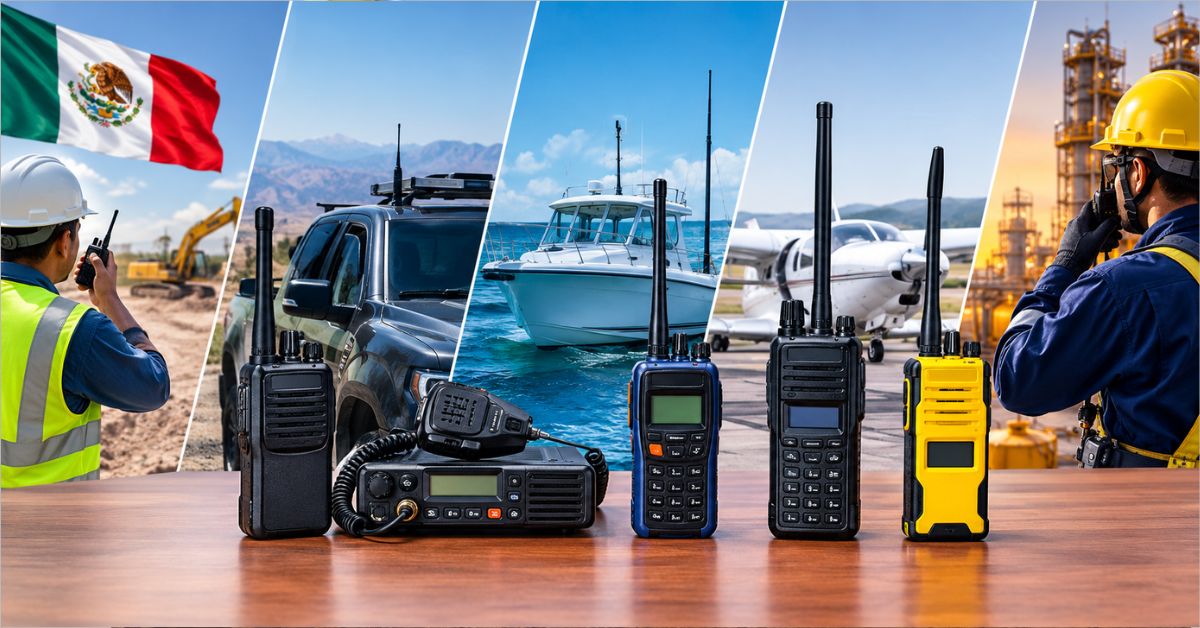

A warehouse in Monterrey, a fishing boat off Baja California, a mine in the Sierra Madre and a resort in Quintana Roo have one thing in common if the people working there can’t reach each other quickly, things go wrong. Cell coverage is patchy in plenty of places, and even where it’s solid, it tends to fail at the worst moment. Two-way radios have survived for exactly that reason. You press a button, and everyone on the channel hears you.
Picking one, though, takes more thought than grabbing the most powerful model available. What you need depends on where your team works, how far the signal has to travel and what hazards are in the way. Specialized retailers such as RadioRed can help with the research, since they gather communication radios and accessories from brands like Kenwood, ICOM and Motorola in one catalog, which makes it easier to compare options by category and by use. What follows is a walkthrough of the main radio types, the features worth paying attention to, and the accessories people tend to forget until they need them.
Analog or Digital?
Before you think about size or shape, settle the technology question.
Analog radios are simple, inexpensive and widely compatible. They suit small teams, short distances and businesses that already own analog equipment. The downside is that voice quality fades gradually as the signal weakens, and the feature list is short.
Digital radios turn your voice into data. In practice that means clearer audio near the edge of coverage, less background noise and, on many models, better battery efficiency. Some also add text messaging, GPS location, emergency alerts and private calls. DMR, P25 and NXDN are among the common digital standards, and each manufacturer builds its own systems on top of them.
If you’re not ready to replace everything at once, look at dual-mode radios, which work in both analog and digital. They let you migrate in stages, which is a real help when the budget is tight.
Portable Radios
Handheld radios are the most common type for good reason: they’re light, easy to carry and ready the moment you pick them up. You’ll see them with security guards, event crews, hotel and restaurant staff, campus personnel, warehouse teams and construction workers.
A few things separate one model from another:
- Frequency band. VHF usually works better in open outdoor areas. UHF generally handles buildings, concrete and metal structures more effectively, so it’s often the safer pick if your team moves between indoors and outdoors.
- Output power. More watts can mean more range, but terrain and obstacles frequently matter more than the number on the spec sheet.
- Battery life. It should last a full shift without anxiety. Long days are normal in Mexican industry and hospitality.
- Durability. Dust and water resistance, listed as an IP rating, count for a lot in dusty, wet or humid workplaces.
- Controls. Large buttons and a simple layout suit most users. Supervisors may want a display, programmable keys and channel scanning.
Buy for the toughest day your staff will have, not the average one. A radio that handles a downpour on a job site will outlast the same radio sitting in a quiet office.
Mobile Radios
Mobile radios are built to be installed in vehicles or used as fixed base stations. They transmit with more power than handhelds, connect to external antennas and run from the vehicle’s electrical system or a dedicated power supply.
They make the most sense for delivery and logistics fleets, taxi and shuttle operators, farms covering large areas, emergency and rescue vehicles, and dispatch offices that need a strong central station. With stronger output and a proper antenna, they usually reach noticeably farther than a portable. Plenty of organizations use both: dispatchers and vehicles on mobile units, people on foot with handhelds, everyone on the same network.
On long routes, such as highways through mountain country, a mobile radio with a well-installed external antenna can be the difference between a reliable link and a lot of static.
Marine Radios
Mexico has thousands of kilometers of coastline along the Pacific, the Gulf of Mexico and the Caribbean, plus busy ports, fishing communities, charter businesses and a lively recreational boating scene. On the water, a radio isn’t a convenience. It’s safety equipment.
Marine radios work on dedicated VHF channels for ship-to-ship, ship-to-shore and distress calls. When shopping, look for:
- A waterproof body, ideally one that floats. Handheld marine units should survive immersion, and many are designed to stay on the surface if you drop them overboard.
- Digital Selective Calling (DSC). Found on many fixed-mount radios, it lets a vessel send a distress alert at the press of a button, often with position data when the radio is linked to GPS.
- Weather channels. Handy for checking conditions before and during a trip, especially in hurricane season.
- Loud, clear audio. Wind, engines and waves make intelligibility a must.
- Corrosion resistance. Saltwater is hard on electronics, so build quality matters.
Fishing cooperatives, tour operators, marina staff and private boat owners all rely on this equipment. One simple habit is worth adopting: keep a handheld marine radio aboard as a backup to the fixed unit. If the boat loses power, that’s exactly when you’ll need it.
Aviation Radios
Aviation communication has its own rules. Airband radios use a dedicated frequency range and amplitude modulation, unlike the FM used by most land-based radios. They handle communication between aircraft and air traffic control, between aircraft, and in some cases ground operations.
Pilots, flight schools, aerial work operators and airport ground crews depend on gear made for this setting. Handheld aviation transceivers are popular as backups or for pilots of smaller aircraft, while panel-mounted units serve as primary equipment. Useful features include clear audio in a noisy cockpit, compatibility with aviation headsets, quick access to emergency channels and, on some models, navigation and communication in a single device.
Aviation is heavily regulated, so confirm that the equipment and the way you plan to use it meet the requirements of Mexican civil aviation authorities and applicable technical standards before installing or operating anything.
Intrinsically Safe Radios
Some workplaces contain flammable gases, vapors or combustible dust. In those areas, an ordinary radio could, in rare circumstances, produce a spark or enough heat to cause an explosion. Intrinsically safe radios are engineered to limit electrical and thermal energy so they can’t ignite a hazardous atmosphere.
They’re typically needed in oil, gas and petrochemical facilities, refineries and fuel terminals, chemical and pharmaceutical plants, mines, and some grain-handling, paint and manufacturing environments.
Check the certifications carefully. These radios are tested and rated against recognized safety standards for specific hazardous classifications, and the rating has to match the area where the radio will be used. A rugged radio isn’t automatically safe for an explosive atmosphere. Only certified equipment qualifies. The same goes for batteries and accessories: use the approved ones, because mixing in non-certified parts can void the safety rating.
Repeaters
Every radio has its limits. Hills, buildings and sheer distance can weaken or block a signal. A repeater picks up a transmission and sends it out again at higher power, usually from an antenna mounted high on a tower or tall structure.
You’ll want one if your operation spans a large facility, campus or industrial park, if your people work in valleys, mountains or dense urban areas, if vehicles travel beyond handheld range, or if several sites need to share one network.
A well-installed repeater can turn a patchy system into a dependable one, but planning matters. Antenna height, cable quality, duplexers, power supply and licensing all affect results. For larger projects, talk to a qualified radiocommunications specialist before you buy.
Accessories Worth Planning For
Accessories get treated as an afterthought, yet they shape daily use and how long your equipment lasts.
- Spare or high-capacity batteries keep you running through long shifts.
- Multi-unit chargers save time when you’re charging a whole fleet.
- Speaker microphones let you talk without taking the radio off your belt or vest.
- Earpieces and headsets come in discreet versions for security and hospitality, and noise-canceling versions for industrial settings.
- Antennas can noticeably improve range and clarity.
- Cases and holsters protect the radio and keep it within reach.
- Programming cables and software let you customize channels, tones and features.
Stick to accessories designed for your specific radio model when you can. Mismatched parts can cause poor audio, short battery life or even damage.
Regulations and Long-Term Costs in Mexico
Operating radio equipment here involves more than buying a device. Depending on the frequency, power and type of use, you may need authorization or a concession from the national telecommunications authorities, and equipment generally has to meet applicable homologation and technical requirements. Rules and responsible agencies can change, so verify current requirements before setting up a system, particularly for repeaters, marine use and aviation.
Think about long-term cost, too, not only the sticker price. Support, spare parts, firmware updates and the availability of compatible accessories all affect what a radio system is really worth. Buying from an established retailer that carries recognized brands also makes it easier to add compatible units later.
Matching the Radio to the Job
If you’re starting from scratch, work through these questions in order:
- Where will it be used? Indoors, outdoors, on the water, in the air or in a hazardous area?
- How far apart will people be, and what’s between them?
- How many users do you have, and do you need group channels, private calls or a dispatcher?
- Analog, digital or dual-mode? Think about growth and any equipment you already own.
- What durability and safety ratings do the conditions demand?
- What accessories will you need? Put batteries, chargers and headsets in the original budget.
- What do the regulations require? Confirm licensing and certification before you buy.
Where the Technology Is Heading
Radio Communication keeps evolving. GPS and location tracking are increasingly built in, which helps dispatchers monitor staff and respond faster in emergencies. Noise suppression has improved, making speech easier to understand in loud workplaces. Batteries last longer, which cuts downtime. Data and messaging features let radios work alongside other communication tools rather than compete with them, and more organizations are linking radio networks with other platforms for wider coordination.
None of this makes traditional radio obsolete. It makes it more capable, especially where speed and reliability matter more than anything else.
Final Thoughts
A radio is only as good as its fit for the job. A portable suits a security team, a mobile unit serves a delivery fleet, a marine radio protects a boat crew, an aviation transceiver supports pilots, and an intrinsically safe model keeps workers protected around explosive atmospheres. Repeaters stretch your coverage, and the right accessories keep everything running day after day.
Take time to assess what you actually need, compare brands and features, and confirm the regulatory requirements before buying. A well-planned system pays for itself in safety, efficiency and coordination, especially in the places where communication can’t afford to fail.