
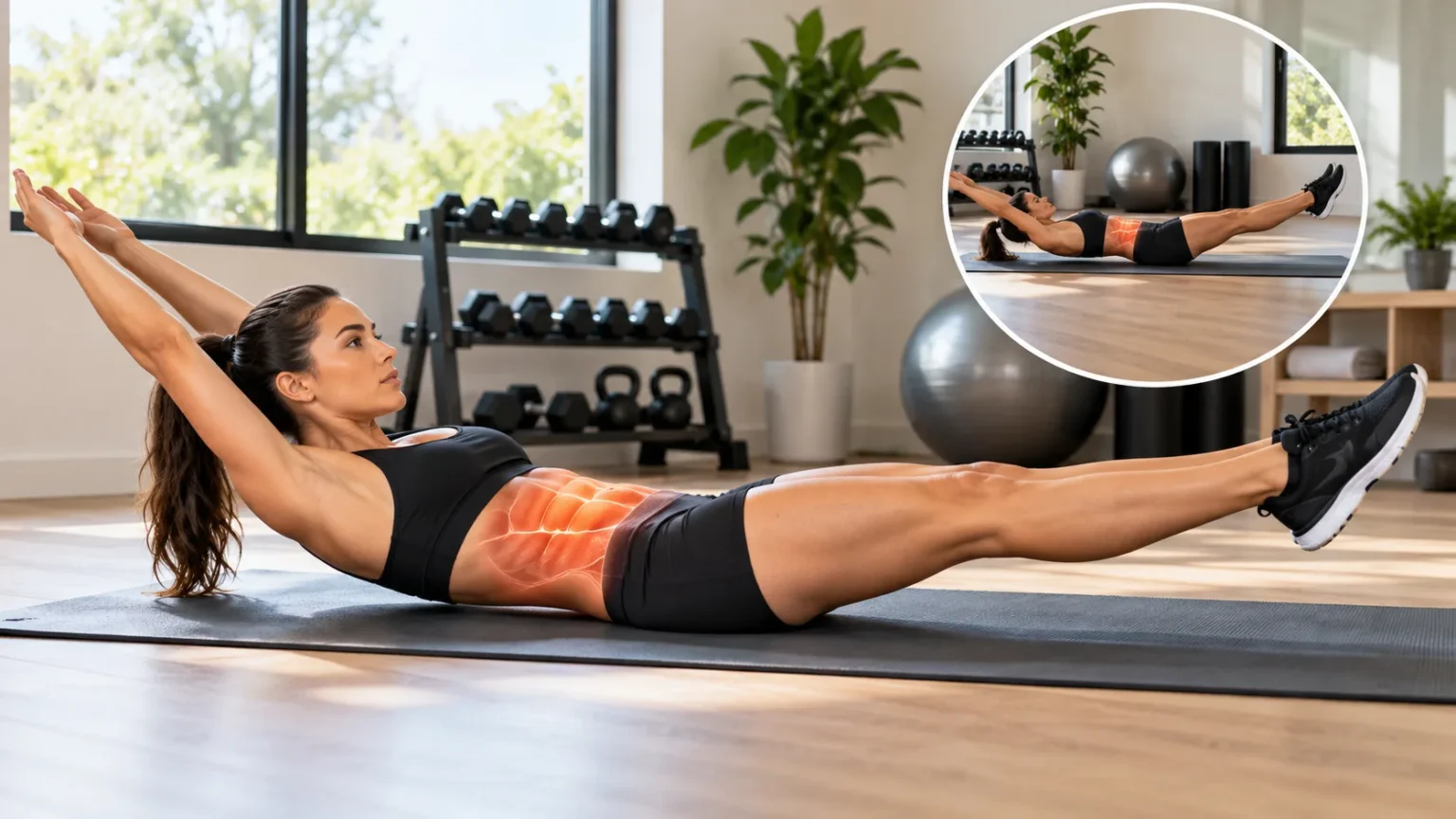

What Is a Hollow Hold?
The hollow hold is a bodyweight core exercise that teaches you to keep your trunk stable while your arms and legs extend away from your center. You perform it while lying on your back and maintaining controlled tension through your abdominal muscles. The exercise is widely used in gymnastics, calisthenics, strength training, and general core-conditioning programs.
Unlike exercises that involve repeated bending of the spine, the hollow hold focuses on resisting unwanted movement. Your goal is to keep your lower back controlled while maintaining a strong, slightly rounded body position. This challenges the abdominal muscles to stabilize your torso while your limbs create additional leverage and make the position more demanding.
The exercise may look simple because there is very little visible movement, but maintaining proper technique requires coordination and muscular endurance. Beginners often discover that even a short hold can feel challenging. Starting with an easier variation allows you to learn the position properly before extending your arms and legs farther from your body.
What Muscles Does the Hollow Hold Work?
The hollow hold primarily challenges the muscles around your abdomen, including the rectus abdominis and deeper trunk stabilizers. These muscles work together to control the position of your pelvis and spine. Your obliques also contribute by helping maintain stability and preventing your trunk from shifting as your arms and legs extend.
The hip flexors participate as well because they help keep the legs lifted above the floor. Depending on your arm position, muscles around the shoulders, upper back, and chest also work to maintain the shape. This combination makes the hollow hold more than a simple abdominal exercise because several areas must coordinate at the same time.
Your glutes can also contribute by helping control pelvic position, especially when you focus on keeping your lower back from excessively arching. The exercise therefore trains integrated core control rather than isolating one muscle. Proper breathing and controlled tension help these muscle groups work together without creating unnecessary stiffness throughout the entire body.
Benefits of the Hollow Hold Exercise
One major benefit of the hollow hold is improved core stability. A stronger, better-coordinated core can help you control your trunk during lifting, running, climbing, gymnastics, and many everyday movements. The exercise teaches you to maintain position while external leverage changes, which is useful for activities where your arms and legs move while your torso remains stable.
The hollow hold can also improve body awareness. You learn how to recognize when your lower back begins to arch, when your ribs flare upward, or when you lose abdominal tension. Developing this awareness can transfer to other exercises such as planks, push-ups, pull-ups, dead bugs, leg raises, and overhead movements.
Another advantage is convenience because the hollow hold requires no equipment. You can perform it at home, at the gym, or while traveling with only a small amount of floor space. The difficulty can also be adjusted easily by changing the position of your arms or legs, making it suitable for several levels of training experience.
How to Do a Hollow Hold Correctly
Begin by lying on your back with your knees bent and your feet on the floor. Gently tighten your abdominal muscles and bring your lower ribs toward your pelvis without aggressively forcing your back into the ground. Lift your head and shoulders slightly while keeping your neck comfortable and your breathing controlled.
Next, raise your feet from the floor and bring your knees above your hips. Maintain your abdominal tension while gradually extending your legs outward until you reach a position you can control. At the same time, reach your arms forward or overhead depending on your current strength and ability to maintain proper spinal position.
Hold the position while breathing steadily and keeping your lower back controlled. If your back begins to arch noticeably away from the floor, shorten the lever by bending your knees or bringing your arms closer to your body. End the set before your technique completely breaks down, because maintaining position is more important than holding longer with poor form.
The Best Hollow Hold Position for Beginners
Beginners should start with a tucked hollow hold instead of immediately extending both legs close to the floor. Lie on your back, lift your shoulders slightly, and bring your knees toward your chest. Keep your arms reaching forward while maintaining abdominal tension and a comfortable position through your neck and lower back.
This shorter body position reduces the leverage placed on your core muscles. It allows you to learn how the exercise should feel before progressing to more demanding variations. You should be able to breathe during the hold rather than holding your breath and using maximum effort simply to remain in position.
Once you can maintain the tucked position comfortably, gradually move your knees farther away from your chest. You can then extend one leg at a time before progressing to both legs. Slow progression gives your abdominal muscles and hip flexors time to develop enough strength and endurance to maintain good technique.
Common Hollow Hold Mistakes to Avoid
One of the most common mistakes is allowing the lower back to arch excessively. This often happens when the legs are lowered farther than your current core strength can control. Instead of forcing the advanced position, bend your knees or raise your legs slightly until you can maintain a stable trunk without losing abdominal tension.
Another mistake is straining the neck by pulling the chin aggressively toward the chest. Your head should remain supported by your own muscular control without creating excessive tension. If your neck becomes uncomfortable quickly, you can briefly practice the position with your head supported while building enough strength to maintain proper upper-body positioning.
Many people also hold their breath during the exercise. Breath-holding may make the position feel temporarily stronger, but it reduces your ability to maintain controlled tension for longer periods. Practice taking small, steady breaths while keeping your ribs controlled so breathing becomes part of the exercise rather than something you avoid.
How Shoulder and Upper-Back Position Matter
The position of your shoulders influences how comfortable and effective the hollow hold feels. When your arms extend overhead, the shoulders need enough mobility and control to remain in position without forcing your rib cage upward. If your ribs flare significantly, bring your arms forward until you can maintain better trunk control.
Upper-back and shoulder muscles help stabilize the arms during harder hollow hold variations. The traps muscle is one part of this broader shoulder-support system and contributes to scapular control during many upper-body movements. Maintaining relaxed but controlled shoulder positioning can prevent unnecessary tension from taking over the exercise.
Avoid aggressively shrugging your shoulders toward your ears while holding the position. Your arms should feel active, but the exercise should remain centered around trunk stability rather than neck tension. If extending your arms overhead immediately causes discomfort or loss of form, keep them closer to your sides while developing more mobility and control.
How Long Should You Hold a Hollow Hold?
There is no perfect holding time that applies to everyone. Beginners may start with short holds of several seconds while learning correct technique. The priority should be maintaining abdominal tension, controlled breathing, and good spinal position rather than chasing an arbitrary time that forces you to continue after your form has deteriorated.
As your endurance improves, gradually increase the length of each hold. You can also perform several shorter sets with enough recovery between them instead of one extremely long effort. This approach often makes it easier to maintain higher-quality repetitions and gives you more opportunities to practice the position correctly.
Once longer holds become easy, increasing the difficulty of the body position may be more useful than simply adding more time. Extending your legs farther, reaching your arms overhead, or using controlled hollow rocks can increase the challenge. Progress only when you can maintain the previous variation without excessive shaking, breath-holding, or spinal compensation.
Hollow Hold Progressions
A simple progression begins with a tucked position where both knees remain close to the chest. Once that feels controlled, move the knees farther away while keeping them bent. You can then straighten one leg while the other remains bent, creating a moderate challenge without immediately moving to the full hollow body position.
The next step is extending both legs while keeping your arms reaching forward. Lower the legs only as far as you can control without allowing your lower back to arch. When this becomes comfortable, gradually move your arms overhead, which increases the total body length and makes the abdominal muscles work harder.
Advanced trainees can add hollow body rocks, in which the body gently rocks while maintaining the same curved position. The movement should come from the body functioning as one unit rather than repeatedly bending at the hips. Progressions should feel challenging but controlled, and technique should remain the main standard for deciding whether you are ready to advance.
Hollow Hold vs. Plank
Both the hollow hold and plank train the core to resist unwanted spinal movement, but they challenge the body from different positions. A plank is performed facing the floor while supporting your weight through your arms and feet. The hollow hold is performed on your back while your arms and legs create leverage away from your center.
The hollow hold usually places greater emphasis on controlling the relationship between your ribs and pelvis while your limbs extend. Planks involve more direct support through the shoulders and upper body. Neither exercise is automatically better because they develop overlapping but slightly different aspects of core stability and body control.
Including both exercises can create a more varied core routine. You might use planks for anti-extension strength in a weight-bearing position and hollow holds for body-line control while lying down. Choosing the right variation depends on your current strength, comfort, training goals, and ability to maintain good form throughout each exercise.
How to Add Hollow Holds to Your Workout
Hollow holds can be included near the beginning of a workout as a core-activation exercise or later as part of a dedicated abdominal routine. When using them early, keep the sets controlled so your core is not excessively fatigued before larger strength movements. Quality is more useful than exhausting yourself before your main training begins.
You can also pair hollow holds with exercises that train different movement patterns. For example, a routine might include hollow holds, side planks, bridges, and controlled bird dogs. This provides a broader challenge to the trunk by training stability from several directions rather than repeatedly performing only one type of abdominal exercise.
Start with a manageable number of sets and increase gradually as your endurance improves. You do not need to perform hollow holds every day to make progress. Consistent practice combined with other strength exercises, adequate recovery, and progressive overload can help you develop better core control over time without relying on one movement exclusively.
When the Hollow Hold May Not Be Appropriate
The hollow hold may not be suitable if it consistently causes significant lower-back pain, neck pain, or other uncomfortable symptoms. Mild muscular effort is expected, but sharp pain should not be ignored. If discomfort occurs even with easier variations, stop the exercise and consider choosing another core movement until the reason for the pain is better understood.
People recovering from recent abdominal, spinal, hip, or pelvic surgery should follow the exercise guidance provided by their healthcare team. The same caution applies to individuals with conditions that limit certain spinal or abdominal movements. A general exercise routine cannot account for every injury, surgery, pregnancy, or individual medical history.
You should also avoid treating the hollow hold as a test you must complete at any cost. There are many effective ways to strengthen the core, including dead bugs, planks, bird dogs, and other controlled exercises. If another movement allows you to train comfortably and maintain better technique, it may be a more appropriate choice for your current needs.
Tips for Improving Your Hollow Hold
Focus on maintaining a strong but controlled connection between your ribs and pelvis. Imagine gently shortening the distance between them without aggressively crunching your torso. This helps create the rounded hollow position while keeping the movement centered around abdominal control rather than simply lifting your head and legs as high as possible.
Progress one variable at a time. If you are lowering your legs farther, keep your arms in an easier position until you can control the change. Trying to extend your legs, reach your arms overhead, and dramatically increase hold time all at once makes it harder to identify which part of the exercise is causing your technique to break down.
Finally, practice consistently rather than chasing fatigue in every session. A few high-quality sets performed regularly can build strength and body awareness more effectively than occasional maximum-effort attempts. Use your ability to breathe, maintain spinal position, and control the start and finish of each repetition as your main measures of progress.
Conclusion
The hollow hold is a challenging bodyweight exercise that develops abdominal strength, core stability, and total-body control. It teaches you to maintain a stable trunk while your arms and legs extend away from your center. Because no equipment is required, it can easily be added to home, gym, gymnastics, or calisthenics training.
Correct technique matters more than how close your legs are to the floor or how long you can hold the position. Keep your ribs and pelvis controlled, breathe steadily, and choose a variation that allows your lower back to remain stable. Progress gradually by extending your limbs only when you can maintain the easier position comfortably.
The exercise does not need to replace every other core movement. Combining hollow holds with planks, bird dogs, side planks, and other strength exercises can create a more complete routine. When practiced consistently and with appropriate progression, the hollow hold can become a valuable tool for improving core strength and movement control.
FAQs
Is the hollow hold good for abs?
Yes, the hollow hold strongly challenges the abdominal muscles by requiring them to stabilize your trunk while your arms and legs create leverage. Correct technique is more important than holding the position for a long time.
How long should a beginner hold a hollow hold?
Beginners can start with short, controlled holds and stop when their lower back begins to arch or breathing becomes difficult. Several high-quality short sets are often better than one long set with poor form.
Why does my lower back hurt during hollow holds?
Lower-back discomfort may occur when your legs are extended farther than your core can control. Try bending your knees, raising your legs, or using an easier variation, and stop if significant pain continues.
Should my lower back touch the floor during a hollow hold?
The goal is to keep the lower back controlled and prevent excessive arching. Exact contact varies between individuals, so focus on maintaining abdominal tension and a stable position rather than forcefully pressing your spine downward.
Can I do hollow holds every day?
Daily practice is not necessary for most people. Your abdominal muscles need recovery like other muscle groups, so several well-planned sessions per week may be enough depending on your broader training program.



