
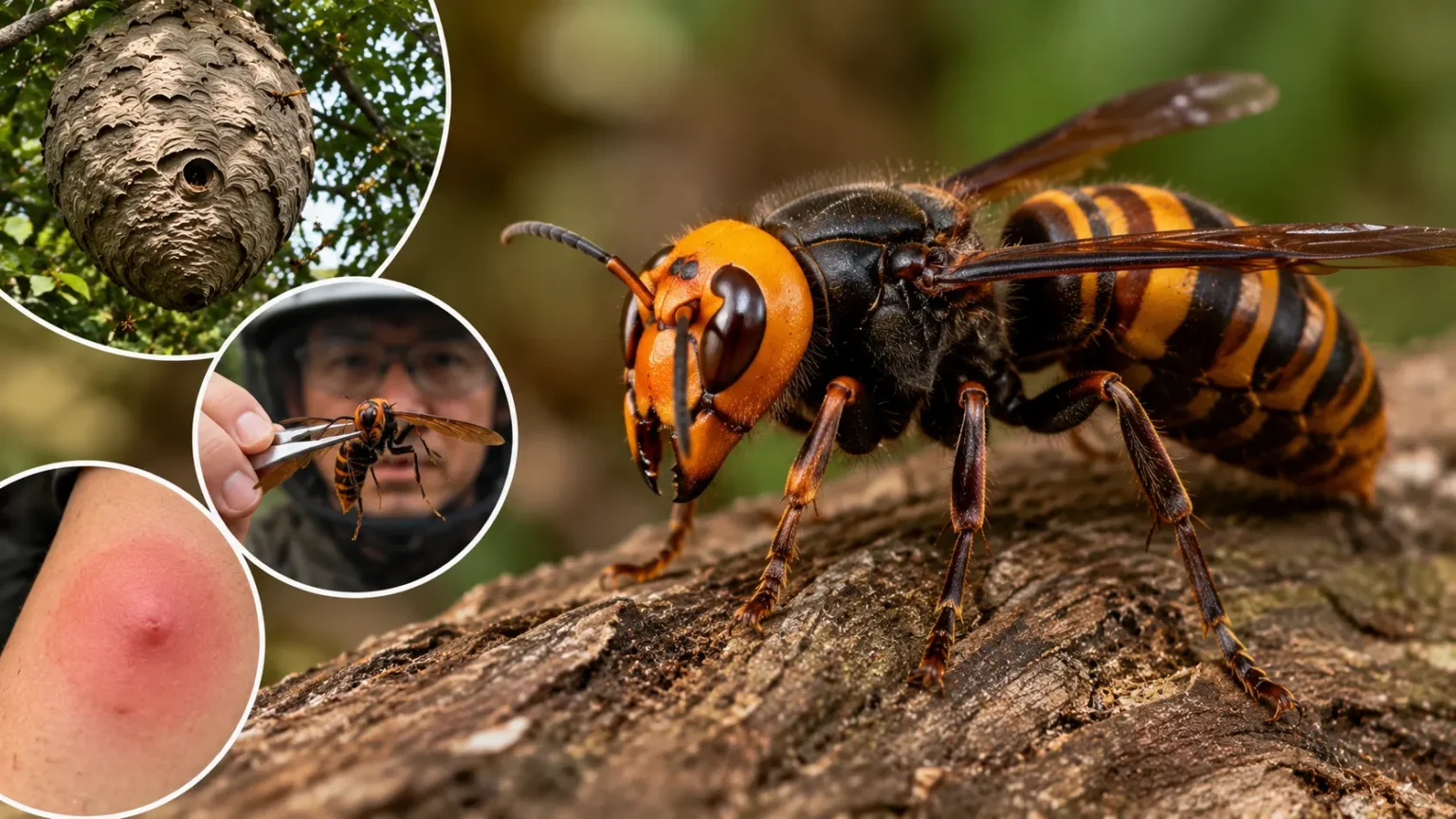

Murder Hornet: How Dangerous Is It Really?
The phrase “murder hornet” sounds like something from a horror movie, which helps explain why the insect attracted worldwide attention when it appeared in North American headlines. The nickname refers to the northern giant hornet, Vespa mandarinia, the world’s largest hornet species. Its impressive size, powerful sting, and ability to attack honey bee colonies created a mixture of legitimate scientific concern and exaggerated public fear.
Northern giant hornets can be dangerous under certain circumstances, but they do not normally hunt or attack humans without reason. Like many social wasps and hornets, they are much more likely to defend themselves or their nest when they feel threatened. A single sting can be extremely painful, while multiple stings can deliver enough venom to cause severe illness. People with serious insect-venom allergies can also experience life-threatening anaphylaxis.
For agriculture and ecosystems, the concern is different. Northern giant hornets are highly effective predators of other insects and can attack honey bee colonies. During an intense hive attack, multiple hornets can kill large numbers of bees, creating a potentially significant threat to managed honey bee colonies and the pollination services associated with them. This ecological risk was one of the main reasons authorities responded aggressively when the species appeared in Washington State.
There is also an important update behind many older articles about murder hornets. After northern giant hornets were detected in Washington beginning in 2019, state and federal authorities located and destroyed nests and continued surveillance. In December 2024, officials declared the species eradicated from the United States after three years without a confirmed detection. Understanding that current context makes it easier to separate real risks from outdated headlines and sensational claims.
What Is a Murder Hornet?
“Murder hornet” is a sensational media nickname rather than the insect’s scientific or preferred common name. The species is Vespa mandarinia, now widely referred to as the northern giant hornet. Earlier English-language sources frequently called it the Asian giant hornet, so readers researching older articles may encounter both names describing the same species.
Northern giant hornets are native to parts of Asia, where they occupy forests and other environments suitable for nesting and hunting. They are natural predators within their native ecosystems and feed on a variety of insects. Their ecological behavior becomes more concerning when they appear outside their native range because local insects may not possess the same defensive adaptations.
The species received enormous media attention after detections in western North America. Headlines focused on its unusually large size, painful venomous sting, and dramatic attacks on honey bees. The nickname “murder hornet” became memorable enough that many people began using it as though it were the insect’s official name.
Scientists and agricultural agencies generally prefer more precise terminology because sensational names can create unnecessary fear and encourage people to kill harmless native insects that resemble the target species. Calling it the northern giant hornet makes discussions clearer and reduces confusion with the many ordinary hornets, wasps, and large flies encountered outdoors.
How Big Is a Murder Hornet?
Northern giant hornets are remarkable partly because of their size. Adults can approach approximately two inches in length, making them noticeably larger than many familiar wasps and hornets. Queens may be particularly impressive, while workers are generally somewhat smaller but still substantial compared with common yellowjackets.
Their appearance includes a large head, prominent eyes, strong mandibles, a robust body, and a banded abdomen. The head is often described as orange or yellowish-orange, while the thorax is darker. Alternating dark and lighter bands across the abdomen create a pattern that can appear dramatic when viewed close up.
Large size does not automatically make every hornet-looking insect a northern giant hornet. Cicada killers, European hornets, paper wasps, horntails, and several large flies can be mistaken for them, particularly by people who saw alarming photographs online before encountering an unfamiliar insect in the garden.
Accurate identification therefore matters. Size, coloration, head shape, abdominal pattern, geography, and other anatomical features need to be considered together. In regions where invasive hornet monitoring programs operate, photographing a suspicious insect from a safe distance is usually much more useful than trying to capture or kill it yourself.
Why Are They Called Murder Hornets?
The nickname became popular because northern giant hornets can kill large numbers of honey bees during coordinated attacks. Their behavior can look particularly dramatic because hornets may enter a colony, kill adult bees, and then access the brood within the hive as a food source for developing hornet larvae.
Their powerful mandibles allow them to kill honey bees efficiently. Descriptions of bees being decapitated contributed heavily to sensational reporting, and the word “murder” quickly became attached to the species. While visually striking, this behavior is predation rather than malicious aggression in the human sense.
The hornet’s venom also added to the reputation. Stings are reported to be extremely painful, and repeated stings can expose a person to a substantial amount of venom. Fatalities have occurred within the species’ native range, particularly after numerous stings or severe allergic reactions.
However, the nickname can distort the actual risk to the average person. Northern giant hornets do not patrol neighborhoods searching for humans to attack. Their strongest defensive responses are generally associated with threats to themselves, their nests, or locations where they are actively feeding.
Are Murder Hornets Dangerous to Humans?
Yes, a northern giant hornet can be dangerous to humans, but the level of danger depends heavily on the circumstances. Its sting delivers venom and can cause intense localized pain, swelling, redness or discoloration, and inflammation. For many people, a single uncomplicated sting would primarily be a painful medical event rather than a life-threatening one.
The situation becomes more serious when a person receives multiple stings. Hornets can sting repeatedly because their stingers do not become permanently embedded in skin in the same way a honey bee stinger commonly does. An encounter near a disturbed nest could therefore expose someone to multiple defensive hornets and a much larger total venom dose.
Allergic reactions are another major concern. A person with an allergy to wasp or hornet venom can develop anaphylaxis, which may involve difficulty breathing, swelling of the throat or tongue, widespread hives, dizziness, fainting, or a sudden fall in blood pressure. Anaphylaxis requires emergency medical treatment.
Despite these risks, northern giant hornets are generally not interested in humans as prey. Keeping distance from nests and avoiding attempts to swat, crush, capture, or handle a suspected hornet can substantially reduce the chance of a defensive encounter. Their danger is genuine but far more situational than sensational headlines imply.
What Does a Murder Hornet Sting Feel Like?
A northern giant hornet sting can be extremely painful because the insect has a substantial stinger and delivers potent venom. People who have experienced large-hornet stings commonly describe immediate sharp or burning pain followed by swelling and tenderness around the affected area.
Local reactions can differ considerably between individuals. Some people may develop a relatively limited swollen area, while others experience more extensive redness, heat, itching, or swelling. A large local reaction can look frightening without necessarily representing anaphylaxis, although worsening symptoms should still be monitored carefully.
Multiple stings create a different medical situation because the total amount of venom rises as additional stings occur. Large venom exposure can produce systemic toxicity even in someone who is not allergic. Symptoms may extend beyond the sting sites and can potentially involve multiple organ systems in severe cases.
Pain alone cannot reliably tell someone whether a reaction is becoming dangerous. Breathing difficulty, throat swelling, faintness, confusion, severe weakness, widespread hives, repeated vomiting, or rapidly worsening symptoms are more important warning signs. These symptoms require urgent medical attention rather than simply waiting for the pain to improve.
Can a Murder Hornet Sting Kill You?
Deaths from northern giant hornet stings have occurred, so it would be inaccurate to describe the species as harmless. However, fatal outcomes are not the expected result of every sting. The greatest dangers involve severe allergic reactions, numerous stings, and substantial venom exposure.
Anaphylaxis can occur after a single sting in a highly allergic individual. The immune system reacts rapidly to venom, potentially causing airway swelling, breathing problems, cardiovascular collapse, and other life-threatening symptoms. People known to have severe insect-sting allergies may be prescribed epinephrine for emergency treatment.
Numerous hornet stings can create another pathway to severe illness even without an allergy. A large quantity of venom can damage tissues and place stress on organs. Medical literature from regions where these hornets naturally occur has documented severe complications following mass envenomation.
The practical message should therefore be balanced. One suspected hornet in the distance does not represent an immediate lethal threat, but disturbing a nest or receiving many stings can become a medical emergency. Respecting the insect’s space is far more useful than assuming either that every encounter is deadly or that the risk can be ignored.
Can Murder Hornets Sting More Than Once?
Yes. Northern giant hornets can sting repeatedly, which is an important difference from the familiar idea that every stinging insect gets only one attempt. Honey bee workers typically leave a barbed stinger behind in mammalian skin, while hornets and many other wasps can withdraw their stinger and sting again.
Repeated stinging makes defensive encounters near a nest particularly hazardous. A person who remains close to an agitated colony can potentially receive several stings from the same insect as well as attacks from multiple hornets responding to a perceived threat.
This is why attempting to knock down, dig up, spray, or otherwise disturb a suspected northern giant hornet nest without professional equipment is dangerous. The issue is not simply the pain from one insect; defensive behavior from multiple colony members can create rapid and substantial venom exposure.
If you encounter unusually large hornets repeatedly entering the same hole, tree cavity, or nest-like location, keep your distance. Where the species is considered invasive or subject to official monitoring, contact the relevant agricultural or invasive-species authority rather than investigating the site personally.
Are Murder Hornets Aggressive?
The term aggressive can be misleading because animal behavior depends on context. Northern giant hornets are formidable predators of other insects, but that does not mean they ordinarily treat humans as prey. Away from their nests, they generally have little reason to deliberately pursue a person who leaves them alone.
Defensive behavior can become much stronger around a nest. Social hornets protect their colony because it contains developing larvae, workers, and reproductive individuals essential to the colony’s survival. Approaching, shaking, digging near, or otherwise threatening a nest can trigger an intense response.
Hornets can also behave defensively around important food resources. Someone who discovers several giant hornets attacking a honey bee colony should avoid approaching closely because the insects may be actively defending access to that food source.
Understanding these circumstances makes encounters more predictable. Rather than treating every hornet sighting as an emergency, give large wasps space and avoid provoking them. Most dangerous interactions occur because humans unknowingly approach a nest or intentionally attempt to handle or destroy one without proper protection.
Why Are Murder Hornets So Dangerous to Honey Bees?
The ecological concern surrounding northern giant hornets largely comes from their ability to attack honey bee colonies. Hornets may initially hunt individual bees, but during a more organized colony attack they can overwhelm a hive and kill large numbers of adult workers.
Once the adult defenders have been overcome, hornets can access the bee brood inside the colony. Developing bee larvae and pupae provide a protein-rich resource that can be carried back to feed hornet larvae. This makes an established honey bee colony a valuable food source for a growing hornet colony.
European honey bees, which are widely managed by beekeepers in North America and elsewhere, may be particularly vulnerable because they did not evolve alongside northern giant hornets in the same way some Asian honey bee populations did. Certain Asian honey bees have developed specialized collective defensive behaviors against giant hornet scouts and attackers.
A widespread invasive population could therefore create significant problems for beekeepers. Honey bees contribute to the pollination of many agricultural crops and plants, meaning damage to managed colonies can have economic and ecological consequences that extend well beyond the immediate loss of individual bees.
How Quickly Can Murder Hornets Destroy a Bee Hive?
Northern giant hornets have the potential to devastate a vulnerable honey bee colony remarkably quickly when multiple workers coordinate an attack. Agricultural authorities have warned that a hive can be severely damaged within hours, depending on the number of hornets, colony strength, and circumstances.
The attack can progress through different stages. Individual hornets may first locate a colony and hunt bees near the entrance. If the food source proves valuable, additional hornets can become involved, eventually overwhelming the defensive bees and allowing the predators greater access to the hive.
This behavior explains why agricultural authorities treated the species as an urgent invasive threat after it appeared in Washington State. The central concern was not that giant hornets would begin attacking people throughout the country but that an established population could spread and threaten managed and native pollinators.
Fortunately, early detection made eradication efforts possible in the United States. By locating and destroying nests before a widespread population became established, authorities reduced the likelihood that beekeepers across the country would have to contend with a new major predator.
Where Do Murder Hornets Normally Live?
Northern giant hornets are native to parts of Asia, where they occur naturally as components of local ecosystems. Their range includes environments that provide suitable prey and sheltered locations for underground or cavity nests.
The hornets commonly nest in locations such as underground cavities, abandoned animal burrows, and hollow spaces near ground level. This nesting behavior can make colonies difficult to discover until workers are repeatedly observed entering and leaving a particular location.
Their native distribution is important because encountering a very large hornet elsewhere does not automatically mean northern giant hornets have arrived. Many regions contain native wasps and hornets that can appear surprisingly large to someone unfamiliar with local insect species.
Geography should therefore be one of the first considerations when identifying a suspected murder hornet. A large insect photographed thousands of miles from any confirmed population is statistically much more likely to be a native lookalike than Vespa mandarinia.
Are Murder Hornets Still in the United States?
The most important current update is that northern giant hornets have been declared eradicated from the United States. Washington State and federal agricultural authorities announced the eradication in December 2024 after three years without a confirmed detection.
The species had originally been confirmed in Washington State near the Canadian border following its appearance in North America in 2019. Authorities subsequently conducted extensive trapping, tracking, nest-location, eradication, and public-reporting efforts to prevent the population from becoming permanently established.
Four nests were found and destroyed in Washington during 2020 and 2021. Surveillance continued after those removals because invasive-species eradication cannot be declared immediately after the final known nest disappears. Authorities needed multiple seasons without confirmed detections before concluding that the population had been eliminated.
That means articles warning that murder hornets are currently spreading across the United States are outdated or misleading. Reintroduction remains theoretically possible through international movement of goods or other pathways, which is why surveillance and public awareness still matter, but there is currently no established U.S. population.
How Were Murder Hornets Eradicated in the U.S.?
Eradication required a combination of public reporting, trapping, insect identification, field investigation, and nest destruction. Members of the public played an important role by reporting insects they suspected might be northern giant hornets, allowing experts to distinguish genuine detections from native lookalikes.
Once individual hornets were found, researchers used innovative tracking approaches to locate their nests. Tiny radio transmitters were attached to captured hornets, which were then released and followed as they returned toward their colony. This allowed field teams to locate nests that would otherwise have been extremely difficult to find in wooded environments.
After nests were identified, trained teams wearing specialized protective equipment removed and destroyed them. The timing was particularly important because preventing reproductive queens from leaving successful nests reduced the chance that new colonies would appear during the following season.
Officials continued trapping and monitoring for several years after the final confirmed detections. That persistence was essential because declaring eradication prematurely could have allowed a hidden colony to rebuild the population. The successful program is now considered an important example of how rapid response can sometimes stop an invasive species before widespread establishment.
Murder Hornet vs European Hornet
The European hornet is one of several insects frequently mistaken for a northern giant hornet. European hornets are large compared with many common wasps and can appear intimidating, particularly when someone encounters one after seeing photographs of murder hornets online.
Northern giant hornets are generally larger and have distinctive head and abdominal characteristics. Their large orange or yellow-orange head is especially noticeable, while the abdomen displays broad alternating bands. European hornets have different coloration and markings when examined carefully.
Geography provides another major clue. European hornets have established populations in parts of North America, while northern giant hornets were confined to a small area of Washington before eradication. Therefore, someone seeing a large hornet in most areas of the United States is far more likely to have encountered another species.
Avoid killing insects solely because they look large or frightening. Native and established wasp species can serve valuable ecological roles by preying on other insects. Photographing the insect safely and seeking expert identification provides more useful information than assuming every oversized wasp is invasive.
Murder Hornet vs Cicada Killer
The cicada killer wasp is another common source of mistaken murder hornet reports. These large solitary wasps can reach impressive sizes and are frequently seen flying close to the ground during warm weather, where they dig burrows and hunt cicadas.
Their size can initially cause alarm, but cicada killers have a very different lifestyle from northern giant hornets. They are solitary rather than members of large defensive social colonies, and females capture cicadas as food for their offspring.
Cicada killers also have distinct markings and body proportions. Once someone knows what to look for, differences in the head, thorax, abdomen, and overall coloration make them easier to distinguish from northern giant hornets.
People often become concerned when several cicada killers appear around lawns or sandy soil because multiple females may create individual nests within the same favorable area. Despite the activity, they are not evidence that murder hornets have established a colony nearby.
Murder Hornet vs Yellow-Legged Hornet
Northern giant hornets should not be confused with the yellow-legged hornet, Vespa velutina. The yellow-legged hornet is a separate invasive hornet species that has generated concern in other regions because it also preys heavily on honey bees and other insects.
Yellow-legged hornets are considerably smaller than northern giant hornets and have different body coloration. Their distinctive yellow leg sections contribute to the common name, while the abdomen and thorax differ from the broad orange-and-black appearance associated with Vespa mandarinia.
This distinction became particularly important after northern giant hornets were eradicated from the United States. Other invasive hornet species can still require monitoring, so an article stating that “murder hornets are gone” does not mean every invasive hornet concern has disappeared.
Accurate identification helps agricultural agencies direct resources appropriately. Reporting a suspicious invasive hornet with a photograph and location is more helpful than relying on a nickname because different species require different surveillance and control strategies.
What Should You Do If You See a Murder Hornet?
If you believe you have seen a northern giant hornet, do not attempt to catch it with your bare hands or approach a suspected nest. Keep a safe distance and avoid sudden actions that could threaten the insect.
If it can be done safely, take a clear photograph or video. Images showing the head, abdomen, approximate size, and surrounding environment can help entomologists determine whether the insect resembles the invasive species or a common native lookalike.
In places where agricultural authorities request invasive-hornet reports, submit the photograph and location through the appropriate official reporting system. A precise location can be particularly useful because genuine sightings near shipping facilities or previous detection areas may deserve greater attention.
Do not destroy a suspected nest yourself. Professional teams use protective equipment and established control techniques because multiple defensive hornets can create serious danger. Even if the insect turns out to be a different species, disturbing a large social wasp nest can still lead to painful multiple stings.
What Should You Do If a Murder Hornet Chases You?
If hornets become defensive, the priority is to move away from the area quickly and seek shelter. A building or enclosed vehicle can provide protection from pursuing insects. Continuing to remain beside a disturbed nest increases the possibility of additional stings.
Do not stop near the nest to fight the insects. Swatting may increase defensive behavior and wastes time that could be used to increase your distance. Protect your face and eyes while continuing toward shelter if hornets are actively attacking.
Avoid jumping into water as an escape strategy. Remaining exposed or repeatedly resurfacing can leave you vulnerable, while getting to solid enclosed shelter provides a more dependable barrier between you and attacking insects.
Once you are safely away, evaluate any stings and your overall condition. One uncomplicated local reaction can often be monitored, but numerous stings, rapidly worsening symptoms, or any signs of anaphylaxis require medical attention.
How to Treat a Hornet Sting
After an uncomplicated hornet sting, move away from the insect or nest before focusing on treatment. Remaining at the site creates the possibility of being stung again. Once safe, wash the affected area gently with soap and water.
A cold pack wrapped in cloth can help reduce pain and swelling when applied intermittently. Elevating a swollen arm or leg may also be comfortable. Over-the-counter pain relievers or antihistamines may be appropriate for some people when taken according to labeled directions and personal medical considerations.
Unlike a honey bee sting, a hornet generally does not leave its stinger embedded in the skin, so there usually is no stinger to scrape out. Avoid cutting, squeezing, burning, or applying harsh chemicals to the sting because these approaches can injure the skin without neutralizing venom already delivered.
Continue monitoring symptoms for changes. Local swelling may increase for a period before improving, but breathing problems, faintness, widespread hives, severe facial or throat swelling, or rapidly developing systemic symptoms require emergency treatment.
When Is a Hornet Sting an Emergency?
A severe allergic reaction can develop rapidly following a hornet sting. Difficulty breathing, wheezing, throat or tongue swelling, widespread hives, dizziness, fainting, or signs of shock should be treated as medical emergencies.
People with a previously diagnosed severe insect-venom allergy may carry an epinephrine auto-injector. If prescribed, it should be used according to the individual’s emergency plan, followed by appropriate emergency medical evaluation because symptoms can sometimes return after initial improvement.
Multiple stings also warrant greater caution even when no obvious allergy exists. Large venom exposure can produce systemic toxicity, and the number of stings that becomes dangerous varies according to body size, health, age, and individual response.
Children, older adults, and people with significant medical conditions may require closer assessment after numerous stings. When someone has been attacked by many hornets, seeking medical guidance promptly is safer than waiting for severe symptoms to develop.
Are Murder Hornets More Dangerous Than Bees?
For an individual sting, a northern giant hornet can deliver a substantial amount of venom and produce severe pain. It can also sting repeatedly, which creates a different type of risk from a honey bee worker that commonly leaves its stinger behind after stinging mammalian skin.
However, saying murder hornets are universally “more dangerous” than bees ignores exposure frequency. Honey bees, yellowjackets, wasps, and ordinary hornets are encountered far more commonly by many people and collectively cause serious allergic reactions and fatalities every year.
The most medically important factor for an individual may actually be venom allergy rather than insect size. A person who is highly allergic can develop anaphylaxis from a sting by a much smaller insect, while another person may tolerate a single large-hornet sting without developing a life-threatening reaction.
Northern giant hornets nevertheless deserve greater caution around a nest because of their size, venom delivery, and repeated stinging ability. Comparing insects solely by appearance oversimplifies risk; species behavior, number of stings, allergy status, and proximity to the nest all matter.
Do Murder Hornets Have Any Natural Predators?
Northern giant hornets occupy an ecological food web rather than existing without natural enemies. Birds, mammals, other insects, parasites, pathogens, and competition can influence hornet populations depending on the region and life stage.
Within their native range, prey species have also evolved defenses. One of the best-known examples involves certain Asian honey bees that can collectively surround an invading hornet and generate intense heat and other stressful conditions that kill the attacker.
Such defenses demonstrate why invasive species can create unusual ecological problems. When a predator arrives in a region where local prey did not evolve alongside it, native species may lack behavioral or physiological strategies that help related organisms survive in the predator’s original ecosystem.
This mismatch was one reason scientists were concerned about northern giant hornets establishing in North America. Preventing establishment was much more practical than hoping natural predators would eventually control an expanding invasive population.
Why Invasive Murder Hornets Were Such a Concern
An invasive species can cause problems when it establishes outside its native ecosystem and begins spreading without the ecological checks that normally influence its population. Northern giant hornets had several characteristics that made authorities take their North American appearance seriously.
Their predation on honey bees represented the most obvious agricultural threat. Beekeepers already manage numerous challenges affecting colony health, including parasites, diseases, pesticides, nutrition, and habitat loss. Adding a powerful new hive predator could have increased pressure on vulnerable colonies.
Native insects were another concern. A newly established large predator would not limit itself exclusively to managed honey bees, potentially altering relationships among local insect populations and affecting broader food webs.
Early eradication offered the greatest chance of preventing those effects. Once an invasive insect becomes widespread across a large region, elimination can become nearly impossible. The successful response in Washington therefore prevented a localized detection from developing into a permanent national problem.
Are Murder Hornets Something You Should Fear?
For most people, northern giant hornets are not a day-to-day threat. The species is native to Asia and has been declared eradicated from the United States. Someone living elsewhere who encounters a large wasp is much more likely to be seeing a native or already established species.
Fear is also unnecessary because hornets generally do not seek humans as food. Keeping distance from large wasps and their nests dramatically reduces the chance of a dangerous encounter.
At the same time, respecting these insects is sensible. A northern giant hornet has a painful sting, can sting multiple times, and can become highly defensive when its nest is threatened. Multiple stings or anaphylaxis can produce severe and occasionally fatal medical outcomes.
The healthiest perspective sits between panic and complacency. Northern giant hornets are powerful insects deserving appropriate caution and invasive-species monitoring, but the nickname “murder hornet” exaggerates the likelihood that an ordinary person will be attacked simply for being nearby.
The Bottom Line: How Dangerous Is the Murder Hornet Really?
The murder hornet, properly called the northern giant hornet (Vespa mandarinia), is the world’s largest hornet and possesses a painful venomous sting. It can sting repeatedly, and severe allergic reactions or numerous stings can become medically dangerous.
Its greatest broader threat is arguably to honey bees and other insects rather than humans. Coordinated hornet attacks can devastate vulnerable bee colonies, creating concerns for beekeeping, pollination, agriculture, and ecosystems if the species becomes established outside its native range.
For readers in the United States, the situation has changed significantly from the alarming headlines of 2020. Following nest destruction and several years of surveillance without confirmed detections, agricultural authorities officially declared the northern giant hornet eradicated from the United States in December 2024.
So, how dangerous is a murder hornet really? Potentially very dangerous if you disturb a nest, receive numerous stings, or experience anaphylaxis—but not the human-hunting monster suggested by its nickname. Respecting large stinging insects, avoiding nests, recognizing allergy symptoms, and reporting genuine invasive-species concerns provide a much more useful response than panic.
Frequently Asked Questions
Can a murder hornet kill a human?
Yes, northern giant hornet stings can occasionally be fatal, particularly after numerous stings or severe allergic reactions. A single sting is painful but is not automatically deadly for most people.
Are murder hornets still in the United States?
Northern giant hornets were officially declared eradicated from the United States in December 2024 after three years without a confirmed detection.
Why are murder hornets so dangerous to bees?
Northern giant hornets can coordinate attacks on honey bee colonies, killing many adult bees and accessing the brood inside the hive as food for their developing larvae.
What should you do if you see a murder hornet?
Keep a safe distance and do not attempt to capture or disturb it. If invasive-hornet reporting is available in your area, take a photograph safely and report the location to the appropriate authority.
How painful is a murder hornet sting?
A northern giant hornet sting can cause intense immediate pain, swelling, and inflammation. Multiple stings or symptoms of an allergic reaction require much greater medical attention.



