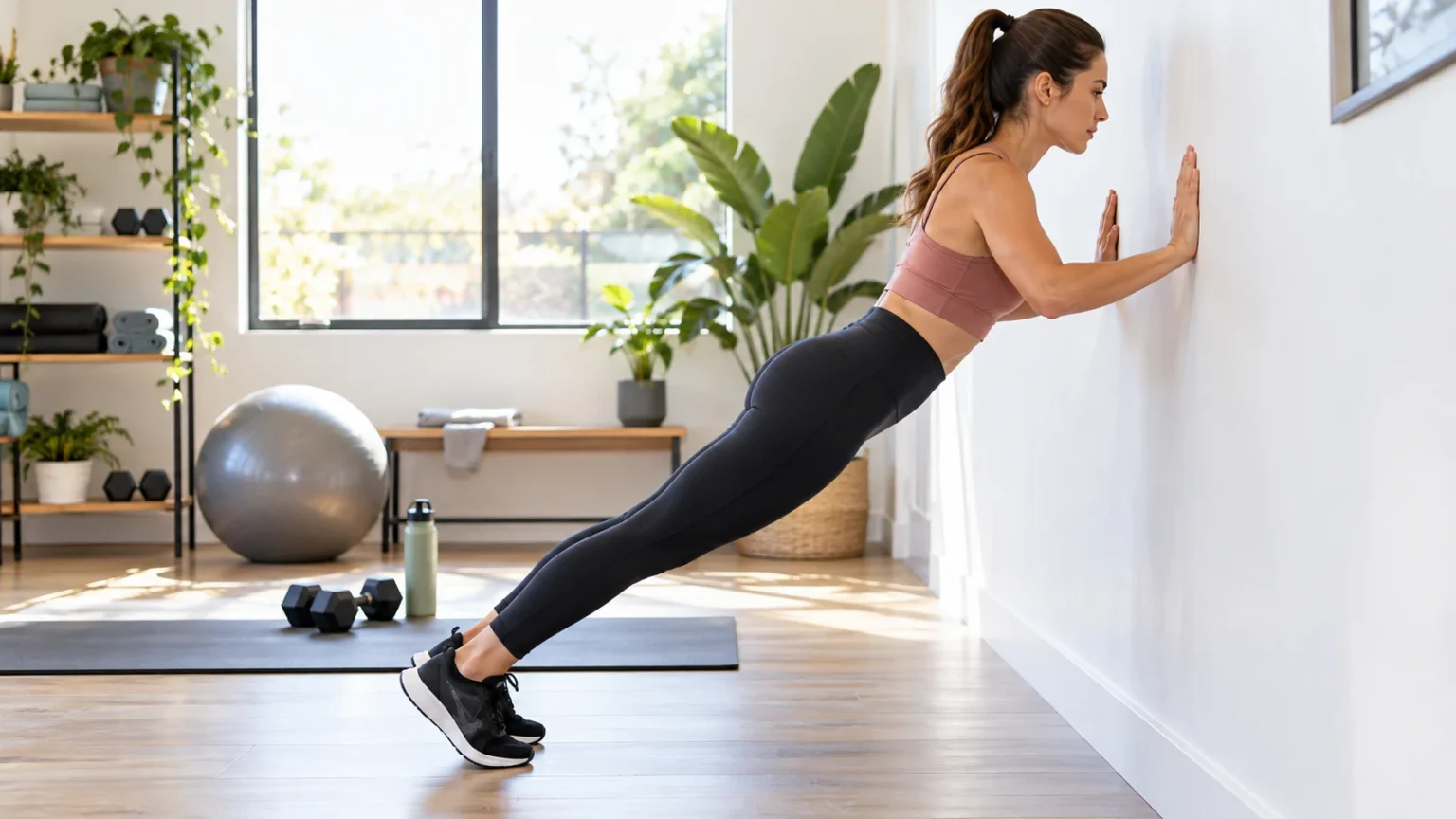

Wall push-ups are a beginner-friendly bodyweight exercise that strengthens the chest, shoulders, arms, and upper body without requiring you to get down on the floor. Because the movement places less body weight through the arms than a traditional push-up, it can be easier to learn and more comfortable for people who are building strength gradually.
The exercise is also useful for practicing basic push-up mechanics. You can focus on hand placement, elbow position, core control, and smooth movement without managing the full resistance of a floor push-up. This makes wall push-ups suitable for beginners, older adults, people returning to exercise, or anyone who needs an easier pressing variation.
Although wall push-ups are simple, form still matters. Standing too close to the wall, allowing the hips to sag, or letting the elbows flare excessively can reduce the quality of the movement. Learning how to position your body correctly helps you get more from each repetition and creates a stronger foundation for harder push-up variations.
What Are Wall Push-Ups?
Wall push-ups are a vertical variation of the traditional push-up performed while standing and pressing against a wall. Instead of supporting most of your body weight on your hands and feet, you remain upright and lean toward the wall. This reduces resistance while keeping the basic pushing movement similar.
To perform the exercise, place your hands on the wall around chest or shoulder height and step your feet backward. Bend your elbows to bring your upper body toward the wall, then press through your palms to return to the starting position. The farther your feet are from the wall, the more challenging the movement usually becomes.
Wall push-ups can be used as a starting point before progressing to countertop, bench, knee, or floor push-ups. They can also serve as a light upper-body exercise on their own. Their accessibility makes them useful in home workouts, rehabilitation settings, warm-ups, and simple strength routines.
What Muscles Do Wall Push-Ups Work?
The chest muscles, particularly the pectoralis major, are among the main muscles working during wall push-ups. These muscles help move the upper arms toward the front of the body as you push away from the wall. The chest works together with the shoulders and arms throughout each repetition.
The front portions of the shoulders, known as the anterior deltoids, also contribute significantly. Your triceps straighten the elbows during the pushing phase, while muscles around the shoulder blades help stabilize the upper body. The exact amount of work each muscle performs can change slightly depending on hand position and body angle.
Your abdominal and trunk muscles also contribute by keeping the body aligned from head to feet. Although wall push-ups are not primarily a core exercise, good trunk control prevents the hips from drifting forward or backward. This creates a more stable platform for the upper body to push effectively.
How to Set Up for Wall Push-Ups
Stand facing a sturdy wall and place your palms against it around shoulder height. Your hands should usually be slightly wider than shoulder width, although small adjustments may make the position more comfortable. Spread your fingers naturally and keep your palms flat so pressure is distributed evenly across the hands.
Step your feet backward until your body forms a slight diagonal line toward the wall. Keep your heels on the floor if comfortable and avoid standing so close that the movement becomes extremely small. A greater distance from the wall increases the amount of body weight that your arms need to manage.
Before starting, gently tighten your abdominal muscles and keep your head, upper back, hips, and legs aligned. Avoid pushing your hips toward the wall or excessively arching your lower back. A stable starting position allows your shoulders and arms to perform the movement without unnecessary compensation.
How to Do Wall Push-Ups Correctly
Begin with your arms straight but not aggressively locked at the elbows. Slowly bend your elbows and allow your chest and upper body to move toward the wall. Keep your body in one controlled line rather than letting your head reach the wall before your chest and torso.
Lower yourself until your chest comes close to the wall or until you reach a comfortable range of motion. Your elbows should generally angle slightly downward rather than pointing directly out to the sides. Keep your shoulders relaxed away from your ears and avoid shrugging as you descend.
Press through your palms and straighten your elbows to return to the starting position. Move smoothly instead of pushing explosively off the wall. Each repetition should feel controlled during both the lowering and pressing phases, with your trunk staying stable from beginning to end.
Benefits of Wall Push-Ups
One major benefit of wall push-ups is accessibility. They require no equipment other than a stable wall and can be performed almost anywhere. This makes them a practical option for people exercising at home, at work, while traveling, or in environments where floor-based exercises are inconvenient.
Wall push-ups can also help develop upper-body strength gradually. Because they use less resistance than floor push-ups, beginners can practice pressing movements without immediately handling a large percentage of their body weight. Over time, this may make it easier to progress toward more demanding incline or traditional push-ups.
The exercise can also support movement confidence. People who struggle with floor exercises may feel more comfortable starting in a standing position where getting into and out of the movement is easier. Building success with manageable exercises can create a useful foundation for a more complete strength-training routine.
Common Wall Push-Up Mistakes
Standing too close to the wall is a common mistake because it makes the exercise so easy that the muscles receive very little challenge. If you can perform many repetitions without noticeable effort, step your feet slightly farther back. The movement should still feel controlled, but the final repetitions should require some muscular work.
Allowing the hips to move forward is another frequent problem. When the hips approach the wall before the chest, the body loses alignment and the exercise becomes less effective. Keeping the abdomen gently engaged can help maintain a straight line and reduce unnecessary movement through the lower back.
Elbows that flare directly outward can also make the movement uncomfortable for some people. Instead, allow them to travel at a moderate angle from the torso. Hand width and elbow position should feel natural while still allowing the chest, shoulders, and triceps to share the work.
Wall Push-Ups and Body Alignment
Body alignment helps determine how efficiently force moves through the arms and trunk during a wall push-up. Your head should remain in a neutral position rather than dropping forward. The rib cage, pelvis, and legs should also stay relatively controlled while your elbows bend and straighten.
Pelvic positioning can influence how stable the lower back feels. Some people naturally arch excessively, while others may move into a posterior pelvic tilt when trying to brace. The goal is usually a comfortable, controlled position rather than forcing the pelvis strongly in either direction.
Think about keeping your ribs stacked over your pelvis while maintaining normal breathing. This approach helps you avoid turning the exercise into a whole-body strain. Good alignment should make the movement feel stronger and smoother, not rigid or uncomfortable.
How Many Wall Push-Ups Should You Do?
The right number of wall push-ups depends on your current strength and training goals. Beginners may start with one to three sets of controlled repetitions, stopping before technique begins to break down. A manageable starting range allows you to focus on movement quality instead of simply chasing a high repetition count.
As the exercise becomes easier, you can add repetitions or move your feet farther away from the wall. Another option is to progress to a lower surface such as a kitchen counter or sturdy bench. Lowering the hand position increases the percentage of body weight supported by the upper body.
You do not need to perform wall push-ups every day to make progress. Two or three strength sessions per week may be sufficient for many beginners, especially when other upper-body exercises are also included. Recovery matters because muscles adapt during the time between training sessions.
Wall Push-Ups for Beginners
Wall push-ups are particularly useful for beginners because they make the basic push-up pattern easier to understand. You can practice bending the elbows, controlling the shoulder blades, and keeping the body aligned without worrying about supporting your full weight. This reduces the number of challenges you need to manage at once.
Beginners should prioritize comfortable range and smooth repetitions. There is no need for the chest to touch the wall if doing so causes the shoulders to roll forward or creates discomfort. Gradually increase the range as strength, confidence, and coordination improve.
Progress should be based on movement quality rather than a fixed timeline. Some people may move to incline push-ups quickly, while others benefit from practicing wall push-ups for several weeks. Both approaches are reasonable as long as the exercise remains appropriately challenging and comfortable.
How to Make Wall Push-Ups Harder
The simplest way to increase difficulty is to move your feet farther from the wall. This creates a greater lean and shifts more body weight toward your hands. Make small adjustments because even a modest change in distance can noticeably increase the challenge.
You can also slow down each repetition. Taking several seconds to lower yourself toward the wall increases time under tension and makes the muscles work harder without changing the exercise setup. Briefly pausing near the wall before pressing back can create an additional challenge.
Eventually, you can move your hands from the wall to a sturdy countertop, desk, or bench. As the supporting surface becomes lower, the movement gradually approaches a traditional push-up. This progression allows you to increase resistance while maintaining the same basic pushing pattern.
Wall Push-Ups vs Floor Push-Ups
Wall push-ups and floor push-ups train many of the same upper-body muscles, but the resistance is very different. Wall push-ups keep most of your body weight supported by the feet, making them easier. Floor push-ups require the arms and trunk to manage substantially more body weight.
The difference in difficulty means each variation serves a different purpose. Wall push-ups are often better for learning technique, rebuilding strength, or starting an exercise program. Floor push-ups are more appropriate once someone has enough strength and control to maintain proper alignment under greater resistance.
There is no reason to rush from one variation to another. Progressing through wall, countertop, bench, and floor push-ups can provide a gradual increase in difficulty. Choosing the version that matches your current ability usually produces better results than repeatedly struggling with a variation that is too advanced.
Wrist and Shoulder Comfort During Wall Push-Ups
Wall push-ups usually place less pressure on the wrists than floor push-ups because less body weight travels through the hands. However, some people may still feel wrist discomfort, especially when the palms are flat against the wall. Small changes in hand height or wrist angle may improve comfort.
Shoulder discomfort can sometimes occur when the hands are positioned too high, too wide, or too close together. Adjusting hand position and reducing the range of motion may help. The shoulders should move smoothly without sharp pinching, catching, or a feeling of instability.
If pain persists despite technique changes, stop the exercise rather than repeatedly pushing through discomfort. Shoulder and wrist pain can have many causes that are not solved simply by changing push-up form. A qualified healthcare professional can help assess ongoing or worsening symptoms.
How to Add Wall Push-Ups to a Workout
Wall push-ups can be used as part of a simple upper-body workout alongside rows, shoulder exercises, and light resistance training. Pairing pushing and pulling movements can create a more balanced routine. Beginners may perform wall push-ups near the beginning of the session while their arms are still fresh.
They can also be included in a full-body workout with squats, step-ups, calf raises, and core exercises. This creates a simple routine that requires little or no equipment. Keeping the program straightforward can make it easier to build a consistent exercise habit.
Wall push-ups may also work as a light warm-up before harder pressing exercises. A small number of controlled repetitions can prepare the shoulders, elbows, and chest for movement. The warm-up should remain easy enough that it does not fatigue the muscles before the main workout begins.
Conclusion
Wall push-ups are a simple and accessible exercise for developing chest, shoulder, arm, and upper-body strength. They require minimal equipment and place less resistance on the body than traditional floor push-ups. This makes them especially useful for beginners and people who need a gradual introduction to pressing exercises.
Proper technique makes the movement more effective. Keep your body aligned, control your elbows, maintain a stable trunk, and choose a distance from the wall that provides an appropriate challenge. Smooth repetitions are more valuable than rushing through large numbers with poor form.
As strength improves, wall push-ups can be progressed by increasing distance, slowing the movement, or moving to a lower supporting surface. Listen to your joints and increase difficulty gradually. With consistent practice, wall push-ups can provide a practical foundation for stronger and more advanced push-up variations.
FAQs
Are wall push-ups good for beginners?
Yes. Wall push-ups use less body weight than floor push-ups, making them easier to control. They can help beginners learn basic pressing technique while gradually developing upper-body strength.
Do wall push-ups build muscle?
They can help build strength and muscle, especially in beginners. Progress becomes more effective when resistance gradually increases by stepping farther from the wall or moving to lower surfaces.
How many wall push-ups should I do?
Start with a manageable number of controlled repetitions for one to three sets. Increase repetitions or difficulty gradually once the exercise becomes easy and your technique remains consistent.
Can wall push-ups help you progress to regular push-ups?
Yes. Wall push-ups can be the first step in a progression toward countertop, bench, knee, and floor push-ups by gradually increasing the amount of body weight supported by the arms.
Why do my shoulders hurt during wall push-ups?
Shoulder discomfort may come from hand placement, excessive range, poor control, or an existing condition. Reduce the range and adjust your setup, and seek professional advice if pain continues or worsens.